- Place
- Kruonis Eldership, Kaišiadorys District Municipality
- Region
- Kaišiadorys District
- Type
- historic Roman Catholic church with a detached stone bell tower
- Address
- 49 Vytauto Didžiojo Street, Darsūniškis, 56303 Kaišiadorys District
- Coordinates
- 54.73648, 24.12020
- Visit duration
- 30-60 minutes; longer if you combine the visit with Mass and a walk through Darsūniškis
- Best time
- in daylight, before or after Sunday Mass, after checking the parish information
Darsūniškis Church, Darsūniškis Assumption Church
A towerless church by the Nemunas
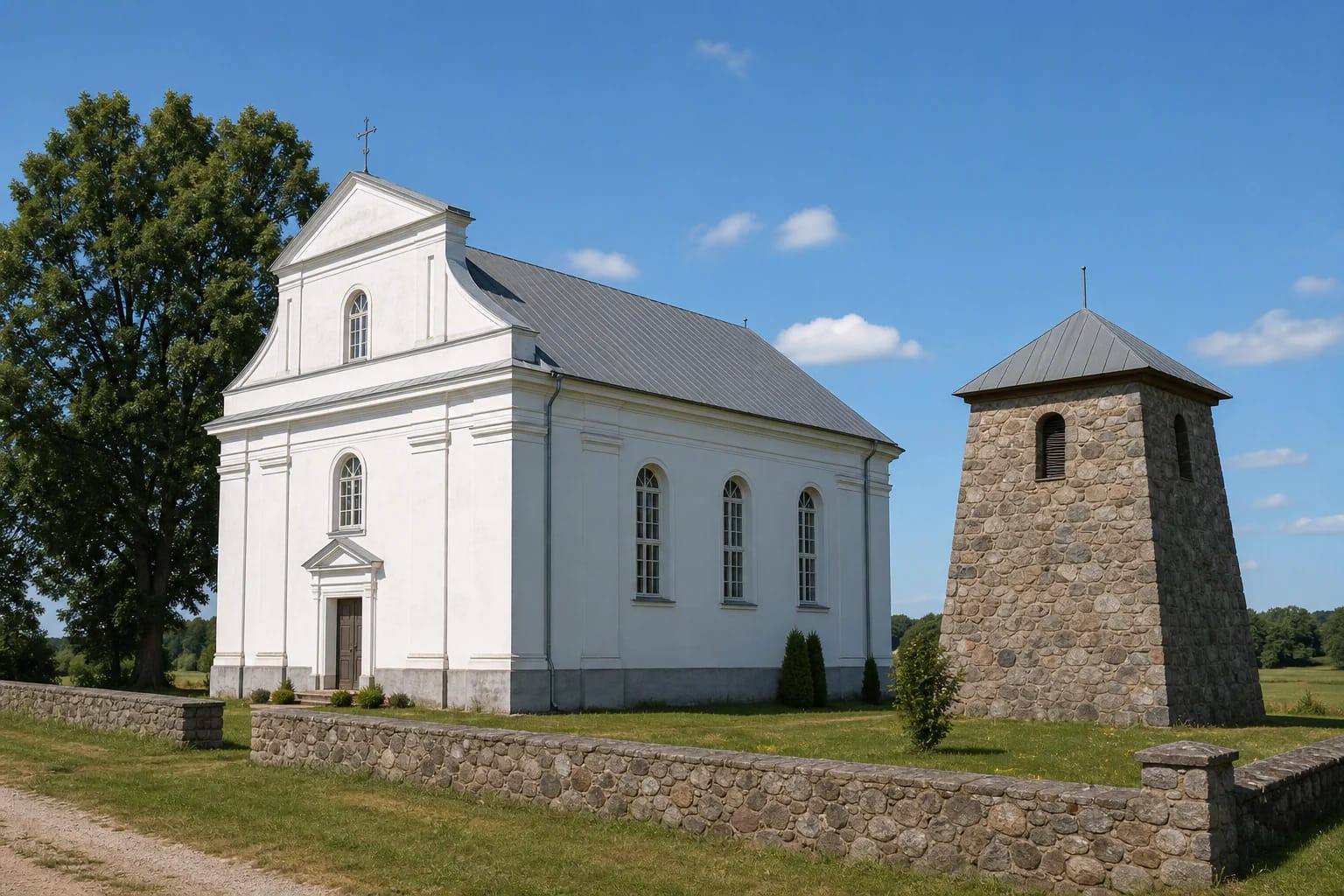
Darsūniškis Church of the Assumption stands at 49 Vytauto Didžiojo Street in Darsūniškis, in Kaišiadorys District's Kruonis Eldership. Its long white body, triangular pediment, and tall arched windows create a quiet village Classicist composition without a large tower on the façade.
The church is best read together with its yard and separate stone bell tower. A low masonry boundary, grass, and the open Nemunas-region horizon make this a small historic ensemble rather than a façade-only stop.
Construction in 1848-1853 and wartime damage
Construction of the present masonry church is dated to 1848-1853, with 1853 often highlighted as the key date. Together, these dates place the church's present form in the middle of the nineteenth century.
The church was severely damaged during the fighting of 1944 and restored after the war before returning to liturgical use. The exact restoration stages are not recorded consistently, so it is safer to refer to post-war rebuilding than to attach one precise reconstruction date.
A Classicist façade and a detached bell tower
The composition is a towerless rectangular church with a triangular pediment, raised attic wall, pilasters, and cornices. Inside, two rows of three quadrangular piers divide the space, and the presbytery ends in a rounded apse.
A separate stone masonry bell tower stands beside the church and is associated with 1862. That separation is one of the site's defining details: do not mentally fuse the tower into the church or look for a single steeple on the roof.
Interior layers and notable objects
The interior includes a 1897 main altar by Pranas Zykus, a late-eighteenth-century monstrance, and a bell from 1930. These are specific historic interior details, but the position, visibility, and closeness of any object can change in an active church.
The post-war building is not an untouched nineteenth-century interior. A thoughtful visit distinguishes older liturgical objects from later repair and reconstruction layers, and asks the parish before attempting detailed photography or a closer inspection.
Mass, access, and a respectful visit
Sunday Mass is at 12:00. Use it to plan a visit, but check the latest parish information before travelling, especially on major feast days, because the schedule can change.
Separate museum hours or a ticket are not listed. The most reliable time to ask about entering is just before or after Mass, quietly and without interrupting worship; if the gates or doors are closed, stay on the public approach and never climb the fence.
Protect the churchyard, low wall, and stone bell tower, and park only where it is lawful without blocking gates or residents' access. The coordinate marks the church site, not a guaranteed visitor car park.