- Place
- Šiauliai District Municipality
- Region
- Šiauliai Region
- Type
- the Neverdauskas family alpaca farm and a visitor animal park trading under the Dargaičiai Zoo name
- Address
- Dargaičiai village, Gruzdžiai eldership, LT-81414 Šiauliai District
- Coordinates
- 56.13661, 23.25551
- Visit duration
- 1.5-2.5 hours; longer when children spend time observing or feeding approved animals
- Best time
- a weekday morning from May to September, before the day becomes hot and the visitor flow grows
Dargaičių zoo, Dargaičiai mini zoo, Alpakų auginimas, Neverdauskas family zoo, Dargaičiai Zoo
An alpaca farm that became one of Šiauliai District's busiest family attractions
The park is in Dargaičiai village in the Gruzdžiai eldership, approximately 25 km north of Šiauliai. Its exact Google Maps listing is named Dargaičiai Small Zoo Alpakų auginimas and has Place ID ChIJ6e2YPYn35UYR75W6qGYcV30. The point at 56.136615, 23.255512 identifies the visitor site rather than a surveyed ticket-office threshold, so it is classified as a site point. The operator's contact page gives only Dargaičiai village, making this exact map listing safer than guessing a street number.
Alpaca breeding is the core of the Neverdauskas family farm. The official website says that the visitor zoo opened in 2017, while the Šiauliai District tourism strategy records the earlier growth of the farm: annual visits rose from 3,200 in 2016 to 50,000 in 2020. The expansion reflects more than the animals themselves, with laid paths, resting places, children's activities, and provision for both individual visitors and pre-arranged groups.
The word zoo can be misleading in a regulatory sense. In 2025, Lithuania's Environment Ministry named five licensed zoos: two state institutions and private zoos in Klaipėda, Vilnius, and Kalvarija Municipality. Dargaičiai was not on that list, so its public name should not be treated as proof that it holds the same zoo licence and species-conservation role. For travellers, the most precise description is a visitor alpaca farm and small animal park.
Alpacas remain the main attraction, while the exact collection changes
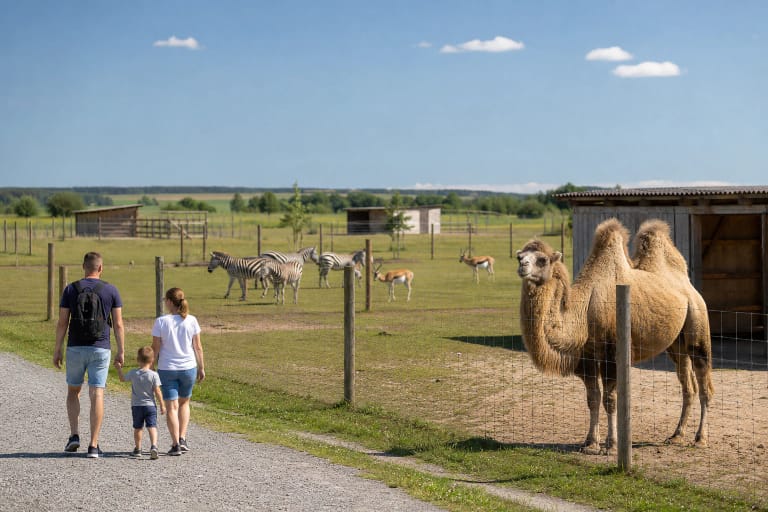
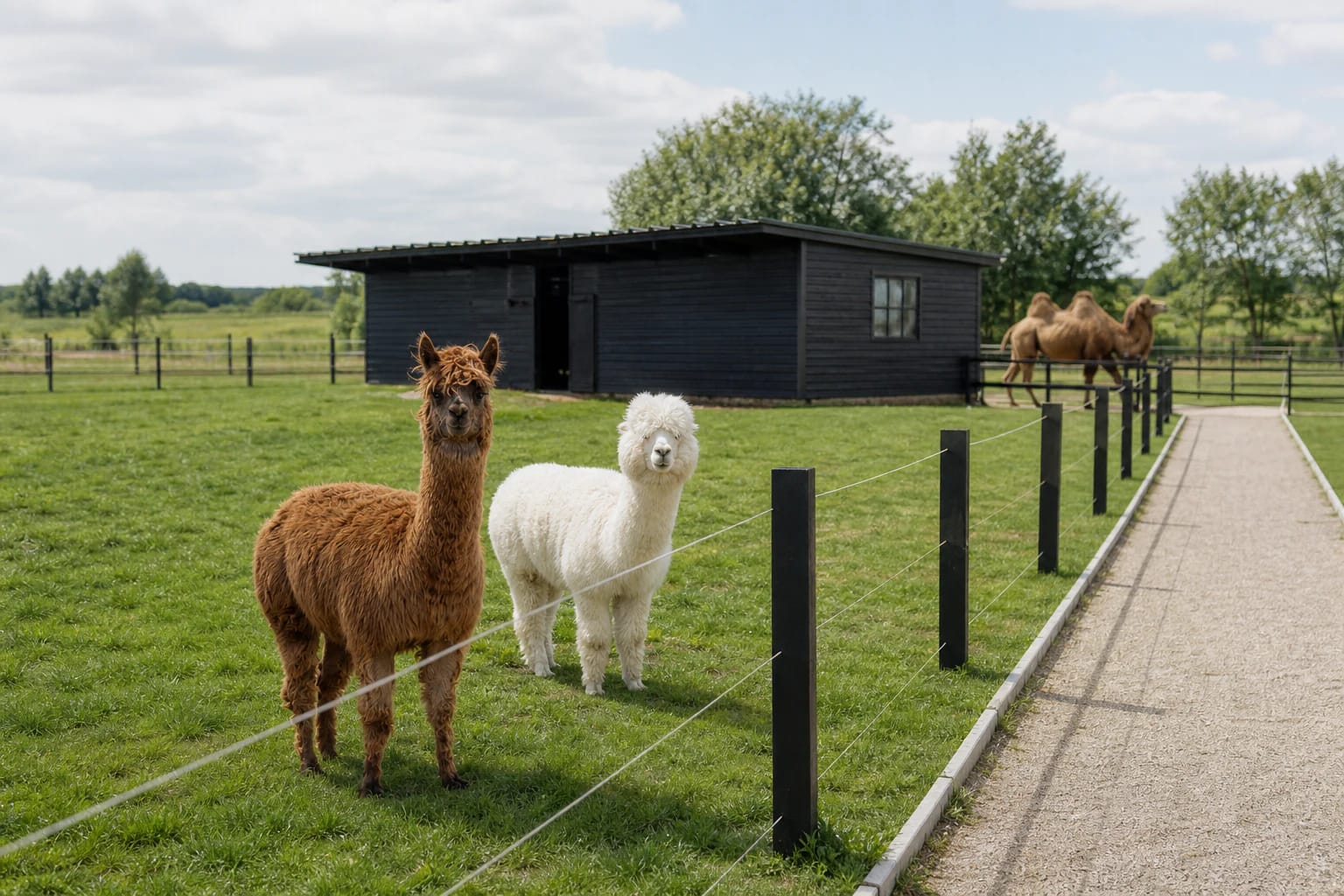
Alpacas define the place. Official photographs show them in open paddocks beside dark timber farm shelters, and the shop offer advertised by the operator includes alpaca-wool yarn, socks, gloves, and scarves. This is not merely a display of unrelated exotic animals: a visit can help families compare an alpaca with other camelids named in the collection, including the llama, guanaco, and two-humped Bactrian camel.
The operator's catalogue also lists miniature Falabella horses, Shetland ponies, miniature and Poitou donkeys, Highland and zebu cattle, Valais Blacknose, Jacob, Racka, and other sheep breeds, several goat breeds, deer, fallow deer, mouflon, African ostriches, emus, rheas, peafowl, pheasants, black swans, Patagonian maras, red-necked wallabies, peccaries, zebras, and meerkats. These are catalogue entries, not a promise that every animal remains at the park or will be visible on a particular day.
The official figures are inconsistent. One part of the home page advertises 15 species and more than 100 animals, the animal page names roughly fifty species and breeds, and older introductions give still other totals. The animal catalogue is marked as last updated in 2020, so anyone travelling specifically for a zebra, meerkats, or another named animal should call first.
Feeding and touching are allowed only under the rules in force on the day
Dargaičiai's rules allow feeding only with food bought at the park; children are advised to offer it from a container. Do not bring bread, vegetables, sweets, or branches picked from nearby trees. An animal approaching the fence does not mean that food carried by a visitor is appropriate for its diet.
Visitors may not enter cages or enclosures, put fingers through mesh, or lean on fences. Stroking or feeding is permitted only at arm's length when a keeper and the signs for that particular area allow it. Keep faces back, do not tease or frighten animals, and do not run. Children must remain with an adult, who is responsible for their safety and behaviour.
Wash or sanitise hands after any permitted contact and before eating. Lithuania's State Food and Veterinary Service also advises visitors to farm-animal holdings to follow the keeper's biosecurity instructions, stay out of animal buildings without permission, and leave vehicles in the designated parking area. Pets are prohibited at Dargaičiai. The published rules do not describe an assistance-dog exception, so discuss such a requirement before travelling.
2026 tickets and opening hours change with the season
On July 21, 2026, the official home page advertised daily opening from 11:00 to 18:00 between May 1 and October 1. Outside that period, it listed weekends and public holidays from 11:00 to 16:00, with weekday group visits available by prior arrangement. An older contact page defines the season differently, from June 1 to September 30, so confirm any visit near the beginning of May or start of October by phone.
On the same date, adult admission cost EUR 10. The published concession price was EUR 7 for visitors aged 3-18, seniors, and people with disabilities, while children under 3 entered free. The rules require proof of entitlement for a concession, and the entry ticket is valid once. Prices and eligibility can change, so consult the official page immediately before departure.
The website does not publish separate charges for animal feed, led pony activity, electric ride-on cars, birthdays, or guided visits. Confirm the availability, age limits, duration, and full price of those activities directly. Do not assume that every children's activity shown online is included in general admission or runs every day.
Outdoor paths, rest areas, and practical family preparation
Most of the park is outdoors, so weather materially changes the visit. In summer, arrive when the gates open and bring a hat, water, and sun protection; after rain, grass and open path sections can remain wet. Animals may rest in shelters or keep back from the fence. Allow 1.5-2.5 hours for an unhurried circuit and do not expect scheduled performances.
The operator advertises a large car park, toilets, coffee and snacks, benches, shelters, swings, and sandboxes. These services, seasonal retail, and children's activities can change. Confirm rules for eating your own food, card payment, and baby-changing facilities before travelling, particularly outside the main season.
Official photographs show even gravel paths and maintained lawns, but the operator does not publish a complete step-free route, gradients, door widths, or accessible-toilet details. Larger wheels are sensible for a pushchair. A visitor with a mobility disability should ask the operator to confirm the route from parking to the ticket point, every desired enclosure, and the toilets.