- Place
- Šiauliai City Municipality
- Region
- Šiauliai Region
- Type
- university botanical garden, living plant collection, and educational research base
- Address
- Paitaičių g. 4, LT-77175 Šiauliai
- Coordinates
- 55.93261, 23.28298
- Visit duration
- 1-2 hours; longer with a guided tour, educational session, or event
- Best time
- mid-May to mid-June for rhododendrons and summer for the floriculture and alpine collections; check event dates separately
Šiauliai Academy Botanical Garden of Vilnius University, Šiauliai Botanical Garden, Šiauliai University Botanical Garden
A 6.54 ha garden on Paitaičių Street, with the map pin at the gate
The official short name is VU Šiauliai Academy Botanical Garden; the contact page also uses the fuller Šiauliai Academy Botanical Garden of Vilnius University. It operates at Paitaičių g. 4, LT-77175 Šiauliai. Older maps, publications, and reviews may still say Šiauliai University Botanical Garden, the name used before 2021, but they refer to the same place.
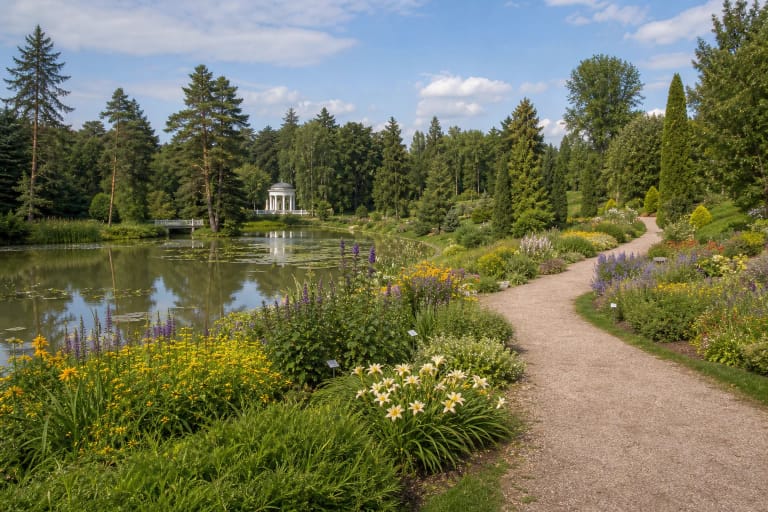
At 6.54 ha, this is not a vast landscape park or a conservatory complex. Its strength is the close concentration of university collections, varied garden landforms, a pond, scientific observations, and education. On 20 July 2026, the Lithuanian official page reported more than 4,600 plant species and cultivars. The English VU version then gave about 4,400, VLE more than 3,800, and the institutional history more than 4,000. These are snapshots of a changing living collection made at different times and with different counting scopes, not four equally current inventories.
Coordinates 55.932605, 23.282978 mark the visitor arrival point beside the Paitaičių Street gate and garden building. They do not represent the middle of the 6.54 ha grounds, one particular bed, or a confirmed accessible parking bay. For navigation, this entrance point is more useful than an abstract centroid of the collections.
From a biological station to a Vilnius University garden
The beginning of the site and the formal establishment of the botanical garden are not the same date. In 1958, the Šiauliai city authorities assigned 2.5 ha of then-unused ground beside the railway to a biological station. Staffing began in 1961, with Stasys Gliaudys appointed as manager. The present institution therefore traces its research base to 1961.
In 1962, the site received an orchard, several perimeter rows of trees and shrubs, a small alpine-style flower bed, and the beginnings of a plant-collection section. Some material came from the Vilnius botanical garden, the research institute at Dotnuva, and Vilnius greenhouses. In 1967-1968, excavation of a drainage channel about 4 m deep destroyed roughly 1,000 plantings. A pond with an island and a water culvert followed in 1968, meaning that today's water and slope landscape also carries an infrastructure history.
Professor Kęstutis Kazimieras Vilkonis prepared a program aligned with botanical-garden requirements in 1997. On 1 September that year, Šiauliai University Botanical Garden was formally founded on the agrobiological station of Šiauliai Pedagogical Institute. When Šiauliai University merged into Vilnius University on 1 January 2021, the garden became a unit of VU Šiauliai Academy and took its present name.
The alpine slope is the garden's most distinctive route feature
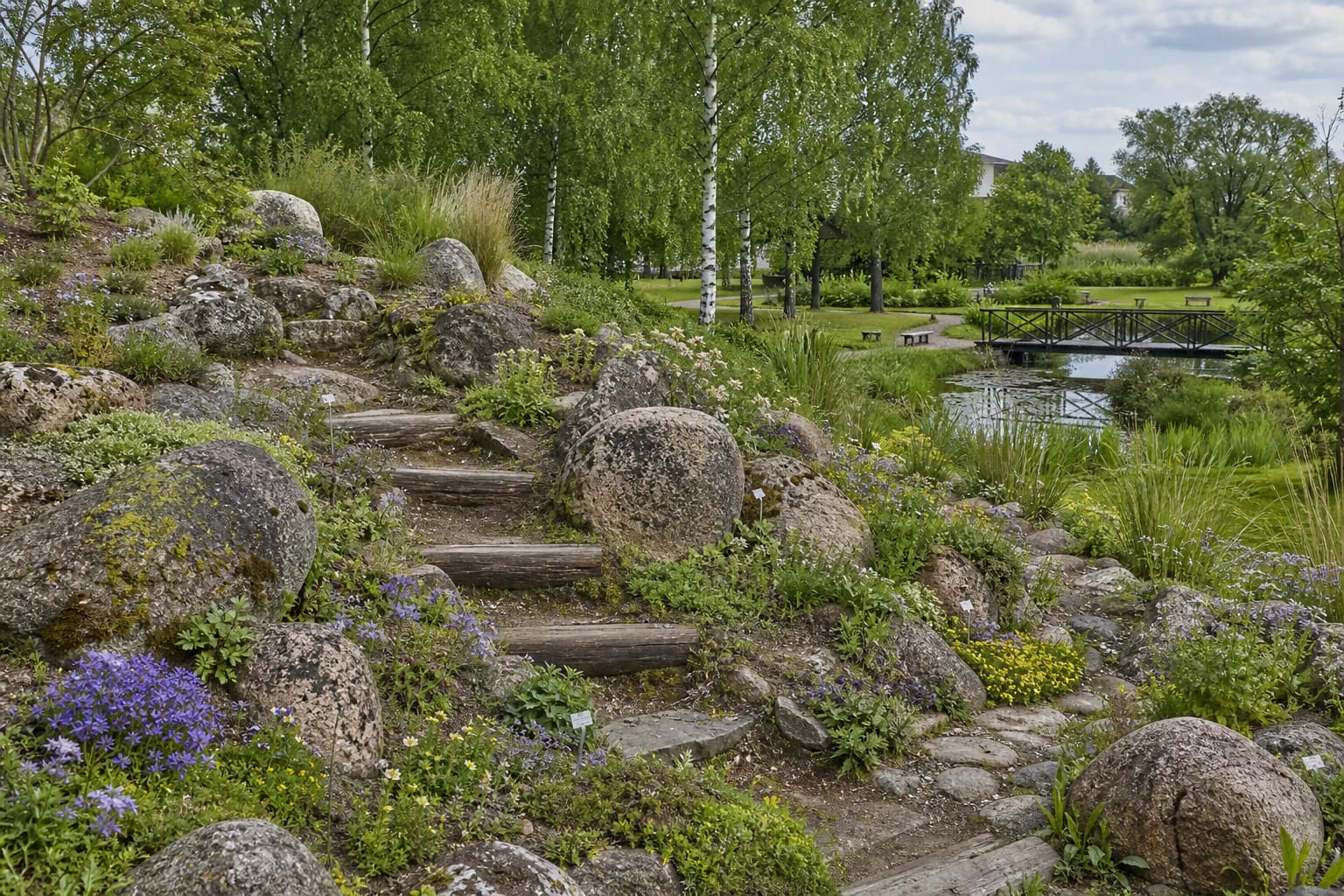
The alpine collection is much more than a decorative pocket of stones beside a path. It occupies an artificial rocky slope divided into displays for plants from European, Asian, and American mountain systems and the Far East. Low mats and small flowering specimens grow among the rocks, with collection labels helping visitors identify individual plants.
The official collection inventory gives 1,490 specimens: 1,147 species and 343 cultivars across 86 families. Particularly strong groups include saxifrages, gentians, bellflowers, stonecrops, pasqueflowers, and a collection of more than 40 fern species and cultivars on the north-facing slope. Seeds also arrive through exchange with other alpine gardens, so this is a university collection, not an attempt to reproduce the native flora of a local Šiauliai hill.
View the slope both from below and from the upper paths, but expect uneven stone or earth surfaces, timber steps, and steeper sections. Flowers and labels are best examined from the route without stepping into the beds: many alpine plants form small, slow-growing clumps that are easily damaged.
Rhododendrons, flower collections, Lithuanian flora, and phenology
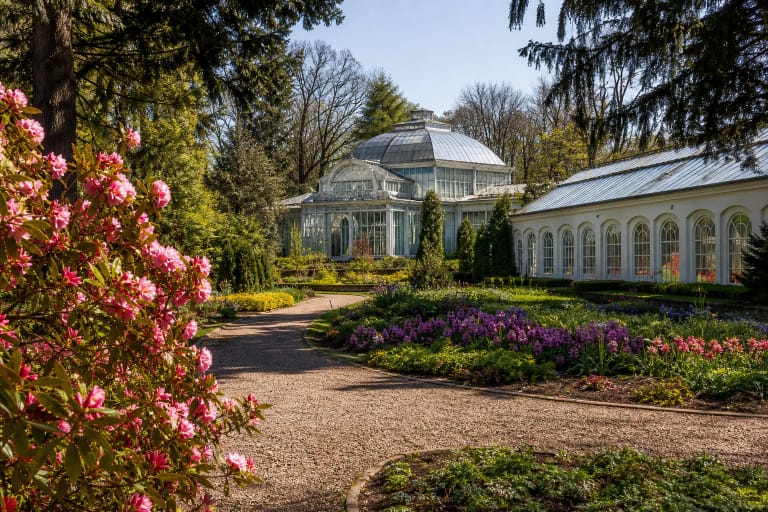
The dendrology section records 279 coniferous and 680 deciduous trees and shrubs. Its heather-family collection contains 302 taxa, including 185 rhododendron species and cultivars and 38 heather cultivars. Developed since 2001, it sits beside an older layer represented by remnants of the 1962 orchard and oaks, lindens, and larches planted under Stasys Gliaudys.
The floriculture section holds about 1,400 taxa, mostly perennial ornamentals. Its groups include hostas, astilbes, asters, peonies, coneflowers, dahlias, lilies, tulips, heleniums, daylilies, and irises. Lithuanian breeding is visible in dahlias donated by local growers, while a substantial bearded-iris collection was enlarged in 2010 with plants from Šiauliai architect and flower grower Vida Marcinkevičienė.
In the systematics and geography display, plants occupy 118 beds arranged according to a flowering-plant classification; the section page lists 676 taxa and another 17 cultivars from 82 families. The Lithuanian-flora section grows about 380 taxa, including native, rare, medicinal, culinary, and ethnobotanically useful plants. Reconstructed traditional village flower gardens compare plants from different periods, but they are educational displays rather than the surviving garden of a historic homestead.
The site is also a scientific observation base. Within the International Phenological Gardens network, staff monitor 18 woody species and forms, following leaf emergence, shoot growth, flowering, fruit ripening, autumn color, and leaf fall. Collection records are managed in IrisBG, specimens enter the HUS herbarium, and seeds are exchanged with more than 250 botanical gardens worldwide.
Flowering seasons and why an event day is different from an ordinary visit
Rhododendrons flower most fully from around mid-May to mid-June. Spring temperatures and the mix of species move the peak, so there is no permanently reliable best weekend. Irises and peonies draw attention in early summer, followed by lilies, daylilies, heleniums, asters, and dahlias. On the alpine slope, fewer species may flower at any one time; close observation of individual labeled plants matters as much as a mass display of color.
The official garden page names four traditions: Odė pavasario džiaugsmui, or Ode to the Joy of Spring; Žolinė; Vėjų diena, or Day of Winds; and Sužibėk botanikos sode!, or Shine in the Botanical Garden. They are not permanent exhibits or a guarantee of the same annual date. The municipality advertised a free Žolinė festival on 15 August 2025 with music, plant displays, and education, but a free event on one date does not make ordinary garden entry free or confirm the same terms for 2026.
Check the latest garden news if travelling for a particular bloom or event. Poor weather can change an outdoor program, and a busy event may alter path access, parking, or the way the ticket desk operates compared with a normal day.
2026 hours, tickets, booking, and practical access
On 20 July 2026, the official Lithuanian page listed hours of 08:00-17:00 Monday-Thursday, 08:00-15:45 Friday, and 10:00-18:00 Saturday only from 2 May through 30 October; the garden was closed on Sunday. New visitors are not admitted and the ticket desk stops service 30 minutes before closing. Holidays, events, or operational decisions can change this schedule, so check the official page before travelling.
The price list then published as effective from 22 April 2024 charged EUR 3 for a one-day visitor permit and EUR 24 for a named annual permit. Schoolchildren, students, and pensioners received a 50 percent discount, while listed groups could enter free with proof of eligibility. The ticket desk accepted cash and bank cards. Prices and legal definitions of concessions age quickly, so rely on the newest official price list rather than treating this page as the final notice.
An ordinary permit covers a self-guided visit to the public garden during its opening hours. A guided tour or educational session, conference space, access to the Stasys Gliaudys Natural History Museum, and a dated event program are not automatically part of a spontaneous walk. The price list, for example, gave EUR 4 per person for a 45-minute Lithuanian-language adult tour or activity for 15-30 people and EUR 6 in English; booking and conditions for a smaller group must be agreed in advance. No public daily opening schedule for the museum was found.
The institution reports free parking beside the gate. Buses 13, 22, and 24 serve the Dubijos stop, with the final approach on foot. Some garden paths are relatively level, but the site also includes gravel, stones, timber bridges, steps, and the steeper alpine slope. No recent audit of the whole site, confirmed accessible bay, or published toilet-access description was found. Contact the garden ahead about a wheelchair or pushchair route and toilet needs. Pets are not allowed. Stay out of the beds, do not pick plants, and do not move collection labels.