- Place
- Kalvarija Municipality
- Region
- Suvalkija
- Type
- seasonal open-air zoo with collections of predatory cats, hoofed animals, and birds
- Address
- 10 Muitinės Street, Trakėnai village, Kalvarija Municipality
- Coordinates
- 54.36622, 23.19076
Zooparkas, Trakėnai Zooparkas, Trakėnai Zoo, Zoo Trakėnai
Google shows two neighbouring zoo pins, but this guide covers Zooparkas at 10 Muitinės Street
The main Zooparkas entrance is at 10 Muitinės Street in Trakėnai village, coordinates 54.366224, 23.190765. It lies approximately 7 km south-west of Kalvarija on the route towards the Lithuanian-Polish border. The official website's contact details, the public legal-entity register, and Google's Zooparkas entry all identify the same address.
A second Google pin called Trakėnai Mini Zoo appears only a few hundred metres away and has its own telephone number, coordinates, and review set. Both entries point to the same website, but their ratings cannot be added together. The 4.6 score on this page belongs specifically to the Zooparkas listing at 10 Muitinės Street.
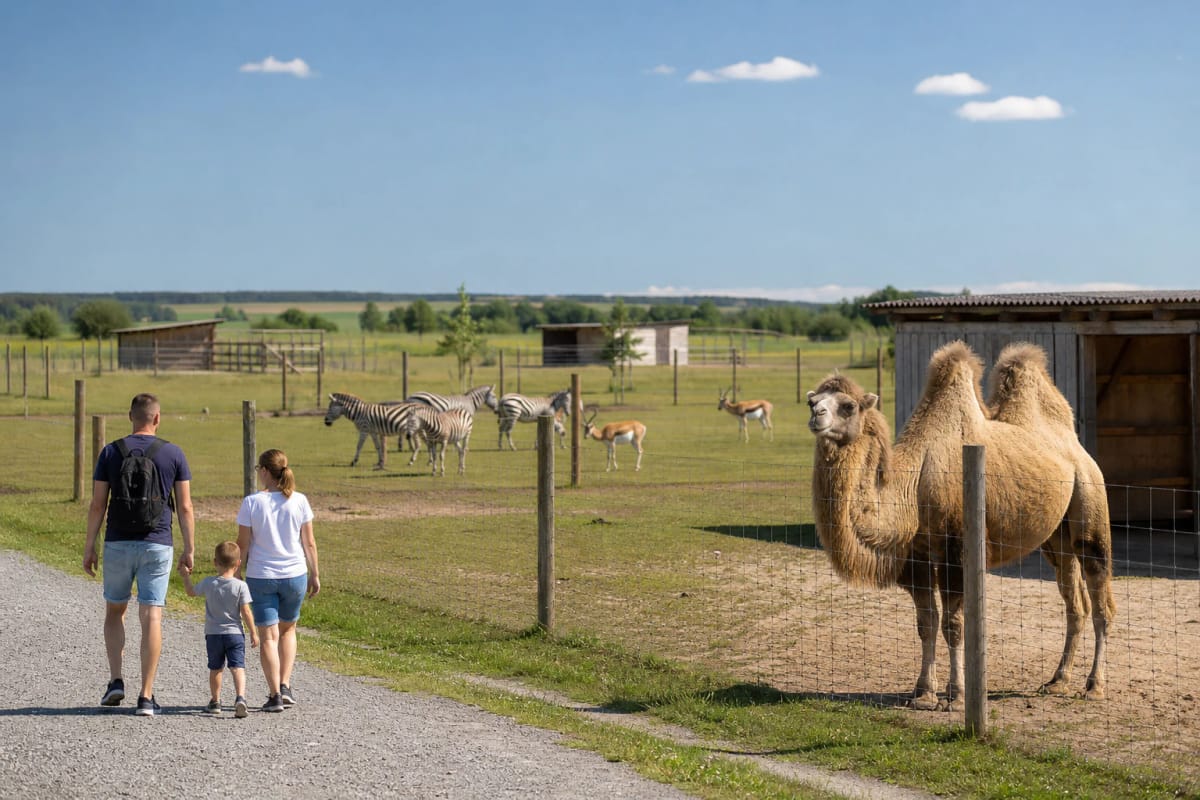
This is an outdoor site of broad grassy enclosures, practical wire fencing, service buildings, and long views across the Suvalkija plain. It is not an urban zoo of enclosed tropical houses. Rain, heat, wind, and each animal's decision to retreat into shelter directly affect what visitors experience.
The current catalogue highlights big cats, hoofed animals, and three bird species
The official 2026 animal pages list a lion, tiger, jaguar, puma, caracal, and Eurasian lynx among the predators. They represent six different adaptations within the cat family, but the catalogue does not guarantee that every animal will remain in the visible part of its enclosure. Cats sleep for long periods, seek shade at hot midday, and may be held away from view for husbandry or welfare reasons.
The hoofed and related animal list is much longer: Grant's zebra, blackbuck, American bison, yak, Père David's deer, sika and fallow deer, water buffalo, Poitou and domestic donkeys, llama, alpaca, guanaco, Bactrian camel, Ankole-Watusi and Highland cattle, zebu, ponies, sheep, goats, and East Caucasian tur. The Lithuanian catalogue's pilkarusvė kengūra is a red-necked wallaby, not Australia's eastern grey kangaroo.
The bird section identifies a great white pelican, budgerigar, and greater rhea. The Lithuanian name rausvasis pelikanas and scientific name Pelecanus onocrotalus correspond to great white pelican in English, while the greater rhea is a flightless South American bird rather than an African ostrich. Clarifying these names lets children leave with more than a striking visual memory.
A family park begun in 2008 developed into an institution with official zoo status
In a 2019 interview, the owners dated the park's beginning to 25 July 2008, when the Vasiliauskas family started an animal collection on private land. The public institution Zoo parkas was entered in Lithuania's Register of Legal Entities on 15 November 2010. These dates describe different milestones: the first belongs to the visitor park, the second to the legal entity operating it.
In 2025 the Environment Ministry stated that Lithuania had two state and three private zoos, including one in Kalvarija Municipality. Zoo status entails a permit and duties concerning conservation and education, species-appropriate conditions, escape prevention, visitor safety, and animal records. It is not the same as membership in an international zoo association, which the park does not claim on its website.
A pair of unusually golden-coloured tigers arrived from a Czech zoo in 2019 and became a widely reported attraction. Animal collections change, however, and the present official catalogue names only the general species tiger. Anyone travelling specifically to see an individual golden tiger mentioned in older articles should confirm its current presence with the park first.
The zoo, playground, and Dinosaur Park require separate tickets
On 13 July 2026, official zoo admission cost €10 for an adult, €4 for a child aged 3-6, and €7 for a school pupil aged seven or above, an eligible full-time student, or a senior. Children under three entered the zoo free. A document is required for a concession, and visitors should verify prices before travelling because tariffs can change.
The playground cost €5 for every person using its attractions. The tariff explicitly states that an adult who must accompany a child on an attraction because of an age restriction also needs a ticket. This matters when budgeting: zoo admission does not automatically pay for active amusements.
Dinosaur Park admission was €4 for ages 3-6 and €5 from age seven through adulthood, while children under three entered free. The official page presents all three sections in separate price tables and advertises no single combined pass. Tickets apply only on the day of purchase and are non-exchangeable and non-refundable, so decide at the ticket desk which areas the group will actually use.
Feed animals only with approved park food and keep hands away from enclosures
Visitor accounts mention feed sold at the ticket desk for permitted sheep, goats, and other animals, but the Trakėnai website does not publish a standalone feeding policy. Ask staff which animals may be fed that day and with which product. Do not offer your own bread, vegetables, or sweets: apparently ordinary food can damage an animal's digestion or disrupt a veterinary diet.
Do not push fingers through wire, lean on barriers, provoke a predator with noise, or throw anything into an enclosure. Even a calm-looking donkey, goat, or llama can bite, push, or snatch food suddenly. Keep small children on the visitor side of the safety barrier and wash or sanitise hands after any explicitly permitted contact and before eating.
The education page advertises three 90-minute programmes for groups of 10-25: Farm Friends for ages 3-6, Different Corners of the World in the Zoo for pupils aged 7-14, and Understanding Big Cats for participants aged 14 or above. Each group programme was listed at €70 in 2026 and could be adapted by arrangement. This is a booked guided activity, not a tour automatically included with standard admission.
Summer hours are 10 am-7 pm in 2026, but the season and outdoor conditions must be checked
The official website announced 4 April as the start of the 2026 season, while the main Google entry showed daily opening from 10 am to 7 pm on 13 July 2026. That is a summer schedule, not a year-round promise: in earlier seasons the park generally received visitors until late autumn and restricted days outside peak season. Check the latest official notice or telephone the park before travelling.
The official gallery shows level but predominantly grass and gravel surfaces, large exposed enclosures, and limited natural shade. Closed comfortable shoes, a hat, sunscreen, and water are useful on a dry day; wheels may become harder to push after rain. The website publishes no detailed access plan or guarantee of an accessible toilet or food outlet, so confirm a specific mobility need and on-site services by telephone.
Allow 2-3 hours for the zoo alone and half a day with the playground and dinosaur area. Arriving in the first opening hour reduces heat and improves the chance of seeing animals moving, although no particular behaviour can be guaranteed. On 13 July 2026, the Zooparkas Google entry had 2,008 reviews averaging 4.6 out of 5; the neighbouring Mini Zoo's 4.7 rating is not included.