- Place
- Vilnius City Municipality
- Region
- Vilnius
- Type
- open memorial cherry grove dedicated to Japanese diplomat Chiune Sugihara and friendship between Lithuania and Japan
- Address
- Upės Street, Vilnius 09309
- Coordinates
- 54.69596, 25.27187
- Visit duration
- 30-60 minutes; longer for a picnic, photography, or a combined visit with the National Gallery of Art and the Neris riverbank
- Best time
- follow current photographs and city updates during April and early May rather than relying on a fixed blossom date; choose an early weekday morning for a quieter visit
Čiunės Sugiharos sakurų sodas, Čijunės Sugiharos sakurų parkas, Chiune Sugihara Sakura Garden, Sakura Park by the White Bridge
The exact site is an open grove on Upės Street, not the newer Japanese Garden
The current Go Vilnius listing uses the Lithuanian name Čiunės Sugiharos sakurų sodas, which also appears on a marker at the site. Municipal and older tourism texts also use Čijunės Sugiharos sakurų parkas, Č. Sugiharos Park, or simply the sakura park by the White Bridge. These variants identify the same Upės Street grove. The English title used by Go Vilnius is Chiune Sugihara Sakura Park.
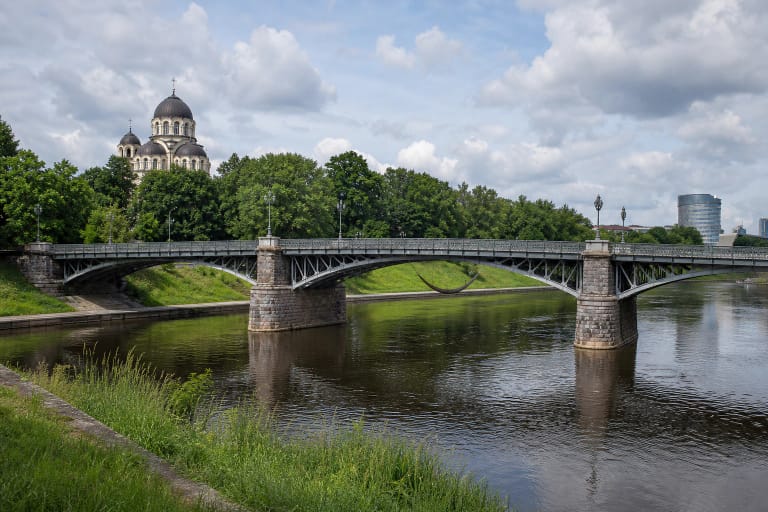
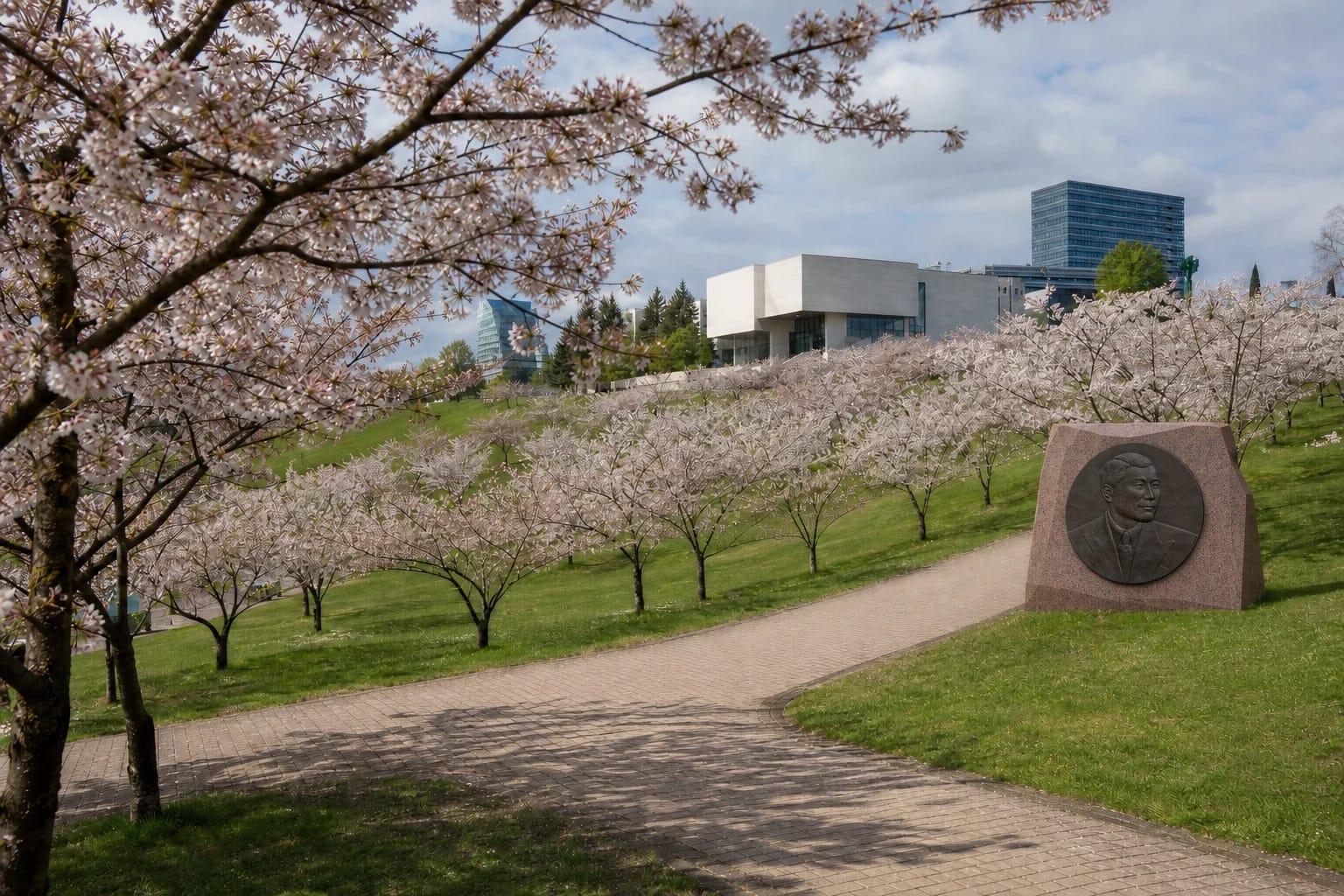
The grove spreads across a broad green slope on the right bank of the Neris, between Upės Street, the riverside promenade, and the approaches to the National Gallery of Art. It is not one fenced plot with a controlled gate. Several paths cross the cherry rows, and pedestrians can approach from the gallery, Upės Street, or the White Bridge direction. The official point at 54.69595682, 25.27187407 is a representative location inside the garden, not its only entrance, a car park, or a verified step-free access point.
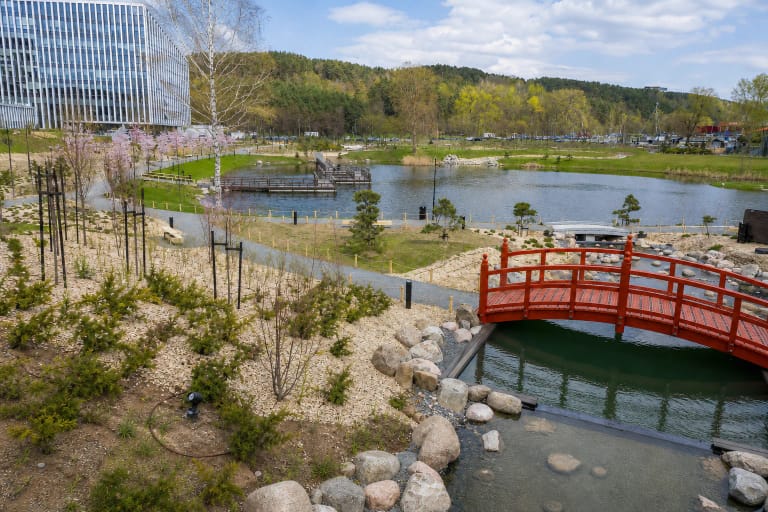
Vilnius Japanese Garden, roughly a kilometre to the north at Linkmenų g. 2A, is an entirely separate attraction. It opened in 2023 around Šnipiškės Lake and contains ponds, bridges, a dry garden, and a defined strolling route. Sugihara Park has no red bridge, koi pond, pagoda, or gate. Its distinctive scene is a cherry grove on an urban slope, the memorial, the gallery, and the Neris landscape.
The 2001 planting remembers a diplomat and the relationship between Lithuania and Japan
An avenue of 200 Japanese cherry trees was planted in Vilnius on 2 October 2001. Official city sources frame the ceremony as a commemoration of the centenary of Chiune Sugihara's birth. The memorial states that the trees were a gift from the people of Japan to Lithuania and a sign of friendship between the two countries. This was conceived as a living diplomatic memorial, not merely ornamental landscaping.
Chiune Sugihara was a Japanese diplomat posted in Kaunas in 1939-1940. The Japanese transit visas he issued in 1940 became one part of a complex chain of documents and travel that helped thousands of Jewish refugees leave wartime Europe. Sugihara was later recognised as Righteous Among the Nations. 'Thousands' is safer than treating one exact figure as settled, because visa lists, accompanying family members, and the final number of travellers are different measures.
A rose-granite memorial with a bronze portrait relief of Sugihara was unveiled on the same day as the 2001 planting. The Vilnija Gates cultural record identifies Japanese cultural-property conservator Yusuke Sakuraba as its designer and connects its erection with Waseda University, where Sugihara had studied. Reading the memorial before photographing the blossom restores the reason this grove exists.
The historic figure of 200 does not reveal today's number of trees
Two hundred is a well-supported count for the original 2001 planting, but it must not be presented as a current inventory. Over more than two decades, some trees failed or were replaced and new cherries were added. Official care reports record 17 new trees in 2021 and another 20 in the following planting season, but no single public 2026 census of every living cherry tree was found.
Vilnius City Municipality and the city's park keepers care for the site. Since 2020, the organisation Baltijos vėjai and Japanese-garden practitioner Kęstutis Ptakauskas have contributed to renewal and replanting. This is later conservation work, not evidence that Ptakauskas designed the entire 2001 landscape. No authoritative named designer of the original grove plan was found.
The varying ages of the trees explain their uneven canopy size and blossom density. Cherries stand in loose rows and groups across the lawn, leaving room to walk and see the city between them. This open, orchard-like character is authentic to the site. Visitors should not expect one continuous pink tunnel or the controlled composition of a formal Japanese garden.
Weather, not a fixed calendar date, determines the blossom week
Go Vilnius says the cherry blossom lasts about two weeks and normally appears in April, sometimes extending into May. Warm weather can open the flowers quickly, while rain, wind, or a sudden cold spell can shorten the best display. Planning from an old claim about early May is unreliable. Check recent, clearly dated photographs or city updates a few days before travelling.
At peak blossom this becomes one of Vilnius's busiest spring spaces. An early weekday morning offers more room to examine both the trees and memorial. On a sunny weekend afternoon, paths and lawns can fill with photographers and picnickers. If calm matters more than maximum blossom density, arrive as buds first open, just after the peak, or in summer when the grove is green but the main floral display has passed.
Official tourism and municipal pages describe reading, photography, and picnics as normal uses. That does not permit breaking branches, picking flowers, climbing trees, or leaving litter. No separate Sugihara Park rule sheet was found, so general city public-space and dog-control rules apply. Signs and temporary event restrictions on site always take precedence over a general online description.
Entry is free, but the slope and visitor infrastructure should not be overstated
On 19 July 2026, official pages listed no ticket, gates, or dedicated opening hours, while an archived Go Vilnius entry marked admission as free. This is an open urban green space, but that should not be turned into an unverified promise of guaranteed 24-hour access at every approach. Events, maintenance, or safety measures can temporarily change movement through the site.
The National Gallery of Art stop on Konstitucijos Avenue is the clearest public-transport landmark, although current services should be checked in the JUDU planner rather than hard-coded. On foot, the grove fits naturally into a right-bank Neris walk from the White Bridge towards Žvėrynas. Official descriptions document neither a dedicated garden car park nor a public toilet, and Upės Street approaches become especially congested during blossom.
Some routes are paved, but the garden occupies a pronounced slope and many of the best views are from grass. No comprehensive step-free route or gradient audit was found, so visitors with limited mobility should verify the most suitable approach and consider surface conditions after rain. Allow 30-60 minutes for the grove itself, or half a day when combining it with the National Gallery of Art, the White Bridge lawns, or a longer riverside walk.