- Place
- Kaunas City Municipality
- Region
- Kaunas
- Type
- memorial museum in the former Japanese consulate and interwar Kaunas house
- Address
- Vaižganto g. 30, Kaunas
- Coordinates
- 54.89263, 23.93306
Chiune Sugihara House, House of Chiune Sugihara, Sugihara House Memorial Museum, Former Japanese Consulate in Kaunas, Sugihara House
A former consulate that looks like a house
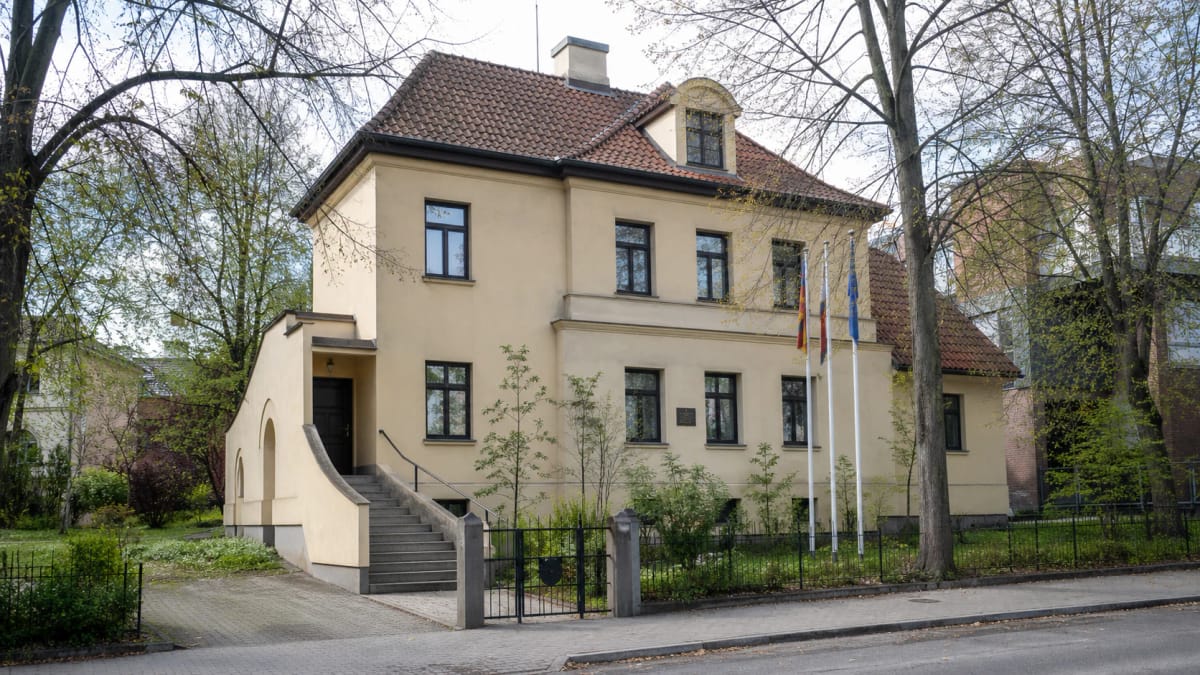
Sugihara House stands at Vaizganto g. 30 on the Žaliakalnis slope, among residential villas and the everyday fabric of interwar Kaunas. It is not a Japanese-style building and not a large state residence. Its strength is precisely that a diplomatic story of global importance took place in an ordinary Kaunas house completed in 1939.
In the Cultural Heritage Register the object is called the house known as Sugihara House, unique code 32700. The register gives it regional significance and architectural, historical, memorial, and urban value. Visitors should therefore see two layers at once: interwar Žaliakalnis architecture and the moral decision of summer 1940, whose memory draws visitors from Lithuania, Japan, Israel, the United States, and elsewhere.
Tonkuno's plot and the 1939 house
The official house history starts not with the consulate, but with Lithuanian education minister professor Juozas Tonkunas. On December 1, 1938, he bought a plot on Vaizganto Street, and in February 1939 a construction project was submitted. KVR states that the project was prepared by construction engineer Juozas Milvydas.
By 1939 the house was close to completion: a finished roof is mentioned in summer, and rooms ready for living in autumn. It was planned as a restrained interwar villa with a mansard volume, tiled roof, asymmetrical facade, concrete steps, curved balcony, and domestic interior elements such as wooden windows, doors, oak parquet, staircases, and radiators.
Sugihara in Kaunas
Chiune Sugihara arrived in Kaunas from Helsinki and rented Tonkunas's house on October 7, 1939. His family lived on the upper floor, while the Japanese consulate premises operated below. KVR and the official museum state that the consulate functioned in this house in 1939-1940.
That timing is exact and important. In autumn 1939 Lithuania was still independent, but after German and Soviet aggression against Poland the number of refugees in Kaunas grew. On June 15, 1940, Lithuania was occupied by the Soviet Union, and diplomatic missions were working under sharply changed conditions. Sugihara's decisions were born inside this field of pressure, uncertainty, and urgency.
A visa chain, not a one-person story
Sugihara House matters not because one consul had a magical route to safety. The refugees' journey depended on a chain of visas and permissions. Dutch consul Jan Zwartendijk issued entries connected with Dutch colonies in the Caribbean, especially Curacao. Sugihara's Japanese transit visas made it possible to plan a route across the Soviet Union to Vladivostok, then to Japan and onward ports.
That is why the museum rightly tells the story of Sugihara, Zwartendijk, and the refugees themselves. The story does not fit into one heroic biography: it required diplomatic wording, refugee documents, Soviet transit permits, railway routes, Japanese ports, and later journeys to other countries.
How many visas were issued
The numbers should be used carefully. Sugihara House notes that the official Japanese consulate visa list contains 2,139 names. At the same time, larger numbers of people saved are widely used, because one visa could help more than one person, families travelled together, and refugee fates continued beyond the consulate paperwork.
For that reason public sources often speak of thousands of people who escaped with help from Sugihara's and Zwartendijk's actions, often mentioning about 6,000 survivors. The clearest reading is this: 2,139 is the scale of a specific visa list, while thousands is the broader estimate of people affected by this diplomatic chain.
What happened to the house after the war
The story of the house owner, Juozas Tonkunas, is painful. The official house history notes that in June 1941 he and his family became targets of Soviet repression. This reminds visitors that Sugihara House is not only about rescue; it is also about the world of Lithuanian state officials, diplomats, intellectuals, and refugees that the occupations destroyed.
During the Soviet period apartments were installed in the house. In 1998 the building was returned to Tonkunas's children, and in 1999 the Sugihara Foundation Diplomats for Life was registered. In 2001 the first exhibition opened in Sugihara's former office; in 2003 Ramunas and Birute Garbaraviciai acquired the house so the museum could continue, and from 2016 more of the house was given to museum use.
What to see in the museum
Visitors come here not for lavish interiors, but for concentrated memory. The museum presents the former consulate space, the history of documents, the biographies of Sugihara and Zwartendijk, refugee routes, and the intersections of Japanese, Lithuanian, and Jewish history. Sugihara's former office is the main emotional point, because a room of that scale makes the visa story feel both human and bureaucratic.
The official visitor page also offers a ticket option with a short documentary film. It is worth choosing if you want not only to see the exhibition, but also to understand more calmly the route from Kaunas through the Soviet Union, Vladivostok, Japan's port of Tsuruga, and the refugees' later destinations.
Žaliakalnis and Modernist Kaunas context
Sugihara House belongs to the Žaliakalnis environment, where interwar villas, institutions, diplomatic addresses, and the lifestyle of a modernizing temporary capital were forming. The UNESCO Modernist Kaunas inscription speaks about the 1919-1939 transformation of Kaunas, and this house lets visitors see that transformation at the scale of a residential district.
Still, the emphasis must not be confused: Sugihara House is primarily memorial and historical in value, not only architectural. The building's restraint helps make the point that diplomatic courage and refugee hope can be tied not to a monument, but to a specific address, staircase, office, and windows onto a quiet street.
Practical visit
When this page was prepared, the official Sugihara House visitor page listed opening hours Monday-Friday 11:00-16:00, with last entry 30 minutes before closing. It also announced the possibility of arranging another time and booking experience tours, so groups and schools should contact the museum in advance.
Ticket information listed a 10 EUR standard ticket and a 12 EUR ticket with an approximately 20-minute documentary film; children aged 7 to 12 had a lower ticket. Parking on Vaizganto Street is limited, so the museum suggests using parking near Kaunas Sports Hall, Perkuno al. 5, and walking to the house.