- Place
- Vilnius City Municipality
- Region
- Vilnius
- Type
- state-protected 1905-1907 steel truss road bridge across the Neris
- Address
- A. Mickevičiaus g., Vilnius
- Coordinates
- 54.69046, 25.25886
- Visit duration
- 20-40 minutes; 1-2 hours with a Neris riverfront and Žvėrynas walk
- Best time
- daylight year-round; check city traffic and nearby construction notices before setting out
Old Žvėrynas Bridge, Nicholas Bridge, Senasis Žvėryno tiltas
A bridge between Žvėrynas and central Vilnius
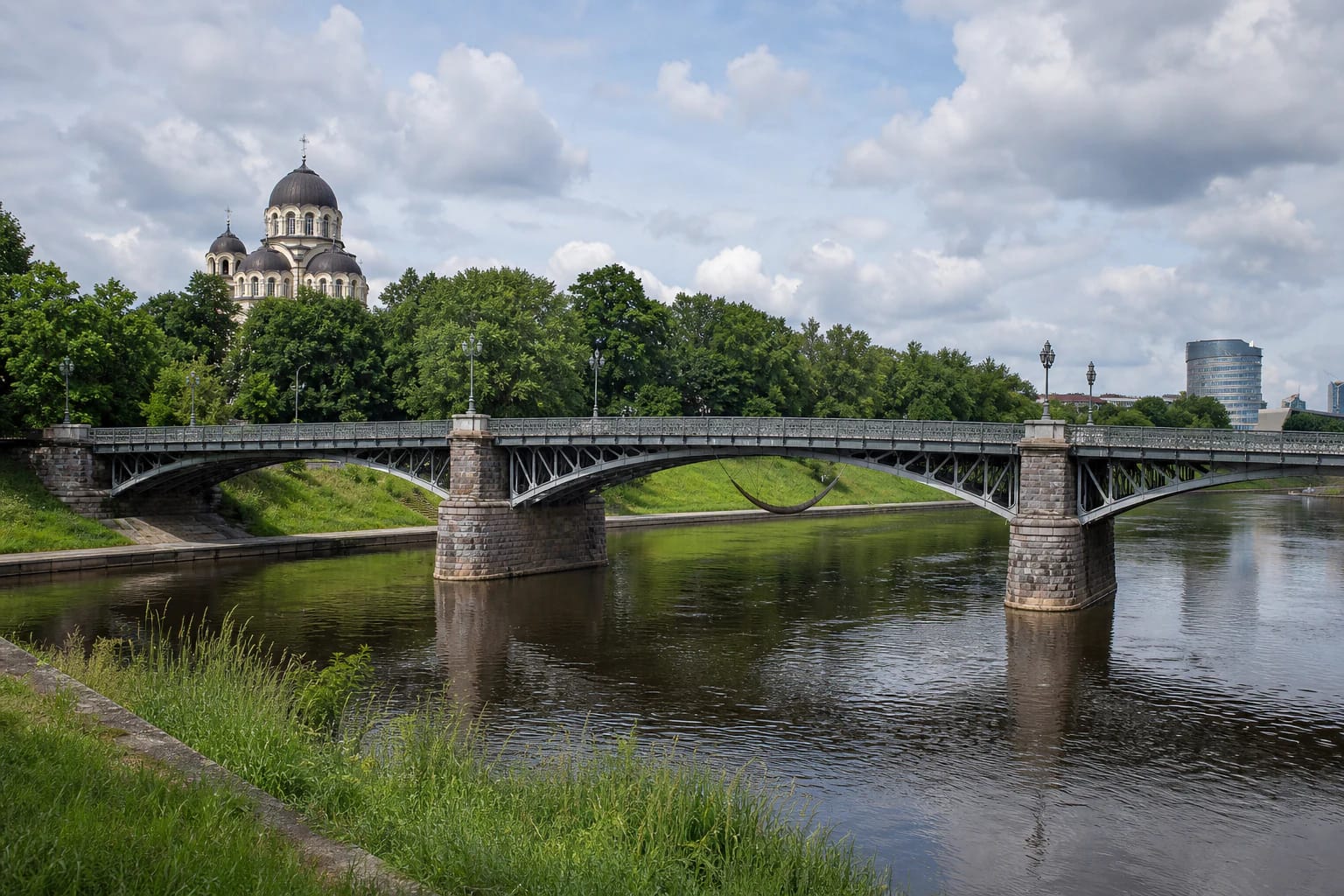
The northern end feeds into A. Mickevičiaus Street in Žvėrynas, while the southern end continues the line of Gedimino Avenue beside the Lithuanian Parliament. From road level, the openwork metal railings and decorative lamps are most apparent. The structure makes more sense from the Neris embankment: three low steel-truss spans rest on two masonry piers in the water and abutments at the banks.
On the Žvėrynas side, the domes of the Orthodox Church of the Icon of Our Lady of the Sign rise above the trees. Kunotas Vildžiūnas's Ship-Crescent sculpture hangs below the bridge, and a stone at one approach marks a defensive barricade. This is not only a viewpoint: cars, pedestrians, cyclists, and scooter riders use the crossing every day.
From a wooden crossing to the steel bridge
The Cultural Heritage Register dates the first wooden bridge at this site to 1892, while VLE gives 1893. Both sources make clear that this early crossing was not today's steel structure. KVR describes it as unreliable and records a city Duma competition for a new metal bridge in 1902. The present bridge was built in 1905-1907; city histories also record the name Nicholas Bridge.
Authorship is not presented consistently. KVR names engineer V. Malinovskis as both project author and construction supervisor. VLE credits engineer V. Personas with the metalwork design and V. Malinovskis with the masonry. Because those attributions differ, this page keeps both documented versions separate.
Five trusses and cut-stone supports
Vilnius City Municipality gives a length of 103.1 m and a width of 11.35 m. KVR describes a three-span structure with five longitudinal steel trusses. Their lower chords curve in the form of segmental arches, and the riveted truss-and-beam deck was manufactured by the Warsaw company K. Rudzkij ir Ko.
The load-bearing system also includes two cut-stone masonry abutments at the banks, two masonry piers in the Neris, steel bearings, and approach embankments formed in earth. The register protects the types of openwork metal railing and decorative lamp as significant details. In 2024 the municipality noted that, apart from the closed Bukčiai footbridge, this was the only Vilnius bridge then in use with piers standing in the water.
War damage, barricades, and renewal
KVR records damage during both world wars, repairs or rebuilding after each, and further work in 1937, 1960, and 2004-2005. Vilnius City Municipality says part of the bridge was blown up in 1944 and dates the last major reconstruction to 2005, while VLE gives 2006. The sources therefore present the date of the latest major reconstruction differently.
Barricades defending the Lithuanian Parliament stood on the bridge in 1991. A stone marker at the bridge records the defensive barricade that stood here in 1991-1992, while part of the original barriers is displayed beside the Parliament. This event forms part of the bridge's registered historical value rather than an urban legend.
A scheduled repair lasting roughly two and a half months ended in 2024. Metal railings, barriers, and fascia beams were painted; expansion joints and the sidewalk surface were repaired; drainage was added to the outer spans; graffiti was removed; and granite surfaces were washed. Riverfront approaches and the steps on the Žvėrynas side were also renewed. Kunotas Vildžiūnas's Ship-Crescent beneath the bridge was installed on June 12, 2010, as part of the Vilnius Signs public art project.
Access, visiting, and safety
Žvėrynas Bridge is public road infrastructure rather than a ticketed attraction, so it has no separate visitor opening hours, ticket office, or admission charge. At deck level it can be approached from A. Mickevičiaus Street and from the Gedimino Avenue and Parliament side; riverside paths and steps descend to the lower embankments. Wet metal, stone, steps, and winter ice can make surfaces slippery.
In 2026 the municipality reported that the usable clear width for pedestrians on Žvėrynas Bridge narrows to only 0.5-1 m in places, against a standard of at least 1.5 m. A two-way micromobility lane would require 2.5 m, but no separate lane of that kind exists here. With narrow sidewalks and busy road traffic, it is safer to walk a bicycle or scooter, pass others slowly, and keep children close.
In the official city information checked on 2026-07-15, Žvėrynas Bridge itself was not listed as closed to public access. Access and traffic arrangements can nevertheless change temporarily because of maintenance, events, or construction of the nearby new pedestrian and cycle bridge between A. Goštauto and Upės streets. Check current Vilnius City and JUDU notices before travelling and follow all barriers on site.