- Place
- Vilnius City Municipality
- Region
- Vilnius
- Type
- 4.9 ha Japanese strolling garden around Šnipiškės Lake
- Address
- Linkmenų g. 2A, Vilnius
- Coordinates
- 54.70186, 25.26778
- Visit duration
- 1 to 1.5 hours; longer during blossom or with children
- Best time
- late April and May for cherry and other blossom, or September and October for leaf colour; flowering dates vary each year
Šnipiškės Japanese Garden, Vilniaus Japoniškas sodas
The exact Šnipiškės garden, not simply a cherry avenue
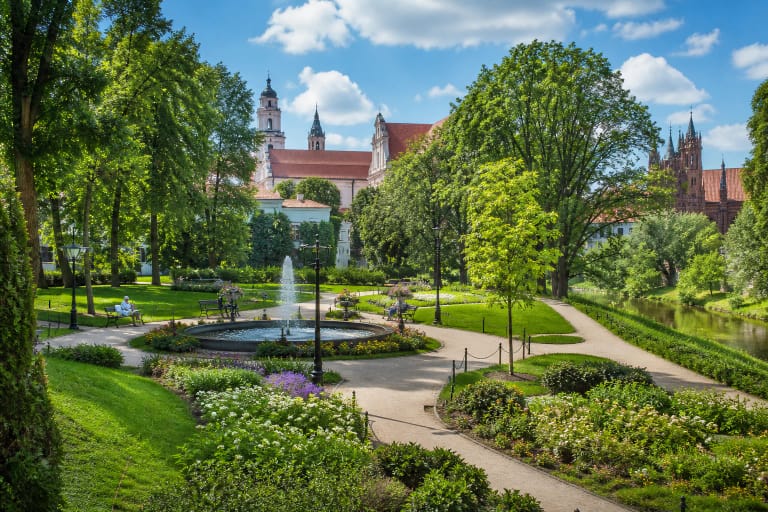
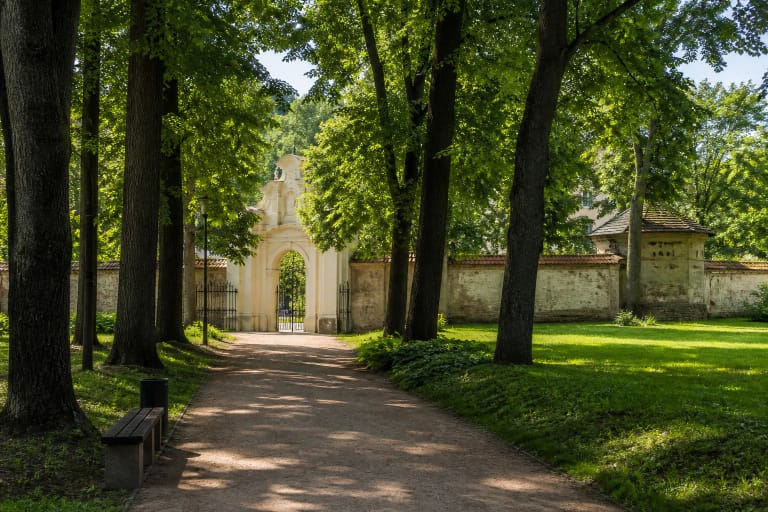
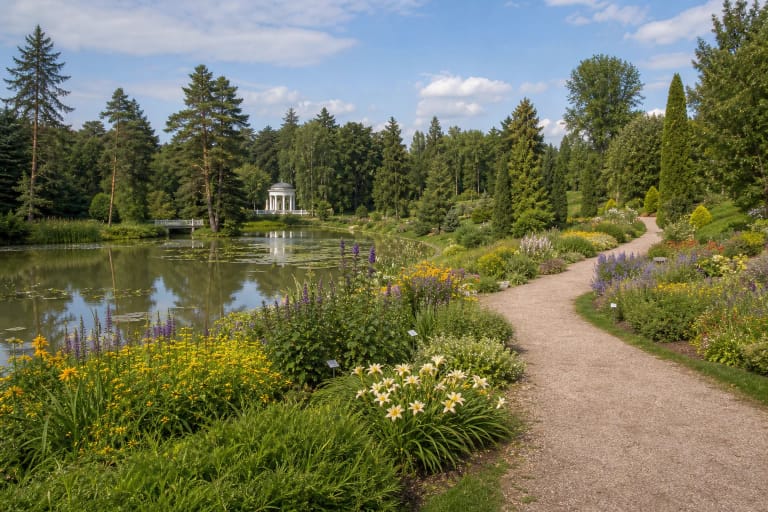
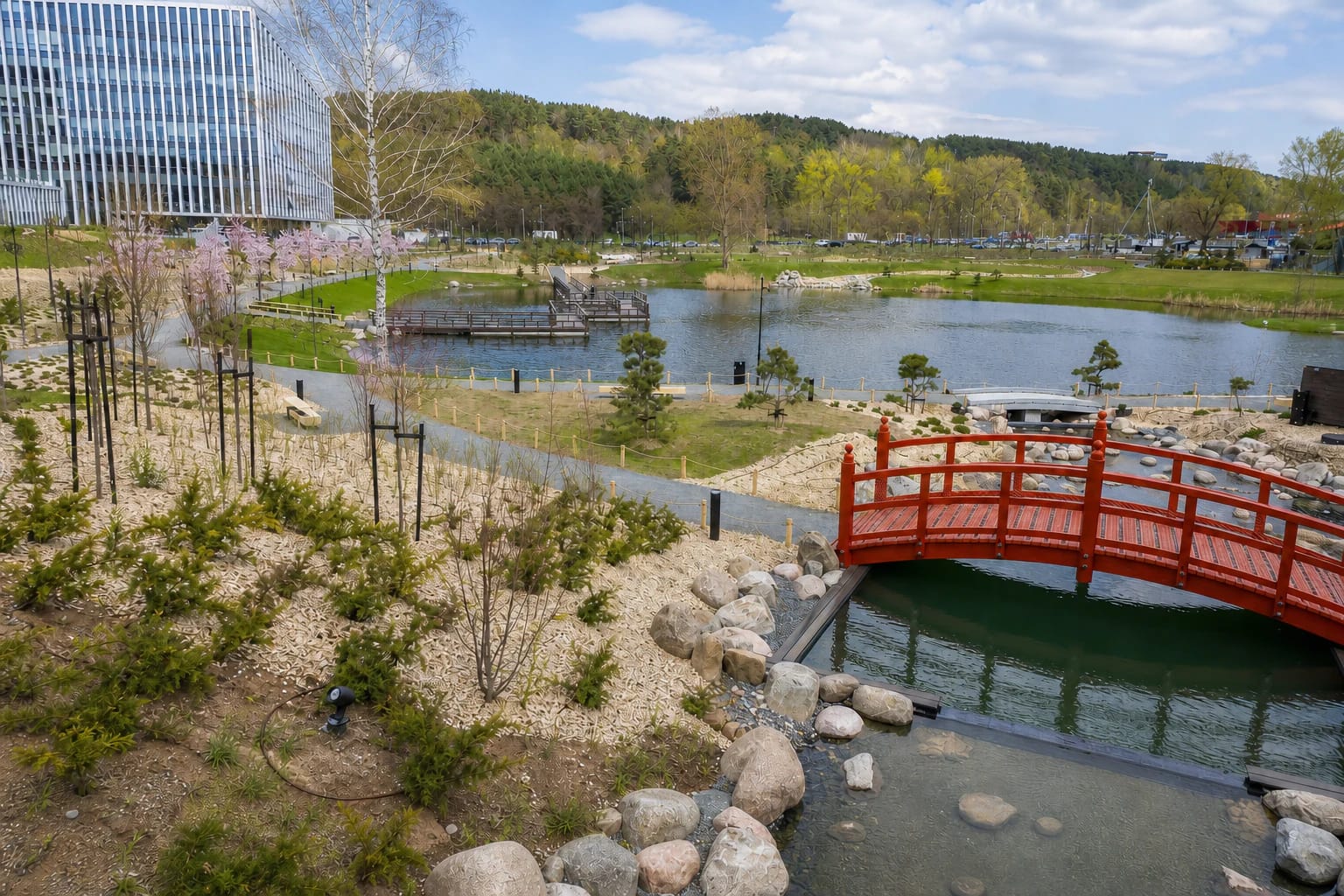
Vilnius Japanese Garden occupies 4.9 ha at Linkmenų g. 2A in Šnipiškės, within the block framed by Linkmenų, Lvivo, Geležinio Vilko, and Žalgirio streets. It is a gated city garden around Šnipiškės Lake, not Chiune Sugihara Sakura Park on Upės Street, the small Sei Shin En garden near T. Kosciuškos Street, or the Japanese display at Vilnius University Botanical Garden in Kairėnai.
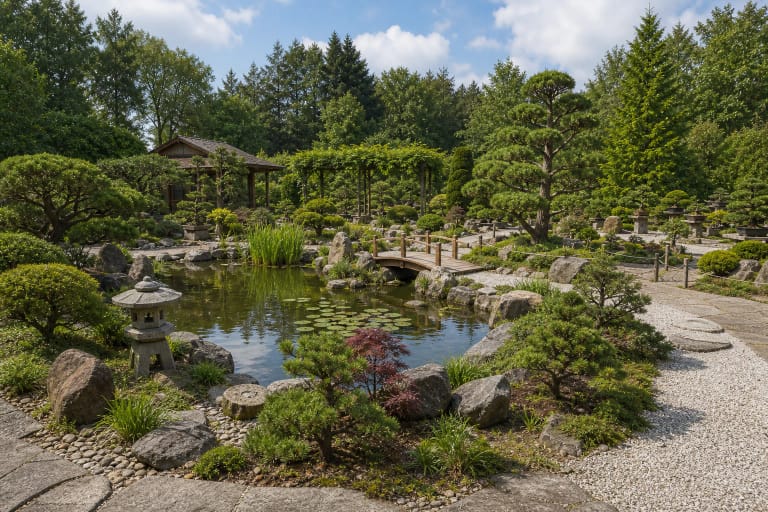
The manager describes it as a kaiyū-shiki-teien strolling garden. Views unfold along a loop intended to be walked clockwise. Shaped hills and planting soften the scale of surrounding roads and buildings, while the wooded Šeškinė slope beyond Geležinio Vilko Street is drawn into the longer view. The tall Šnipiškės office buildings remain an honest and recognizable part of this urban setting.
A Japanese concept implemented in Lithuania
The early project history published by the Embassy of Lithuania in Japan connects the idea with bonsai practitioner Kęstutis Ptakauskas and the company Tokvila. Japanese landscape architects Yukihiro Nakane and Shiro Nakane prepared the concept presented to Vilnius in 2013. A Terra Firma LT team then led the technical design and adaptation to the site in Lithuania, with landscape architect Linas Ūsas identified as project lead in municipal material.
Construction began in late 2020, and the project manager records completion in the second quarter of 2023. Visitors were first admitted on 21 April 2023 as the cherry trees began to bloom, followed by the formal opening celebration on 29 April. Some structures discussed in early concept material were not part of the finished garden, so a present-day account should focus on the built paths, bridges, pavilion, waterworks, and planting compositions.
Lake, cascade, dry stream, and a living seasonal cycle
The composition centres on natural Šnipiškės Lake, formed at the edge of the Neris palaeovalley and marked on old city plans. Vilnius city parks give its area as 0.88 ha and maximum depth as 6.7 m. A pontoon bridge crosses part of the lake, while a separate cascade and koi pond are crossed by the red arched Moon Bridge. Aerators, stone-edged banks, a small waterfall, wooden pavilion, and broad grey-surfaced paths make a coherent walking sequence rather than a theatrical set.
The dry stream begins at a stone-built dry waterfall on a hill, descends towards the main lake, and passes beneath small granite bridges. Its neighbouring dry garden is meant to be viewed from a designated point without stepping into the gravel and stone composition. In spring, the avenue of 20 Prunus 'Accolade' cherry trees, irises, rhododendrons, and creeping phlox provide the strongest colour. Summer is layered green, while maples, dogwoods, and spindle trees colour the autumn. Nearly 700 trees were planted and some mature site trees were retained, so the garden will continue to change as the planting grows.
Hours, rules, accessibility, and water safety
On 2026-07-15, Vilnius city parks published seasonal hours of 6:00-23:00 from April through October and 7:00-22:00 from November through March. The manager listed no admission charge or ticket price, so entry was free at that date. Hours, temporary closures, and event arrangements can change; check the manager's latest notice before travelling instead of relying only on a mapping app's schedule.
Published rules require visitors to remain on paths, leave plants and gravel or stone compositions undisturbed, avoid climbing rocks and shaped hills, and use lawns only where signs permit. Bicycles must be left at the entrance, while pets may accompany visitors only on paths. Built elements and site furniture were designed around universal-design principles, but no independent audit of the complete route was found, and gradients, bridges, or seasonal path conditions may affect passage. The lake is not presented as a bathing place or supervised skating venue, so remain on paths and bridges, stay off the ice, and observe temporary barriers.
Entrance, arrival, and the exact Google Maps listing
The western entrance at Linkmenų g. 2A is the one most clearly identified in official visitor information. In April 2026, JUDU opened an adjacent 24-hour paid car park with 101 spaces, entered from Geležinio Vilko Street; the published rate was EUR 0.80 per hour. The car park's operating hours do not extend the garden's gate hours. Pedestrians can approach along Linkmenų Street from the lawns by the White Bridge, while current public transport and changing parking terms are best checked in JUDU's live journey planner.
The Google Maps listing checked on 2026-07-15 was named exactly 'Vilniaus Japoniškas sodas', rated 4.6/5, and identified by place ID ChIJl2hSR96T3UYRBu8_XbvIfEg. Its point at 54.701855, 25.2677765 marks the garden site rather than guaranteeing a particular gate is unlocked, so use the Linkmenų g. 2A address for the western entrance and follow gate signs on arrival.