- Place
- Būda village, Jankai Eldership, Kazlų Rūda Municipality
- Region
- Suvalkija
- Type
- community collection of local history and traditional household objects inside Būda Culture House, open only by prior arrangement
- Address
- 2 Liepų Street, Būda, Kazlų Rūda Municipality
- Coordinates
- 54.80411, 23.33110
- Visit duration
- about 30-60 minutes for the collection; allow longer only when a talk or practical activity has been confirmed in advance
- Best time
- only after arranging a visit with Būda Culture House; daylight makes the small details of the mostly open displays easier to examine
Būdos krašto muziejus, Būda Museum, Būda Culture House local-history collection
A community collection inside Būda Culture House
The museum is at 2 Liepų Street in Būda village, within Jankai Eldership. The same building houses Būda Culture House, a branch of Kazlų Rūda Culture Centre. The coordinates 54.804114, 23.3311005 identify the building rather than a separate museum door, parking place, or step-free route.
Kazlų Rūda Municipality's official map calls the collection Būda Local History Museum. In practical terms, however, it is a compact local-history display in culture-house rooms rather than a branch of a national or municipal museum that keeps daily public hours. No public collection total, catalogue of holdings, or permanently staffed curator's desk has been published.
The name matters when planning the journey. Būda is not Ąžuolų Būda, and this collection is not Višakio Rūda's household museum. Enter the full address and choose Būda near Jankai, since the single word Būda can lead a map search to a different settlement in the municipality.
Local donations preserve stories as well as objects
The municipality explains that local-history enthusiasts began collecting objects connected with Būda so the area's past would not disappear. Every exhibit is described as a donation from a resident of the Būda area. That gives the collection a different character from a miscellaneous antiques display: its contents came from homes in the community whose history it records.
Its strength is not the prestige of one exceptional artwork. Meaning lies in the link between a tool, the name used for it, the household that owned it, and the work it once performed. A quick unaccompanied look therefore cannot replace a local explanation, especially when an implement's purpose is no longer obvious from its shape.
Public sources provide no foundation date, formal founding act, or full provenance for every item. Nor can all the exhibits safely be assigned to one period. It is more accurate to understand the museum as a community collection that grew gradually through local donations.
A nail-free table and wafer mould open several windows onto domestic life
The official introduction first asks visitors to notice a table made without nails. It directs attention to timber joints and a craftsperson's solutions instead of treating an old piece of furniture as decoration. Without an object-level study, however, its year, maker, and the precise construction of every joint should not be guessed.
A mould used to bake kalėdaičiai, the thin wafers shared at Christmas Eve, connects the display with seasonal preparation and religious family custom. Another highlight is jokingly described as a wireless iron because it required no electricity. Old metal irons were heated on a stove or with embers, depending on their individual construction.
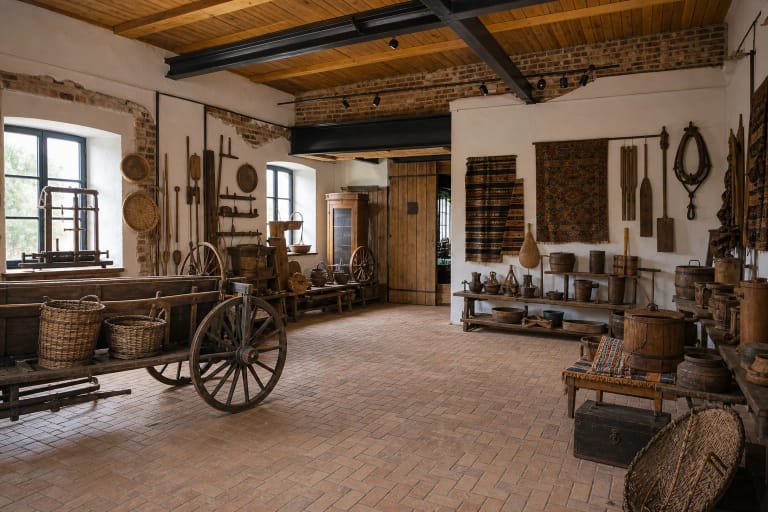
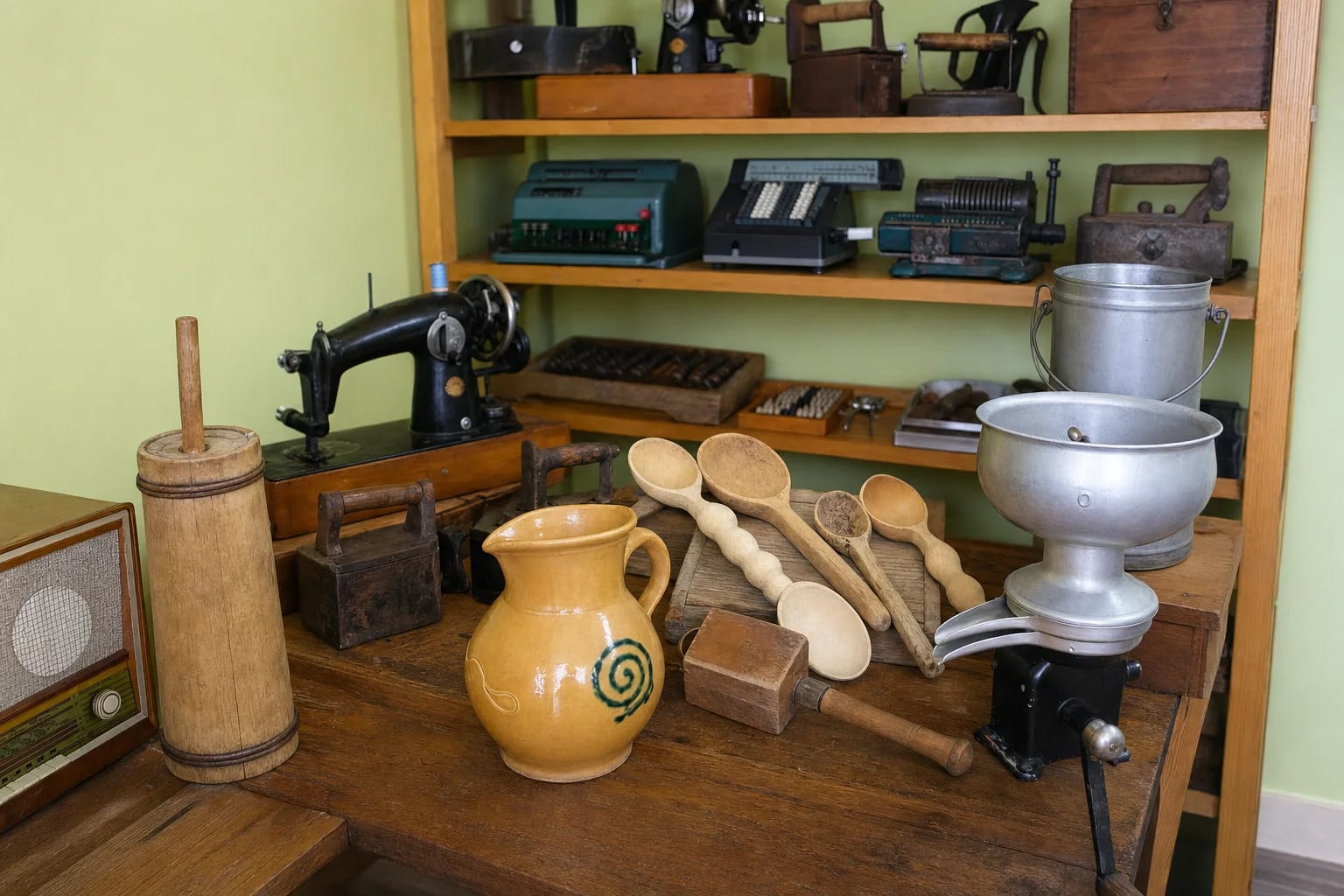
Photographs reveal a broader working household: wooden vessels and spoons, a butter churn, a hand-operated sewing machine, a cream separator, old irons, calculating devices, and a radio. Displays can change, so anyone travelling for one particular object should ask whether it will be available.
Šliotė, abazukas, and peršeklis show how a museum can preserve vocabulary
The municipal description deliberately asks whether readers know the words šliotė, abazukas, and peršeklis. This is more than a quiz. When a working object disappears from daily life, its name often follows, and an interpreted collection can preserve both.
Lithuanian dictionaries explain a šliotė as a wooden vessel holding water in which a whetstone was moistened before sharpening. Reliable public references do not give one equally clear identification for abazukas and peršeklis, so this page does not assign meanings by guesswork. Their precise objects and the senses used around Būda are questions for the guide.
Pairing words with things also makes the collection engaging for families with older children. Visitors can try to infer each tool's purpose before the explanation and then compare their answer with the use remembered by local residents.
Older activity descriptions are not a guaranteed current programme
Earlier visitor descriptions associated Būda with weaving, spinning, dances, games, and making kropeliai. These small baked treats are still fostered as part of the area's food tradition, so the subject has a real local connection. The current official museum entry, however, confirms only visits by prior arrangement, not a fixed schedule of practical activities.
Older listings also referred to groups of 10-20, sessions lasting one and a half to two hours, and a price by agreement. Those details remain useful questions but not promises. Ask whether your booking covers only the display, a hosted talk, a demonstration, hands-on work, or tasting.
For a school group, confirm participant ages, language, group size, length, price per person or per booking, and payment method. Do not arrive expecting that a public event or food service will automatically be running in the culture house.
Visits require an appointment; no standard hours or admission are published
On 19 July 2026, the official museum entry instructed visitors to arrange their visit in advance. Kazlų Rūda Culture Centre listed +370 615 65711 for the cultural-programme manager at Būda Culture House, while the municipality's museum entry also gave the local contact +370 630 86511. Confirm which number is handling bookings when you call.
No regular weekly hours or standard admission charge were found. Ask whether a simple look at the collection is free, whether payment applies only to a guided talk or activity, and whether a minimum group is required. The terms confirmed by the culture house at the time of booking take precedence over any older listing.
Official information does not establish dedicated parking, a visitor toilet, a photography policy, or step-free access to the display. Anyone with mobility, visual, or hearing requirements should discuss the entrance, thresholds, seating, companion access, and whether objects may be touched. Allow 30-60 minutes for a straightforward visit.