- Place
- Biržai City Municipality
- Region
- Biržai
- Type
- Radziwiłł bastion fortress, reconstructed palace, and museum
- Address
- Radvilos g. 3, LT-41175, Biržai
- Coordinates
- 56.20502, 24.75323
Biržų tvirtovė
Biržai Castle: Radziwiłł fortress by Lake Širvėna
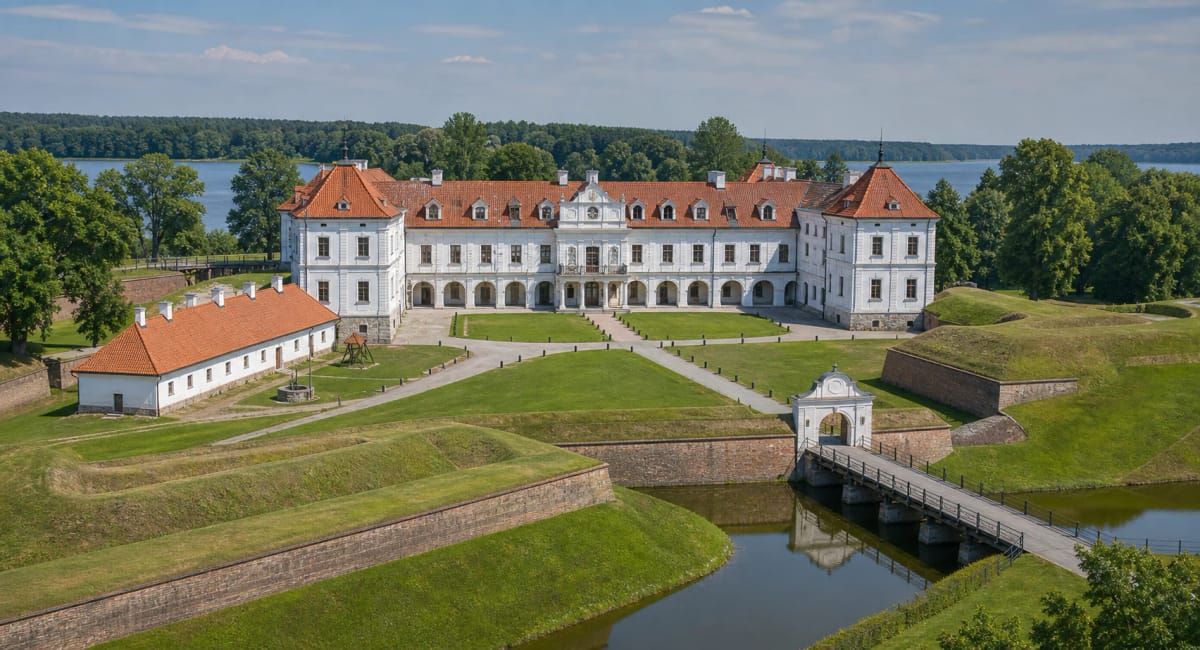
Biržai Castle, also called Biržai Fortress, stands on the southern shore of Lake Širvėna. VLE gives the complex area as about 9.3 ha, and the site still preserves the essential impression of an early modern defensive system: ramparts, water moats, bastions, and the axis of the bridge.
This is not a romantic medieval tower castle. It is a Radziwiłł bastion fortress, which makes Biržai distinctive on Lithuania's heritage map: in one place visitors can see the reconstructed palace, the outlines of the arsenal and barracks, earthwork bastion architecture, and the defensive landscape shaped by the lake.
Kristupas Radvila Perkūnas and the first castle
VLE writes that construction began around 1586 on the initiative of Kristupas Radvila Perkūnas, following the plan of Italian bastion castles. By damming the Apaščia and Agluona rivers, a reservoir of about 400 ha was formed, today known as Lake Širvėna. The castle was built in three stages, and entry was through a curved bridge and a two-storey masonry gate building at the eastern rampart.
By 1589 the courtyard already contained a three-storey masonry palace, an arsenal, stables, food stores, and other buildings. The same year is important for Biržai because of the Magdeburg privilege. The museum presents this Radziwiłł period through copies of privileges, seals, maps, models, and finds such as stove tiles bearing the coats of arms of Liudvika Karolina Radvilaitė and Kristupas Radvila Perkūnas.
Biržai Castle during the Swedish wars
In the seventeenth century Biržai Castle was one of the key fortresses of the Grand Duchy of Lithuania in the north. During the wars with Sweden it was besieged, destroyed, and rebuilt several times. In August 1625, about 8000 Swedish troops under King Gustav II Adolf besieged it; after the second siege the garrison surrendered, the castle was destroyed, and the Swedes took away 60 cannons. In 1637-1682 the fortress was rebuilt, this time with ramparts reworked according to the Dutch bastion-castle plan.
In 1657 the Swedish garrison surrendered to the army of Lithuanian Field Hetman Wincenty Gosiewski, and in 1659 Bogusław Radziwiłł's dragoons retook the castle. In February 1701 Augustus II of the Polish-Lithuanian Commonwealth and Russian Tsar Peter I signed the anti-Swedish Biržai Treaty here. In 1704 the Swedes again captured the castle and blew up the palace and other buildings. In 1811 Biržai Castle passed to the Tyszkiewicz counts, and in 1822 Russian emperor Alexander I ordered its remains to be preserved. This history explains why today's visit is mostly to a reconstructed complex grounded in archaeology and restoration.
The palace and the Sėla museum
VLE states that the castle palace was rebuilt in 1978-1986 according to a project by architect Evaldas Purlys, and in 1989 the Biržai Regional Museum Sėla opened there. The current palace appearance is therefore a late twentieth-century restoration choice that returns the complex to a historical spatial structure.
The museum exhibition Biržai and the Radziwiłłs tells the story of the city, manors, and fortress in the sixteenth-eighteenth centuries. It includes archaeological finds, Tomasz Makowski's engraving of Biržai town and castle, a model of the Dutch-type bastion fortress, stove tiles, and sandstone, dolomite, and stucco interior details.
What to see on the grounds
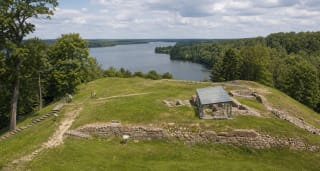
Start with the bridge and water moat: this is where it is easiest to understand that the castle worked as a system, not just as a palace building. VLE mentions surviving ramparts, defensive water moats, the eastern bastion powder magazines, gate-building ruins, the palace central part, and archaeologically marked outlines of the barracks and arsenal.
Inside, give time to the Radziwiłł exhibition and the arsenal. The museum highlights the former richness of the palace, Renaissance cross vaults, masonry and plaster fragments, and the section of wall that survived the Swedish explosion of 1704.
How to visit Biržai Castle
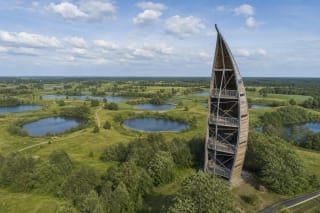
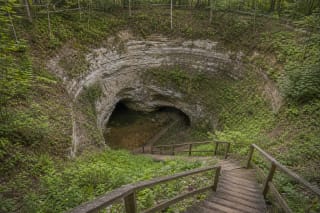
Biržai Regional Museum Sėla gives the address as Radvilos g. 3, Biržai. In the city, the castle combines naturally with the Lake Širvėna shore, Astravas Manor, the long pedestrian bridge across the lake, and the karst objects of Biržai Regional Park.
Allow at least 1.5 hours if you want only the palace, bridge, and main exhibitions. If the bastions, arsenal, archaeological details, city, and lakeshore interest you, plan 2-3 hours. Before travelling, check the museum's opening hours, tickets, and current exhibitions.