- Place
- Birštonas Municipality
- Region
- Birštonas
- Type
- state-protected hillfort with a settlement at its foot and a viewpoint
- Address
- Vytautas Park, Birštonas
- Coordinates
- 54.59709, 24.03436
- Visit duration
- 30-60 minutes; allow roughly 1-1.5 hours for a leisurely walk through Vytautas Park
- Best time
- spring or autumn, when the Nemunas is more visible through the trees; dry weather for safer stairs
Vytautas Hill, Birštonas Castle Hill, Birštonas Hillfort with Settlement
Vytautas Hill is both a panorama and an archaeological site
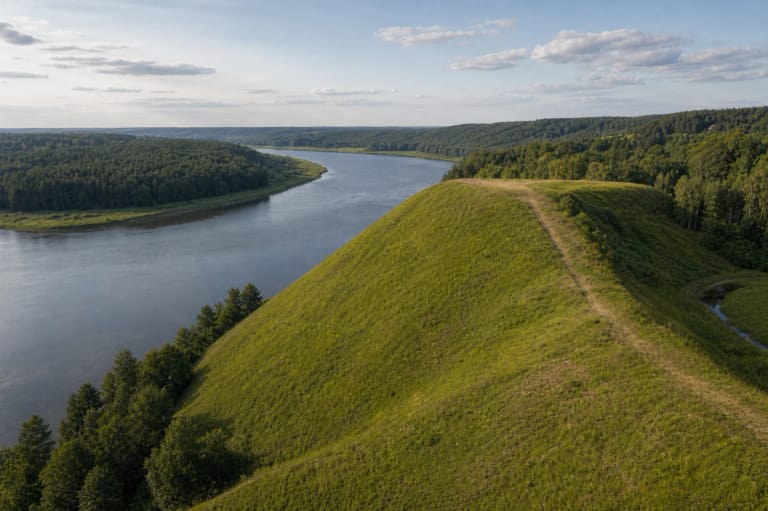
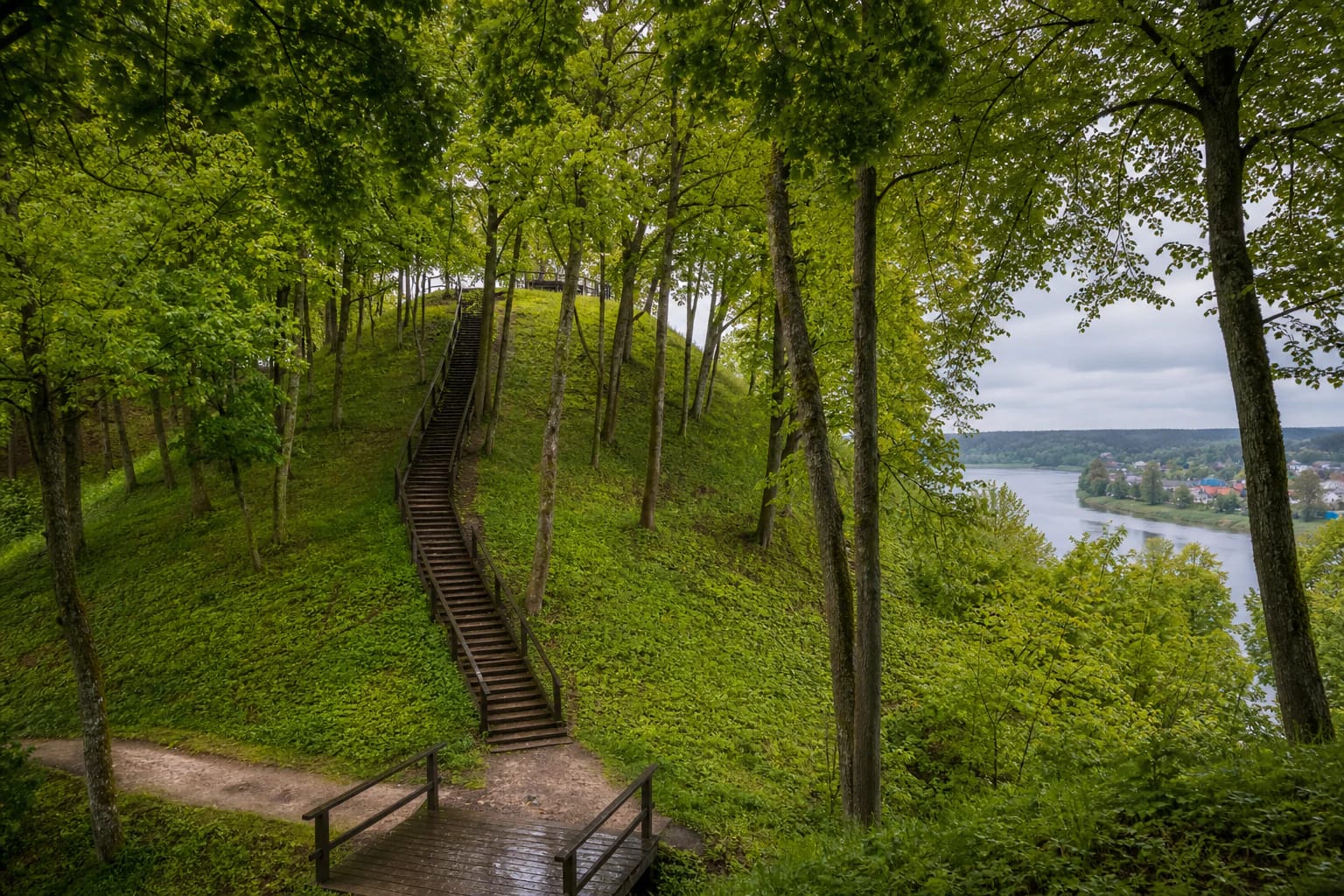
Birštonas Hillfort rises in Vytautas Park on the right bank of the Nemunas, where the river makes a pronounced eastward turn. The summit overlooks the valley and part of Birštonas, but the hill's value extends beyond its view. The Cultural Heritage Register identifies it as an archaeological monument of national significance, and the wider complex includes both the hillfort and a settlement at its foot.
Official descriptions give different height figures. The Lithuanian Universal Encyclopaedia records slopes of 13-20 metres, Saugoma.lt describes a hillfort more than 30 metres high, and Birštonas Municipality refers to a climb of roughly 40 metres. The difference probably reflects different reference points. For a visitor, the practical conclusion is simpler: the ascent is short but steep and uses stairs.
The map pin marks the hillfort itself, not a single car park or guaranteed step-free entrance. Access is through Vytautas Park, so check the current pedestrian approach before setting out and do not attempt to drive to the stairs.
The 70 by 35 metre platform preserves defensive terrain
The summit platform is oval and measures roughly 70 metres by 35 metres. Saugoma.lt summarises its area as about 2,500 square metres and records a terrace of approximately 80 square metres. Hollows surround the hill, while deep spring-fed gullies, wet marshy ground, a rampart, and a fortified outer ward once strengthened its defences.
The north-western part of the platform is disturbed. The Lithuanian Universal Encyclopaedia connects this with pits dug for a water reservoir, so the ground visible today is not an entirely untouched medieval surface. Look for the platform edges, terrace direction, and slopes rather than masonry: the castle that once stood here was wooden.
Traces of an ancient settlement survive at the southern foot. In 1953, archaeologists from the Institute of History carried out an exploratory investigation and found hand-built pottery with roughened surfaces as well as wheel-thrown pottery. The finds indicate occupation not only on the fortified summit but beside it.
Birštonas Castle enters the written record in 1382
Birštonas Municipality and Saugoma.lt identify 1382 as the castle's first appearance in written sources. By the late fourteenth century, the wooden stronghold formed part of the Duchy of Trakai's defensive system at a strategically important position beside the Nemunas. Teutonic forces attacked the castle, but no reconstructed walls or towers stand on the hill today.
Official local sources link the name Vytautas Hill with Grand Duke Vytautas and hunting around the castle. A grand-ducal manor stood nearby, and rulers and nobles came here to hunt. This links documented local history with the name later attached to the hill, but it should not be imagined as a surviving palace of Vytautas.
Saugoma.lt records that King Casimir IV Jagiellon stayed at Birštonas Castle with his family in 1473 while seeking refuge from a plague epidemic. The castle later lost its defensive importance and had disappeared by the seventeenth century. This longer sequence makes the place relevant beyond Vytautas's period alone.
Stairs, paths, and footbridges were renewed in 2023
Vytautas Hill reopened to visitors in 2023 after work on its slopes and visitor infrastructure. Collapses and landslips were reinforced, sanitary tree work was carried out, the gravel path along the western edge and the stairs to the summit were repaired, some path surfaces were renewed, two footbridges were renovated, and a third was added.
The municipality lists a car park and bicycle stands at the foot, with rest, viewing, and educational areas and information panels around the site. This is not a ticketed museum: the official pages checked on 25 July 2026 listed neither a separate admission charge nor opening hours. Temporary works, events, or weather can still affect access, so check current municipal notices.
The maintained route helps channel visitors away from erosion-prone ground. Keep to the stairs and marked paths, do not climb directly up the slopes, disturb the soil, or leave bicycles on the archaeological platform.
Accessibility depends on the particular part of the route
After the 2023 works, Birštonas Municipality wrote that the site had been adapted for people with disabilities, yet the same account identifies stairs leading to the hillfort. No detailed public plan confirming a step-free route all the way to the upper platform was found. A wheelchair user should therefore not assume in advance that the summit is accessible without steps.
If you use a wheelchair, travel with a pushchair, or have limited mobility, ask before visiting which sections can be reached on a level path and which parking place is most suitable. Even without reaching the summit, it is possible to explore part of Vytautas Park and view the hillfort's profile from below.
The stairs can become slippery after rain, during a thaw, or under fallen leaves. Wear footwear with good grip, use the handrail, accompany children throughout the climb, and skip the panorama when the steps are icy.
Combine the hill with central Birštonas
Allow 30-60 minutes for the climb, a circuit of the platform, and the view. If you want to read the information panels, walk slowly through Vytautas Park, and continue into the resort centre after descending, 1-1.5 hours is more comfortable.
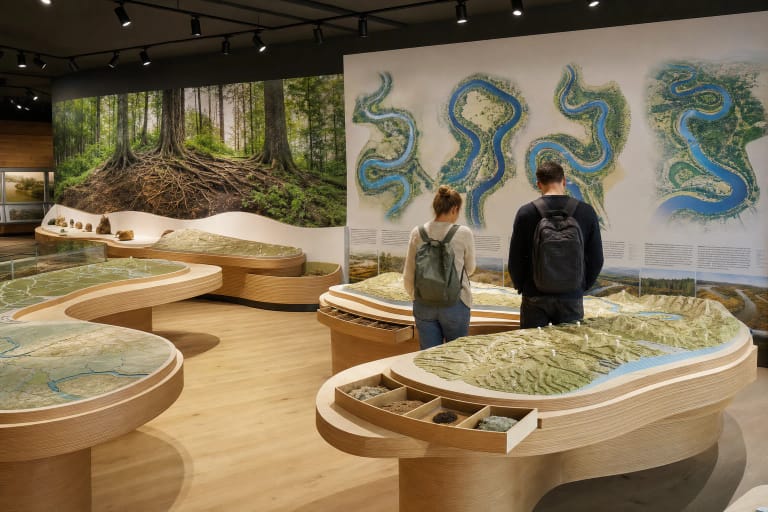
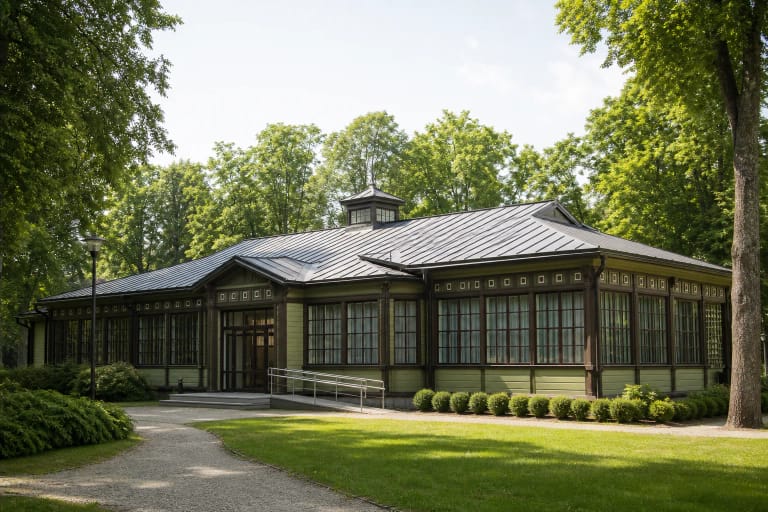
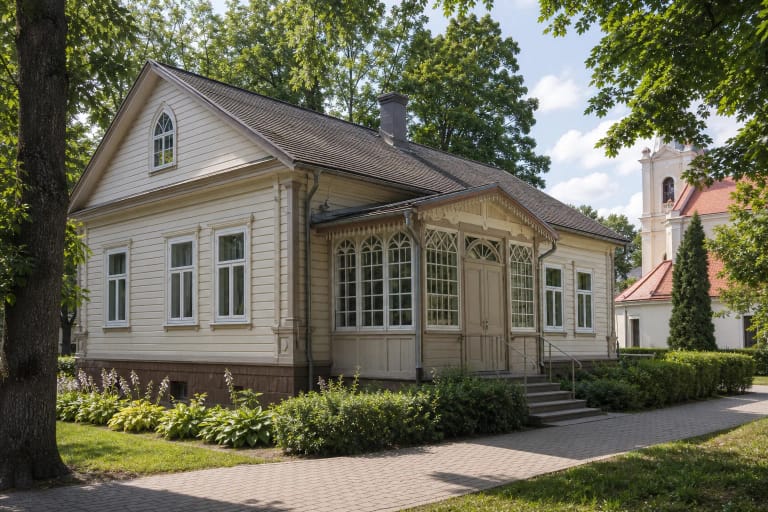
The hillfort combines naturally with the Nemunas Loops Regional Park Visitor Centre, Birštonas Kurhaus, and the Museum of Sacral Art. Choose Birštonas Observation Tower for a wider landscape panorama, or Punia Hillfort elsewhere on the great Nemunas loops for historical comparison.
Foliage changes the experience. In summer the hill is green and shaded; in spring and autumn more of the Nemunas opens between the branches; in winter the relief is clearest but the stairs can ice over. Dry spring or autumn weather usually offers the best balance of visibility and safety.