- Place
- Naisiai, Šiauliai District Municipality
- Region
- Šiauliai Region
- Type
- gene-bank herb garden opened to visitors in 2014 as an outdoor museum
- Address
- Naisiai, Meškuičiai Eldership, Šiauliai District, LT-81474
- Coordinates
- 56.02216, 23.50898
- Visit duration
- 30-50 minutes for the garden; 2-3 hours if combined with other outdoor museums in Naisiai
- Best time
- late May to September for successive flowering; morning or evening light for photographs
Naisiai Baltic Herb Museum, Baltic Herb Garden in Naisiai, Museum of Baltic Plants
An 85 by 40 metre living garden, not an indoor exhibition
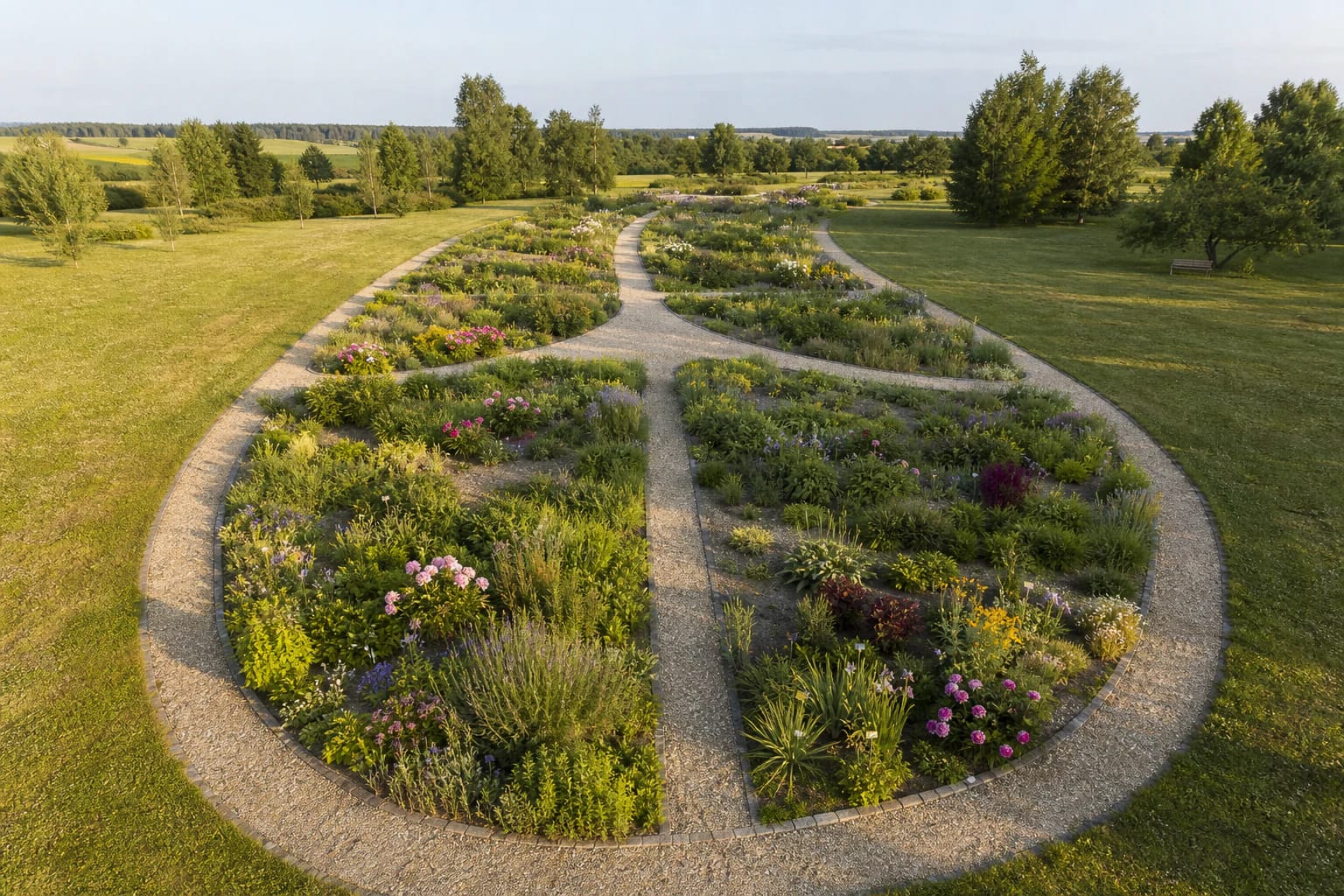
The Baltic Herb Museum is laid out as a large outdoor composition among the maintained green spaces of Naisiai. Its official description gives dimensions of 85 by 40 metres. From above, the outline resembles a prieverpstė, a traditional Lithuanian spindle-board; at ground level, visitors first notice paths dividing planted beds, vegetation of different heights, and colours that change through the season.
The word museum means a living thematic collection here. There is no single exhibition door, ticket desk, or permanent set of equally visible exhibits. The same ground looks different in spring, midsummer, and autumn, because some plants have already finished flowering when others are only beginning.
The coordinates 56.0221629, 23.5089769 mark the herb garden itself. Attractions in Naisiai are distributed across several nearby park and village locations, so this place pin is more useful than a general village address.
Three sections distinguish ritual, household, and cultivated plants
The ritual section contains plants associated in tradition with sacredness, ceremonies, and protection. These accounts should be understood as ethnocultural heritage. A plant's presence in this section does not prove that every Baltic community used it in the same way or that any claimed effect is scientifically established today.
The household section presents medicinal herbs and seasonings used in food, wellbeing, and domestic life. It rewards smelling leaves, comparing their shapes, and reading plant names, but visitors should not pick or taste anything. Traditional use is not personal medical advice, and even a familiar plant may be unsuitable for a particular person.
The cultivated section emphasises ornament and plant breeding. The official museum description specifically names Lithuanian cultivars of lilies, peonies, dahlias, and irises, together with other flowering plants. It shows that plant culture includes not only the use of wild herbs but also gardeners' work in preserving and developing local varieties.
Botanical garden specialists helped create the 2014 collection
The Naisiai community says the museum welcomed visitors in 2014 and was developed with assistance from specialists at the then Šiauliai University Botanical Garden. This helps explain the gene-bank principle: plants do more than decorate the landscape, because they are grouped for comparisons of use and cultural meaning.
Since 2021, the former Šiauliai University Botanical Garden has operated within Vilnius University Šiauliai Academy. That institutional change does not alter the herb museum's 2014 origin, but it explains why older descriptions use the previous university name.
Living collections inevitably change. Plants are divided, replaced, or replanted; some fail to survive a winter, and each year's weather shifts flowering times. The museum is therefore best appreciated through its three-part idea and the garden present on the day, rather than as a promise of an identical species list every year.
Flowering time and viewing height shape the experience
The most colourful period generally runs from late May to September, but there is no single week when every collection flowers at once. Peonies and irises are more prominent in early summer, lilies later, and dahlias in late summer and early autumn. A cold winter or dry growing season can shift that rhythm.
The spindle-board outline is easiest to understand from above, while individual planting groups become more important along the paths. If no raised viewpoint is available, look at a plan or satellite image before walking through the garden; the three sections are then easier to recognise on the ground.
Low morning or evening light is better for photography because plant textures do not disappear into harsh shadows. Stay on the paths, do not move labels, and never pick flowers. This is a maintained living collection, not an unrestricted meadow.
Admission is free, while a guide must be requested in advance
On 27 July 2026, the Naisiai community stated that admission to its museums was free. A free guided visit required registration at least five days in advance using the telephone number or form on the official website. No separate ticket was published for an independent walk through the outdoor garden, but guide, event, and site arrangements should be rechecked before a long journey.
Allow about 30-50 minutes for the herb garden alone. A longer Naisiai walk can include the Museum of Baltic Gods, Sun and Fire Squares, Alka Hill, and other village attractions. They should not be treated as one undifferentiated site: the herb museum has its own composition and map point.
No detailed public step-free access audit was found. Path surfaces, edges, and wet-weather conditions may change, so discuss any specific mobility need when booking a tour. Bring drinking water and sun protection in hot weather because part of the garden is exposed.