- Place
- Naisiai, Šiauliai District Municipality
- Region
- Šiauliai Region
- Type
- free open-air sculpture museum created in 2012 to interpret Lithuanian, Latvian, and Prussian mythology
- Address
- Naisiai, Meškuičiai Eldership, Šiauliai District, LT-81474
- Coordinates
- 56.02048, 23.51658
Naisių Baltų dievų muziejus, Baltic Gods Sculpture Museum, Museum of Baltic Gods in Naisiai, Baltų dievų skulptūrų muziejus
The outdoor trail is free, while the free guide must be booked at least five days in advance
The exact Google listing marks the museum's starting area in Naisiai at 56.0204838, 23.5165791. The displays spread through public village landscaping and paths, so there is no single museum door or ticket office. Google lists round-the-clock access, but daylight is the sensible time to see the carvings, uneven surfaces, and interpretation labels.
The Naisiai community states that its museums are free. A guide is also offered without charge, but must be requested no later than five days before the visit on +370 611 33333 or through the official form; tours can be given in English or Russian when required. No booking is needed for an independent walk.
Allow 1-1.5 hours to cover the 1.4 km route and stop at labels. It crosses maintained grass, gravel and park paths, and the relief of Alka Hill, so wear non-slip shoes after rain. No official source publishes a continuous step-free route plan; discuss a wheelchair or other specific mobility need when reserving a guide.
Scientists, a designer, and northern Lithuanian folk artists created the ensemble opened in 2012
The museum opened in 2012 as a contemporary educational sculpture ensemble. Its concept was developed with ethnologist and historian of science Professor Libertas Klimka, archaeologist Dr Vykintas Vaitkevičius, and designer Vytautas Puzeras. The Council for the Safeguarding of Ethnic Culture's survey independently records the same date, team, sculpture count, and trail length.
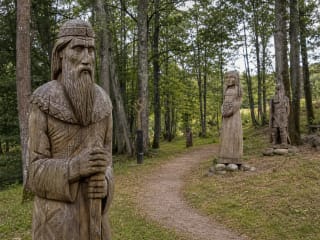
The 53 oak figures are the work of several northern Lithuanian folk artists rather than one sculptor. Thirty-eight form the sequence along the principal 1.4 km trail, with the rest incorporated elsewhere in the ensemble. Their proportions, faces, surfaces, and density of symbols consequently vary: some are clear human figures, while others hide a deity's sphere in a plant, animal, tool, or celestial sign.
Municipal material specifically notes that folk artist Aurimas Šimkus made the museum gates and sculptures of Kalvelis, Žemyna, Veliuona, and Medeina during the 2011-2012 Naisiai symposium. This is a good reason to read not only the deity's name but the maker's solution: the same mythological figure could look entirely different in another artist's hands.
Sun Square, Fire Square, and Alka Hill structure the route rather than forming a random line of sculptures
Sun Square gathers imagery of celestial bodies and powers. Its open, geometrically ordered space lets visitors compare figures and attributes from a distance. The solar signs belong to a modern composition, so they should not automatically be treated as copies of one specific archaeological find.
Fire Square connects the display with the hearth, sacred fire, and the goddess Gabija. Alka Hill introduces the idea of an elevated, set-apart ritual place. In Baltic cultural study, the word alkas denotes a sacred site, but the present hill belongs to the museum's 2012 narrative rather than to a documented ancient temple at Naisiai.
Between these anchors, the path moves through a village park, groups of trees, open lawns, and the vicinity of ponds. The changing spaces help separate themes of sky, earth, plants, animals, crafts, death, and household life. Following the route in order is worthwhile because individual photogenic figures cannot communicate the intended world structure by themselves.
Attributes explain each oak figure's sphere, but its label is safer than guessing from the face
Artists express divine functions through axes, fire, grain, bees, fish, leaves, horses, birds, and other signs. Perkūnas may be linked to lightning and weapons, Žemyna to earth and growth, Gabija to fire, and Kalvelis to smithing tools. Symbols rarely have only one meaning, however, making the small interpretation labels beside the figures essential parts of the display.
The clothing, posture, and carved detail of Veliuona, Medeina, Girstis, and other figures demonstrate folk-art imagination, not ancient portraits. Images produced by pre-Christian Lithuanians for most of these divinities have not survived or are simply not known with confidence. The Naisiai works are therefore modern interpretations, not reconstructed idols.
Oak was selected for more than durability. In Baltic and Lithuanian culture it is associated with power, longevity, sacred places, and especially Perkūnas, yet outdoor timber inevitably greys, cracks, and receives conservation treatment. A richer colour or newer-looking surface need not indicate a later sculpture; it may result from protective maintenance.
The museum's pantheon is a source synthesis because no complete ancient Baltic book of mythology survives
The concept draws upon Lithuanian, Latvian, and Prussian material, archaeology, written records from the 13th to 18th centuries, folklore, and ethnographic descriptions of custom. These sources arose at different dates, in different languages, and were often written by Christian authors, so their lists and definitions of gods do not always agree.
Perkūnas is among the best-attested Baltic deities, while some minor names occur in only one or a few late lists. Lithuanian, Latvian, and Prussian traditions are related but not interchangeable. A label can clearly state the version selected by the museum without ending scholarly discussion about a name, gender, function, or cult.
This uncertainty is not a weakness when it is acknowledged. It turns the trail into a place to compare how fragments become a contemporary narrative. A useful question for a guide is not only what a particular deity governed, but which Lithuanian, Latvian, or Prussian source records it and which details were chosen by the sculptor.
For families the route works as a symbol hunt, but the wooden figures are not play equipment
A sequence of 53 names can be too long for children, so turn the route into a search for fire, a bee, fish, grain, a horse, or a celestial body and only then read the deity's name. This connects mythological function to a visible attribute and keeps the 1.4 km walk engaging.
Do not touch cracks and labels or climb the sculptures. These are outdoor works of folk art, not a playground and not equipment for modern religious rituals. Events can occupy individual spaces, so consult the Naisiai community calendar before making a special journey.
On 13 July 2026, the exact Google listing for the Museum of Baltic Gods had 69 reviews averaging 4.8 out of 5. This is a high score based on a still relatively modest number of reviews. It clears the selection threshold, while later visitor feedback will change the figure.