- Field
- Natural textile dyeing: bark, flowers, leaves, roots, mosses, and ores in the pre-synthetic color kitchen
- Type
- textile
- Heritage status
- well attested
- Context
- Plant dyes, natural dyes, natural dyeing, wool and linen dyeing, yarn dyeing, tree bark, flowers, leaves, roots, mosses, bog and iron ore, mordants, alder bark, aniline dyes
Natural dyes, Organic dyes, Plant dyeing, Yarn dyeing with plants, Traditional textile dyeing
Plant Dyes forms and objects
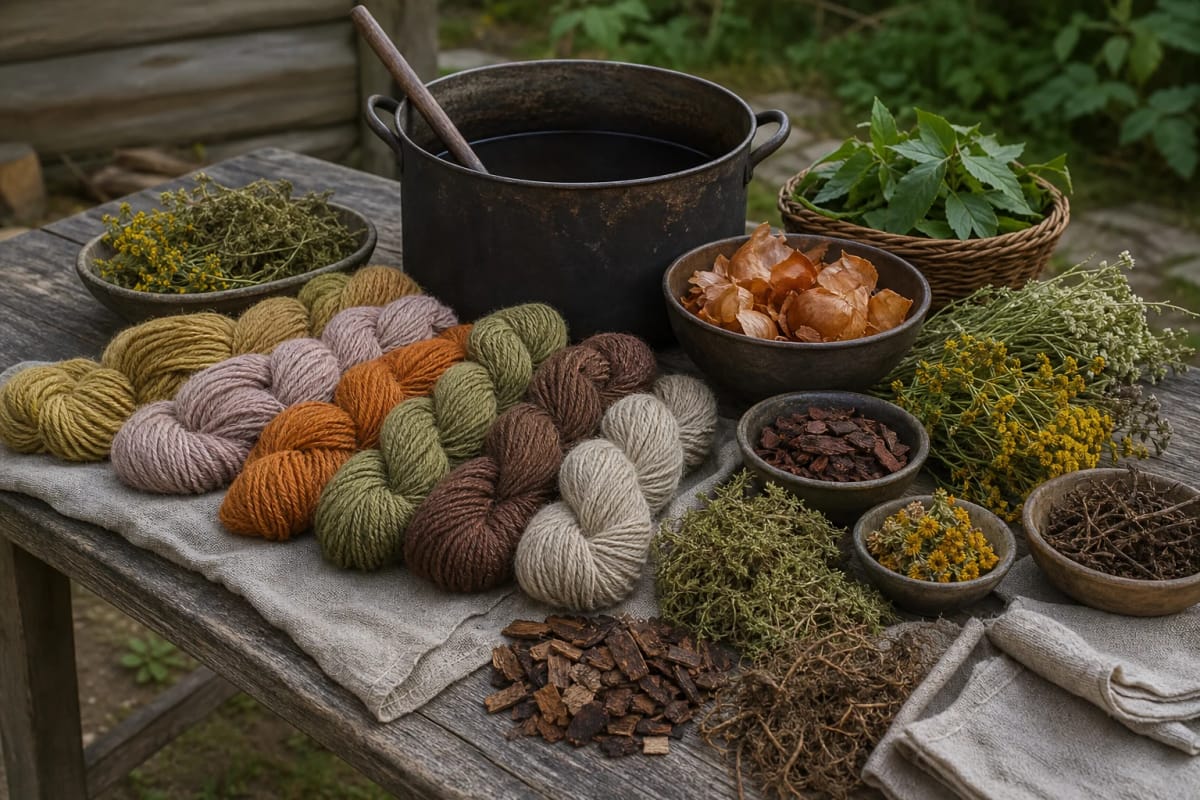
Tree and shrub barks: Bark decoctions were among the strongest and most accessible dyes. Alder, especially black alder, traditionally gave brownish tones; oak, birch, and other barks were also used. The exact shade depended on the tree, the age of bark, soaking time, and mordant.
Flowers and leaves: Flowers and leaves of herbaceous plants were an important group of dyes, most often giving yellowish, greenish, and brownish tones. VLE mentions plant flowers and leaves among the main natural dyes; the result depended strongly on the plant, collection time, and fixing.
Roots and mosses: Roots and mosses are mentioned as traditional sources of dye. They broadened the color range beyond barks and leaves, but like other natural dyes gave softer, earthier tones than later chemical dyes.
Mineral dyes and ores: Alongside plant dyes, bog and iron ore were used as mineral colorants, helping obtain darker, grayish, or brownish tones. Iron salts also acted as mordants, changing the color of a plant dye.
Mordants: Mordants such as alum, iron or copper salts, and other substances help the dye attach firmly to fiber and determine the final shade. The same dye with a different mordant can produce several colors, so mordanting is essential to plant dyeing.
What are plant dyes?
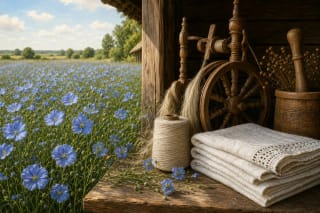
Plant dyes are natural colorants used in Lithuanian village textile to color wool, linen, and hemp yarns and fabrics. Color was obtained from plant flowers, leaves, roots, mosses, and tree bark, with bog and iron ore used alongside them. This was the pre-synthetic textile color kitchen through which households made dyes from what grew around them.
As the Universal Lithuanian Encyclopedia defines it, dyeing is the giving of color to a material, including textiles, leather, and paper. Fibers, yarns, and fabrics are dyed in aqueous solutions of dye, and the dye attaches firmly to the molecules of the fiber. In plant dyeing, that dye comes from a plant or mineral rather than a factory.
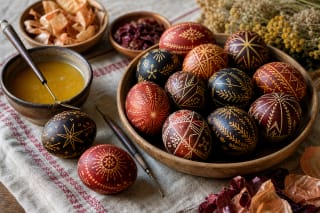
In textile dyeing, the target is thread or cloth rather than an eggshell. The same plants, such as onion skins or alder bark, could also color Easter eggs, but egg dyeing belongs to a ritual field of its own. In textile work the color later travels into the loom, knitting, or felt.
Historical depth: from the third-fourth centuries to aniline
People have used organic natural dyes for a long time. VLE gives a concrete date: dyeing in Lithuania was already practiced in the third-fourth centuries. Colored textile in this land therefore has at least a millennium and a half of history, and it began not with purchased dyes but with local plant and mineral colorants.
This plant-based color system remained primary for a very long time. A weaving survey based on VLE says that until the nineteenth century fabrics were dyed with natural dyes: plant flowers, leaves, roots, mosses, tree bark, bog ore, and iron ore. This concise list names the whole traditional dye family that supported Lithuanian textile before chemical dyes.
The turning point came in the nineteenth century. VLE states that synthetic organic dyes began to be used in Lithuania in the nineteenth century and produced there at the end of the century. The weaving survey adds that aniline dyes made colors more intense. Plant dyes were not suddenly forgotten; they gradually gave way to brighter, more controllable chemical colors.
Dye sources: bark, flowers, leaves, roots, mosses
Traditional dye sources are best seen as categories, not as a fixed recipe table. The first category is tree and shrub bark, which was accessible, dyed strongly, and gave brownish, earthy tones. The second is flowers and leaves, often yielding yellowish and greenish shades. The third is roots and mosses, broadening the color range. The fourth is mineral dyes: bog and iron ore.
The best-attested concrete example comes from a related craft. In its description of fur and leather work, VLE notes that sheepskins were most often dyed brownish with alder bark. Alder, especially black alder, as a source of brown color is a well-attested fact and is valuable when discussing textile too, because the same plant dye belongs to a shared folk color kitchen.
Other plants often mentioned in ethnography, such as onion skins, oak and birch bark, and birch leaves, are best called traditionally used dye categories rather than fixed recipes. One plant's color is not stable. The same flower or bark collected at a different time, in different water, and with a different mordant gives another result; strict charts saying 'this plant gives this color' do not really fit natural dyeing.
Mordants: why the same plant gives several colors
For a plant dye to hold firmly and take the desired shade, fiber must be prepared with mordants. These substances, such as alum, iron or copper salts, and others, join the dye to the fiber and change the final color. Without a suitable mordant, dye is often pale or fades quickly.
The VLE article on dyeing mentions mordants as an important part of dyeing: speaking about leather and fur, it notes that furs are treated with mordant solutions before dyeing and that mordant dyes are used. The same chemical logic applies to textile: the mordant is not an extra but part of the color.
The practical consequence is essential for understanding folk colors: the same dye with different mordants can produce several colors. Iron salts usually darken and mute tones, while other mordants may lighten them or shift them toward yellows and reddish shades. The color seen in old yarn is therefore the result not only of a plant, but of plant, mordant, water, and fiber.
The dyeing process step by step
Traditional plant dyeing begins with gathering the raw material: bark, flowers, leaves, roots, or mosses are collected at the proper time and prepared for a decoction. The dye is usually extracted by soaking and boiling the material in water until a colored solution is obtained.
Before dyeing, the fiber is often prepared: wool or yarn is washed and, when needed, treated with a mordant. VLE notes a general rule that also applies to natural dyeing: dyeing is accelerated by raising temperature and acidifying the solution, while light and bright colors may require bleaching before dyeing. Traditional dyeing is therefore a slow, attentive process, not a single dip.
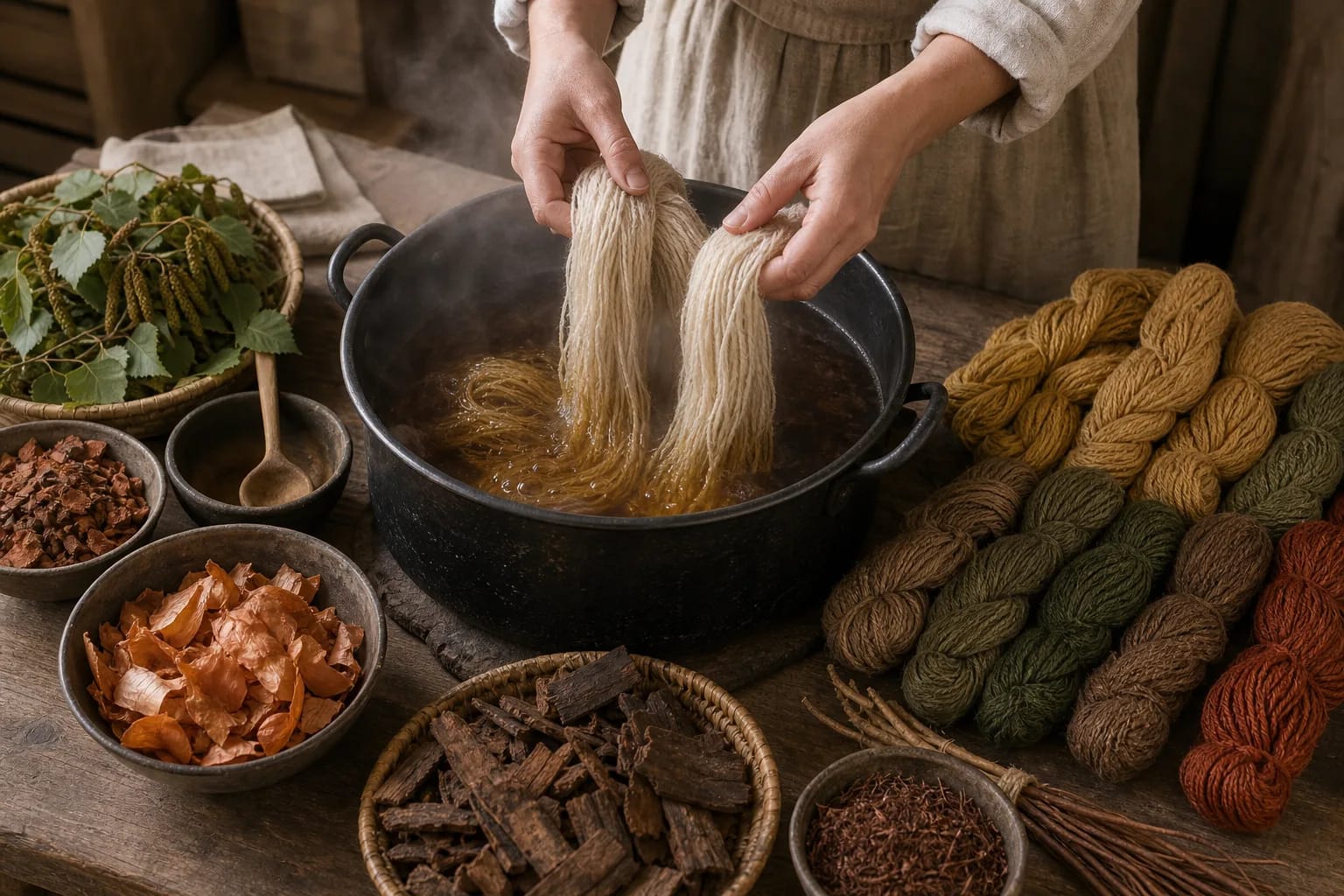
The yarn is then placed in the dye bath and held for the necessary time, sometimes repeatedly, until the desired depth is reached. Finally the dyed fiber or fabric is washed to remove unattached dye and dried. Every stage, including temperature, soaking time, mordant, and water quality, leaves a trace in the final color.
The color world: what can be said responsibly
It is best to speak carefully about the palette of plant dyes. Firmly attested facts are these: dyes were obtained from flowers, leaves, roots, mosses, tree bark, and bog or iron ore; alder bark gave brownish tones; and aniline dyes from the nineteenth century made colors more intense. From this it follows that before aniline, softer, earthier, calmer tones predominated.
Weaving studies based on VLE distinguish white household textiles, such as towels, tablecloths, and sheets, usually plain and made from bleached and unbleached yarns, and colorful textiles, such as gūnios, early bedcovers, and clothing fabrics. In the latter, warm colors were combined with cool ones: red with green, yellow with violet, black with white, orange with blue. This shows that color in textile had compositional as well as practical logic.
Still, overly precise claims about which plant gives which color should be avoided. Many specific recipes today are partly reconstructed from ethnographic descriptions, museum examples, and experiments in natural dyeing. It is honest to say: the categories are well known, but exact old proportions often have to be guessed or rebuilt.
Plant dyes and other crafts
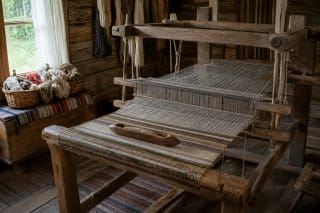
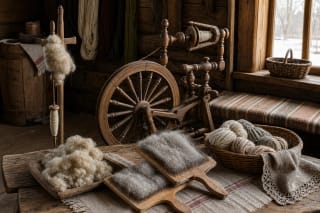
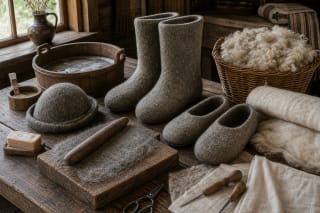
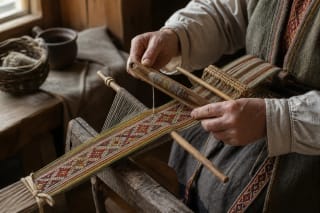
Plant dyeing was not an isolated craft; it stood between spinning and weaving. Fiber was first carded and spun, then yarns were dyed, and colored thread went into the loom, knitting, sash, or felt. Dyeing is therefore directly connected with weaving, spinning, Lithuanian sashes, and felting.
The same set of colorants connects textile with other fields. The brownish color of alder bark is also known in fur and leather work, where sheepskins were dyed with it; onion skins and alder or oak bark were also used for Easter eggs. Easter eggs are a close but separate field: there the eggshell, not the fiber, is dyed, and color serves a festive, ritual meaning.
Because of this kinship, plant dyes are best understood as a connecting folk color kitchen. It supplied color not only to one object but to household textile and even leather and eggs, using the same colorants found and grown nearby.
How to recognize and value plant dyeing today
Plant dyeing today returns through craft centers, museum education, folk artists, and natural dyeing enthusiasts. The Lithuanian Ethnography Museum and the Lithuanian National Culture Centre foster knowledge of traditional crafts, including natural dyeing, so the most reliable information should be sought from such institutions and attested ethnographic sources.
When evaluating an object, it is worth asking whether the color is truly plant-based or only resembles a plant-dye aesthetic. Real natural color is often somewhat uneven, soft, and variable in tone, while a bright, uniform, very saturated shade more often indicates chemical dyes. That does not make chemical dyes bad; it only means they should be named accurately.
A responsible presentation distinguishes attested facts, such as dyeing in the third-fourth centuries, alder bark producing brownish color, and aniline spreading from the nineteenth century, from modern reconstruction or interpretation. Tradition remains strong when plant dyeing is respected both as old knowledge and as a living practice restored anew.