- Field
- The foundation of Lithuanian folk textile: linen, wool, hemp, looms, and patterns
- Type
- textile
- Heritage status
- well attested
- Context
- Lithuanian weaving, hand looms, flax, wool, hemp, warp, weft, shuttle, heddle, reed, linen cloth, dimas, pick-up patterns, supplementary-weft patterns, household textile
Lithuanian folk weaving, Hand weaving, Loom weaving, Household textiles, Folk textile
Weaving forms and objects
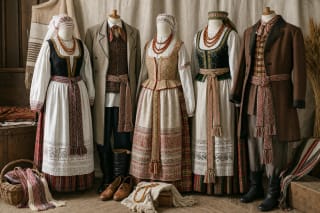
Linen cloth and clothing fabrics: Linen, hemp, woolen, or mixed fabrics for shirts, skirts, bodices, aprons, homespun coats, and other parts of dress.
Household textiles: Towels, tablecloths, sheets, pillowcases, bedcovers, divonai, gūnios, covers, and other everyday or festive household fabrics.
Patterned fabrics: Dimas, pick-up, supplementary-weft, damask-like, rep, and other structures in which ornament is created by the weave itself.
Sashes and narrow fabrics: Woven, pick-up, tablet-woven, or braided sashes that join weaving technology, dress, gift giving, and ritual function.
What is weaving?
Weaving is the making of textile by crossing two systems of threads: lengthwise warp threads and crosswise weft threads. In Lithuanian village culture it was the main way to make clothing, bedding, table, bed, ritual, and farm fabrics.
Weaving is not merely mechanical work. A weaver must prepare threads, calculate warp density, dress the loom, thread the heddles, choose the reed, control the rhythm of the pattern, and keep the fabric under proper tension. Every mistake is visible on the cloth surface.
In Lithuanian folk textile, weaving is the main branch from which many separate fields grow: towels, tablecloths, bedcovers, aprons, skirts, bodices, gūnios, carpets, sashes, and parts of national costume.
Historical depth
VLE surveys of Lithuanian folk textile point to a very old textile tradition: traces of textile are found already in the Neolithic period, and later archaeological finds attest linen, woolen, hemp fabrics, and more complex weaving technologies.
Early textile does not survive as well as stone or metal, so it is often known from impressions in pottery, spindle whorls, textile fragments, textile remains pressed under metal ornaments, and burial contexts.
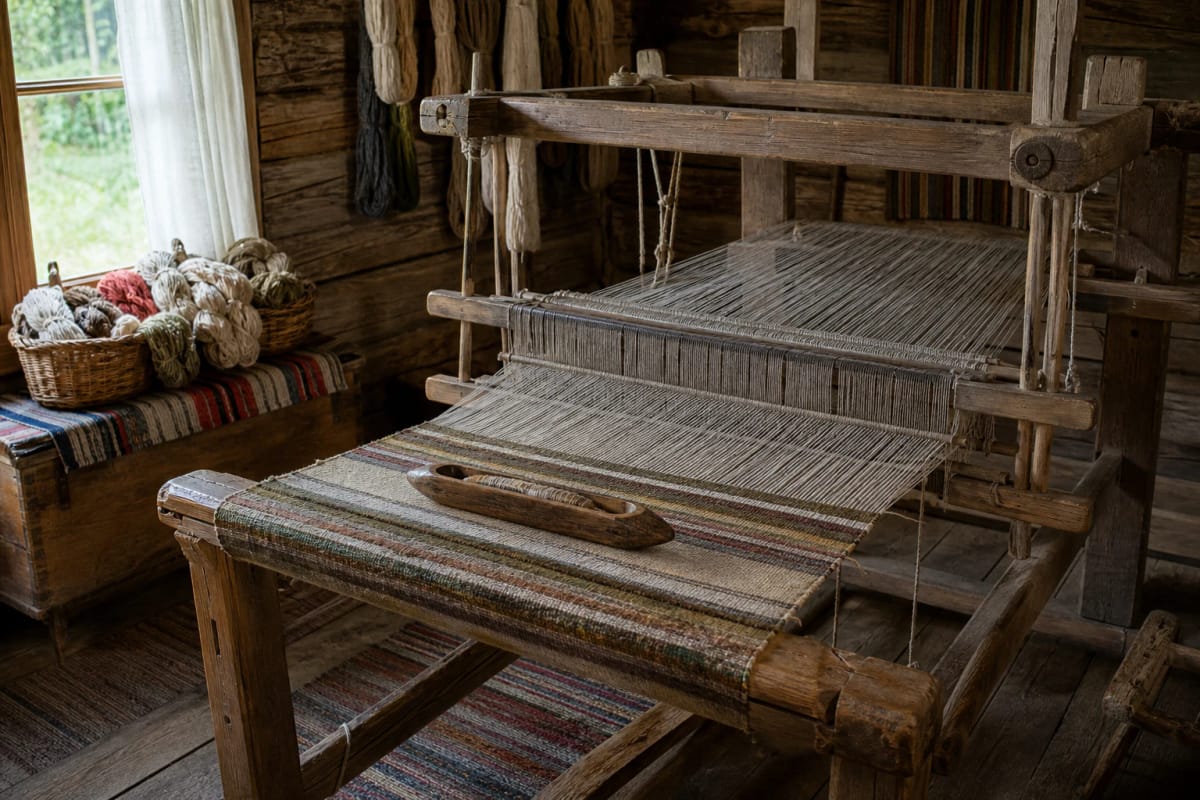
Vertical looms in Europe and the Baltic region are linked with earlier forms of weaving, while horizontal looms over time became a convenient tool for village home work. In Lithuanian traditional textile, the horizontal wooden loom became the recognizable image of weaving.
Materials: flax, wool, hemp
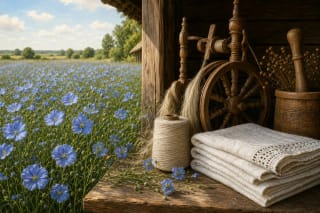
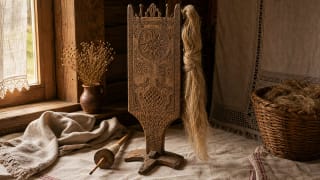
Flax was the most important material for shirts, towels, tablecloths, linen cloth, sheets, and many white household textiles. It required long preparation: growing, pulling, retting, breaking, combing, spinning, and bleaching.
Wool was used for warm fabrics, skirts, shawls, bedcovers, gūnios, homespun coats, and other thicker textiles. Wool quality depended on the sheep, fiber preparation, spinning, and dyeing.
Hemp was important for strong work fabrics, ropes, sacks, and mixed cloth. Later cotton, silk, industrial yarns, and artificial fibers appeared, but the core of traditional textile remained flax and wool.
Until the nineteenth century, fabrics were dyed with natural dyes from flowers, leaves, roots, mosses, tree bark, bog ore, and iron ore; from the nineteenth century, aniline dyes made colors more intense. VLE distinguishes white household textiles (towels, tablecloths, covers, sheets, and later bedcovers), usually plain, from bleached and unbleached linen or linen-cotton yarns, and colorful textiles such as gūnios, early bedcovers, and clothing fabrics, where warm colors were combined with cool ones: red with green, yellow with violet, black with white, orange with blue.
Looms and basic tools
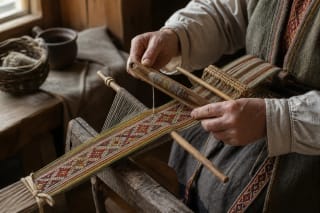
A hand loom is a complex but logical device. The warp is stretched through the loom, heddles lift groups of warp threads, the reed beats the weft, the shuttle carries the weft thread, and treadles control the pattern sequence.
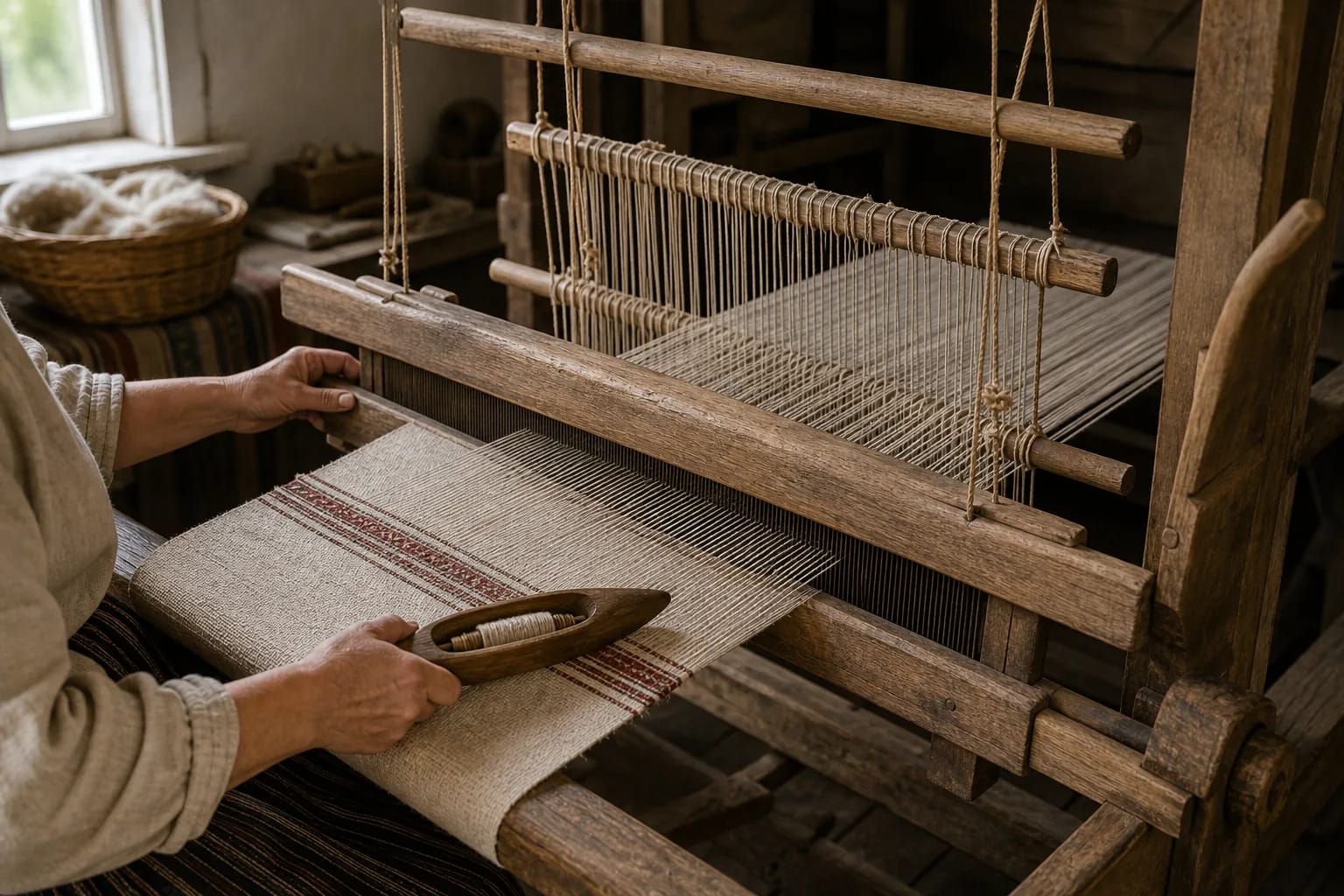
Other important terms include winding, warping, threading, beating, plain weave, twill, dimas, damask-like patterning, pick-up patterns, and supplementary-weft work. These are not decorative words; they precisely describe how fabric is born.
Before weaving, much invisible work has to be done: measuring threads, preparing the warp, evening the tension, and checking the edges. Good fabric often looks simple only to someone who has not seen its preparation.
Fabric structures and patterns
The simplest weaving is plain weave, where the weft passes over one warp thread and under the next. From this clear system come linen cloth, sheets, shirts, towels, and many everyday fabrics.
More complex textiles are made by changing weave structure, colors, and the lifting of warp threads. Dimas fabrics create geometric light-and-shadow patterns, pick-up patterns allow the ornament to be selected by hand, and supplementary-weft fabrics introduce extra colored threads only where the pattern requires them.
Patterns are not only surface decoration. In woven cloth, ornament is often construction: a diamond, square, star, fir-tree form, little rose, or banded rhythm appears from the way threads cross.
What was woven?
Weaving supplied the whole household. Linen was woven for shirts, sheets, towels, tablecloths, pillowcases, aprons, and women's head coverings. Woolen fabrics became skirts, shawls, bedcovers, gūnios, and warm clothing.
Some fabrics were everyday, rougher, and made for work. Others were whiter, patterned, brighter, and kept in the chest for a feast, guest, wedding, dowry, or special occasion. The same craft created both utility and representation.
The value of cloth was therefore measured not only in money. A textile showed industriousness, the richness of a dowry, household order, regional taste, and the ability of a woman or family to prepare for important life events.
Regions and color logic
Regional differences are most visible in particular textiles: white Aukštaitian towels and patterned covers, richer Samogitian woolen shawls and bedcovers, Dzūkian fine stripes and darker combinations, and ornate supplementary-weft aprons in Suvalkija.
Lithuania Minor has its own textile field: a Lutheran environment, Klaipėda region connections, delmonai, darker fabrics, and specific costume combinations distinguish it from other Lithuanian regions.
Even so, a region is not simply a color chart. The look of a fabric is shaped by period, village fashion, family means, availability of materials, the influence of town goods, and the hand of a particular weaver.
Weaving and women's work
In many Lithuanian village homes, weaving was a field of women's work and knowledge. Girls learned from mothers, grandmothers, and neighbors, while dowry preparation encouraged skill in spinning, weaving, bleaching, sewing, and decoration.
Yet weaving was not only closed domestic work. Professional or semi-professional weavers, small-town masters, monastery and manor environments, and later schools also contributed to changes in textile technology and taste.
Today weaving often returns through national costume reconstruction, craft centers, museum education, folk artists, and textile artists. The crucial task remains not only to show the loom but to transmit the technical thinking. Classic studies include Paulius Galaunė's Lithuanian Folk Art (1930) and the multi-volume Lithuanian Folk Art: Textiles (1957-1962).
How to recognize a good traditional fabric
A good traditional fabric has a clear purpose, neat edges, even tension, accurate repetition of pattern, and appropriate material. Hand work does not necessarily mean irregularity; often it means very precise control.
When assessing a reconstruction, it is worth asking which region, period, museum example, or family tradition it follows. A generic 'Lithuanian pattern' is not enough if historical accuracy is the aim.
A good contemporary interpretation can also be valuable if it is honestly called an interpretation. Tradition remains strong when we distinguish a museum copy, national costume reconstruction, folk art, and original textile art.