- Field
- Lithuanian wool felting, felt boots, slippers, and felt textile craft
- Type
- textiles
- Heritage status
- living tradition
- Context
- Wool, felt boots, felt, wet felting, winter footwear, sheep wool, water, soap, friction, warmth
Wool felting, Felt boots, Felt craft, Felted slippers, Felt
Felting forms and objects
Veltiniai: Thick felt boots for winter, snow, cold, and outdoor work; one of the most important traditional felted objects.
Felted Slippers: Popular house footwear in contemporary craft and heritage education, based on the same wool-densifying logic.
Felt Headwear: Caps, hats, and other felted head coverings where shape, density, and resilience matter.
Felt Textiles and Art Objects: A living contemporary tradition using felting for scarves, bags, toys, jewelry, and textile art.
What Is Felting?
Felting is the compaction of wool fiber into a single felted material. Under warm water, soap, pressure, and friction, wool hairs interlock and form a dense, warm, durable layer.
Unlike weaving, felting has no warp and weft. Felt grows from loose fiber that becomes material, which allows it to be seamless, thick, warm, and shaped around a form.
In Lithuanian tradition felting is most strongly associated with veltiniai, winter felt boots. Today it also includes slippers, hats, scarves, bags, jewelry, toys, and textile art.
Wool as Material
Sheep wool felts well because its fibers have microscopic scales. Heat, moisture, and friction help those scales catch, so the wool tightens and shrinks.
Wool quality determines the result. Wool that is too coarse can become stiff, too short a fiber may not hold well, and greasy or poorly cleaned wool is harder to felt. Preparation is half the work.
Traditional felt depends not only on color but density. Good felt is strong, warm, not layered apart, and still somewhat elastic.
Veltiniai: Winter Boots
Veltiniai are thick felt boots for winter. They protect well in dry snow and cold. On traditional farms they were useful for outdoor work, travel, tending animals, and daily winter life.
They could be worn with additional footwear, sewn with leather, or fitted with thicker soles for durability. Without protection, felt wears faster in wet conditions, mud, and on hard ground.
Veltiniai are therefore not merely soft boots. They are technical winter objects where density, shape, foot size, shaft height, and sole protection all matter.
How Felting Is Done
In wet felting, wool is layered, moistened with warm water, soaped, pressed, rubbed, rolled, kneaded, and gradually compacted. Shape is corrected during the process.
Felt boots require more control than a flat mat or decoration. The boot has to fit a foot, so shrinkage must be planned in advance.
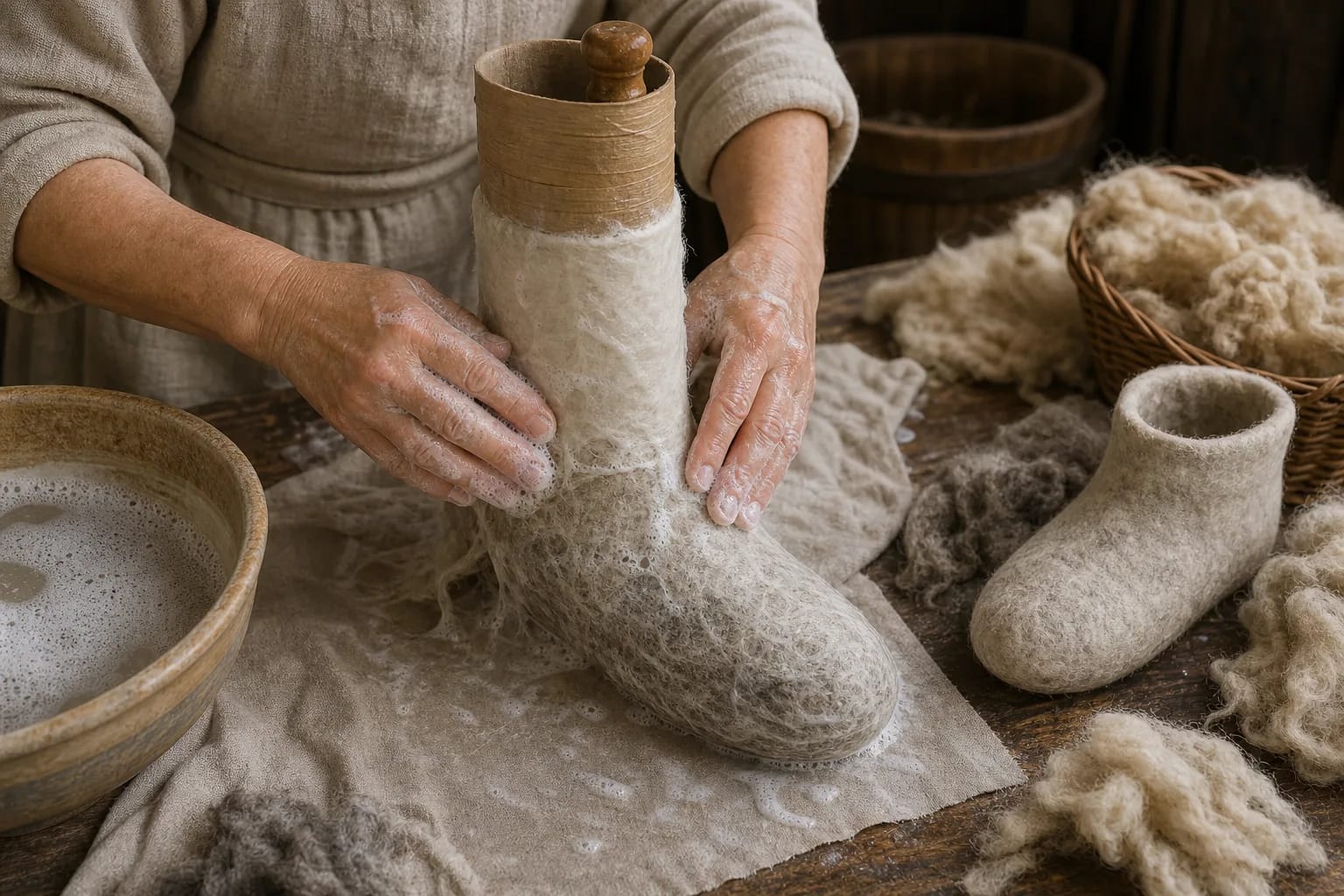
A good felt maker thinks in volume as well as surface. Felt must shrink enough to become strong, but not so much that it becomes too small or too hard.
Vėlykla and the Craft Setting
Some felt was made at home, while larger work could happen in special workshops or vėlyklos. Felting requires water, warmth, space, physical strength, and time. Woolen cloth, especially milas, was from old times until the mid-20th century fulled at fulling houses set at or beside mills, and smaller rolls of cloth were sometimes worked at home.
In the 19th and 20th centuries, veltiniai were made in peasant households, by traveling masters, and in small workshops. Industrial footwear later took over part of the market.
Today felting returns through craft centers, education, folk artists, and textile artists. It is no longer only necessary footwear but a creative heritage craft.
Felted Slippers, Hats, and Scarves
Felted slippers, hats, scarves, bags, and jewelry are very common in contemporary practice. They use the same wool-felting logic, but their function is often comfort, design, or textile art.
Such work is best described as living tradition or contemporary interpretation when it does not have a direct historical peasant example. That is not a flaw; it simply names the layer honestly.
The strength of felting is its ability to use traditional material for new forms. Historical felt and modern decorative felt should not be collapsed into one category.
Dry and Needle Felting
Dry or needle felting, in which fiber is compacted with special barbed needles, is now popular for small objects, toys, figures, and decoration. It is a living textile technique but differs from traditional wet felting of boots.
When discussing traditional footwear, wet felting, density, and function are central. When discussing contemporary folk art, needle felting can be its own creative field.
This distinction avoids presenting modern felted toys as an old peasant tradition.
Regions and Use
Veltiniai were needed wherever winters were cold and people spent long hours outdoors. They belong broadly to Lithuania, while specific workshops, masters, and craft-center practices can be regional.
Craft centers in Utena, Kretinga, Aukštaitija, and other areas often teach felting as heritage craft. Museums show veltiniai together with winter footwear, wool processing, and rural clothing.
Industrial boots, rubber footwear, and city life changed the need for veltiniai. Their traditional value is best understood in the context of winter outdoor work.
How to Care for Felt
Felt likes dry cold but not long moisture. Veltiniai should dry naturally, not on a very hot radiator, so the wool does not harden or deform.
Mud should be allowed to dry and brushed away rather than rubbed wet. If felt becomes very wet, it should be shaped and dried so it does not shrink unevenly.
Woolen objects should be protected from moths and stored dry, clean, and ventilated. Well cared-for felt can last a long time.