- Field
- Lithuanian leather crafts: dressing hides with wool and tanning leather for objects
- Type
- traditional craft
- Heritage status
- well attested
- Context
- Fur work, leather work, hide dressing, leather tanning, sheepskins, fur coats, leather, saddles, harness, footwear, scraper, tub, alder bark, guilds, brotherhood
Hide dressing, Leather working, Fur workers and tanners, Furrier craft, Leathercraft
Fur and Leather Work forms and objects
Dressed hides and fur coats: Sheepskins, more rarely goat or wild-animal skins, left natural white or dyed; plain and cloth-covered fur coats were sewn from them.
Dressed leather for footwear and clothing: Tanned leather for shoes, naginės, caps, gloves, and belts: everyday objects requiring strong, flexible leather.
Harness, saddles, and riding equipment: Saddles, mentioned in thirteenth-century sources as setel, harness, and other leather equipment made by saddlers and specialized leather workers.
Small leather goods and saffian: Finer leather goods and tymas, or saffian, worked by masters of smaller or white leathers, distinct from workers of thick black leather.
What are fur work and leather work?
Fur work and leather work are related but distinct Lithuanian hide crafts. Fur work dresses the hides of domestic and wild animals while leaving the wool or hair on; such skins become fur coats and warm clothing. Leather work removes the hair and tans the hide into a durable material for footwear, belts, harness, and saddles.
The key difference is simple but important: the fur worker preserves the wool, while the leather worker removes it. The product and technology therefore differ. A fur-work object must be soft, warm, and retain a healthy wool layer; a leather object must be resistant, flexible or firm, depending on whether it will become a shoe, belt, or saddle part.
In Lithuania both crafts were old and widespread. They supplied village and town with winter fur coats, shoes, naginės, belts, harness, and saddles. They are presented together because the raw material is the same animal hide, while the processes and results are different.
Historical depth: from the Paleolithic to guilds
Dressing hides in Lithuania reaches the deepest prehistoric layer. VLE states that hides were already dressed in the Paleolithic, using stone scrapers, and that women probably dressed hides and sewed clothing from them. It is one of humanity's oldest crafts, because warm clothing in a cold climate depended on processed hides.
Leather work is also very old. Archaeological research shows that people in Lithuania used dressed leather in the first centuries CE. Written sources mention some leather objects, especially saddles called setel in the late thirteenth-century Livonian Rhymed Chronicle, showing that Lithuanian leather objects were notable to neighbors.
In the medieval and early modern periods these crafts entered organized urban life. Fur workers are known in castles and towns from the eleventh century; around 1458 a furriers' brotherhood formed in Vilnius, and in 1579 the Vilnius fur workers' guild was established. Leather workers had organized into a Vilnius guild as early as the late fifteenth century, with a statute confirmed in 1536-1538; leather workers' guilds appeared in 1542 and saddlers' guilds in 1562.
Raw material: furs and hides
The main raw material for Lithuanian fur work was sheepskin, more rarely goat or wild-animal skins. Sheepskin was accessible and useful: larger farms kept sheep for wool and meat, so hides were available, and the wool layer naturally suited warm coats. Wild-animal furs were more expensive and tied to hunting, whose importance grew after the Valakų reform of 1557.
Leather work used flayed hides, often from larger animals, from which the hair and subcutaneous layer had to be removed. Hide quality and thickness determined purpose: thick leather suited soles, harness, and work footwear, while thinner softer leather suited festive shoes, gloves, or small goods.
Preparation began before the master's work. In fur work, hides were stretched and dried so they would not spoil while enough accumulated. This meant the craft often worked seasonally and in batches, not on a single hide at a time.
Tools and vessels
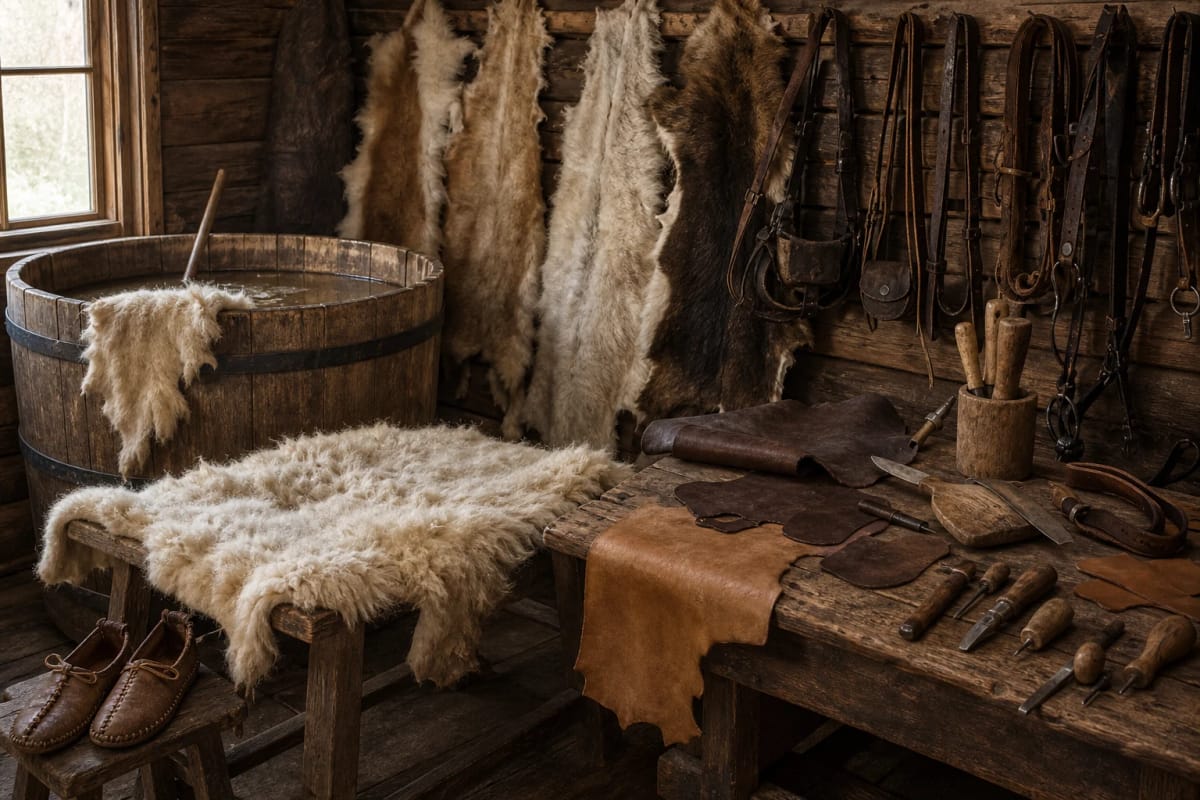
The fur worker's main tool was the kaišena, or scraper: an iron plate with a wooden handle used to scrape hides. It removed the subcutaneous layer from softened hides until the skin became thin and flexible while the wool stayed firmly rooted. Wooden combs for combing wool and brushes for dyeing were also used.
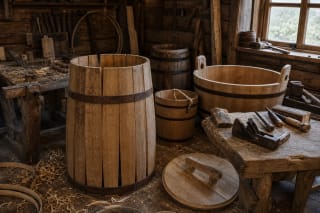
A key vessel was the tub, a large staved barrel in which hides were soaked and fermented. This directly links fur work with cooperage: without a strong watertight tub there was nowhere to ferment hides. Bark was placed in the tub, boiling water poured over it, and hides pressed with wooden blocks.
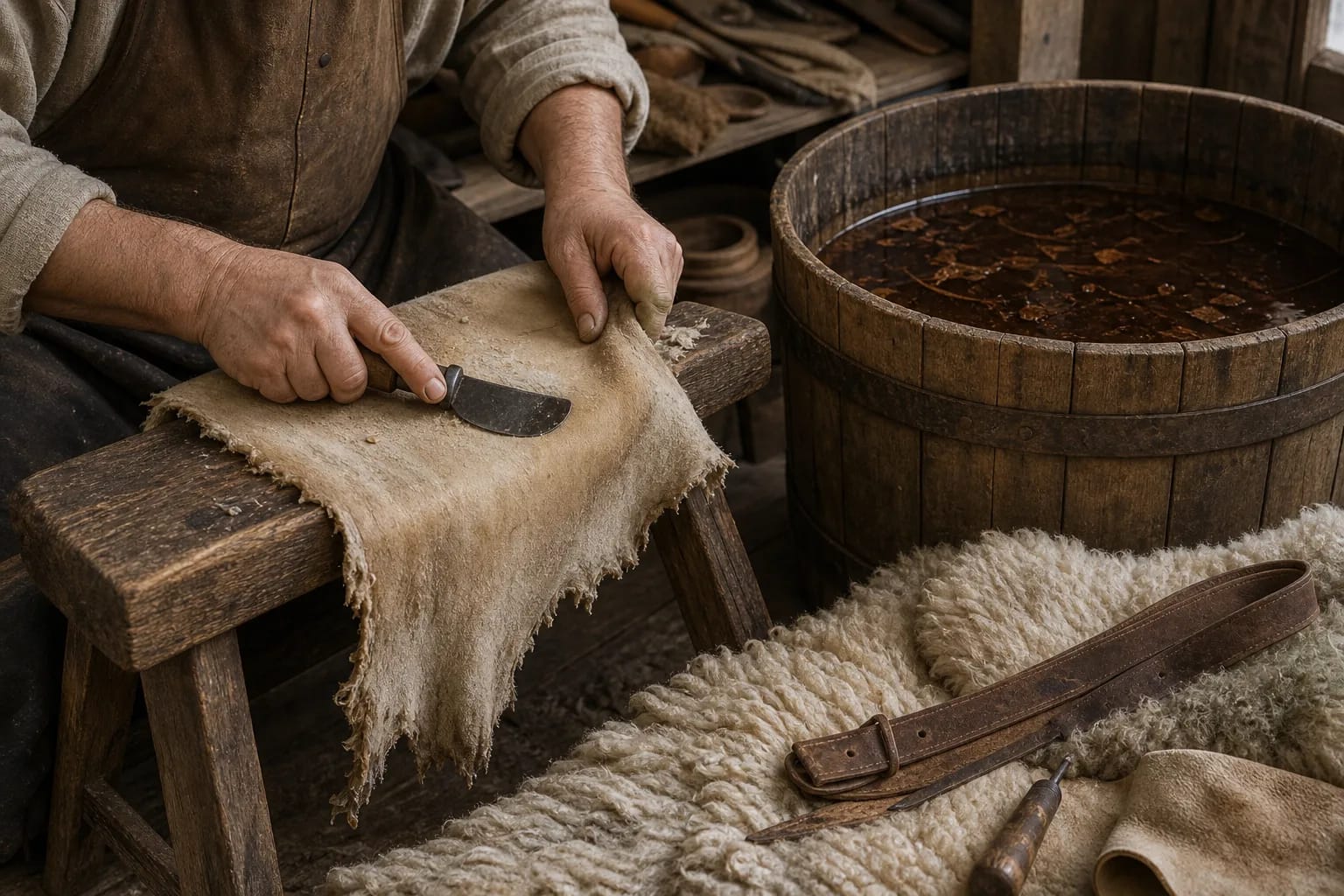
Leather workers used their own tools: knives and rubbing implements to remove hair and tissue, and devices for softening and smoothing leather. A 1937 archival photograph from Liaudiškiai village (Radviliškis district) shows a man processing leather with a homemade wooden device, reminding us that many rural leather workers used simple tools they made themselves.
The fur-working process step by step
After gathering enough stretched and dried hides, the fur worker soaked or fermented them in a large tub. Spruce or oak bark was placed between the hides, boiling water was added, and wooden blocks pressed the hides down. Sometimes oat-flour ferment was used instead of bark. Fermentation took place in a barn-drying house or storeroom: with bark for about a month, sometimes less, and with flour ferment for a week or longer.
Fermented hides were rinsed and dried, in summer on poles or grass, in winter in a bathhouse. Before scraping, they were kept in salty water for three to four hours so they would not harden and dry out. The hide was then softened, a step called vokavimas, and scraped with a sharp knife or kaišena while stretched until the skin became thin and soft.
Finally, sheepskins were left natural white or dyed, often by adding dye directly to the ferment. The most common color was brownish, obtained from alder bark; in the 1930s hides were most often dyed black and red. Plain and cloth-covered fur coats were sewn from the dressed hides. In the mid-twentieth century one fur worker, alongside other tasks, could dress 150-200 hides per year.
Leather work and types of leather
Leather work has the opposite goal from fur work: hair is removed and the skin is transformed into durable leather. In general, the hide had to be soaked, cleaned of hair and tissue, and tanned, traditionally with plant tannins such as those in tree bark, especially oak. Tanning turns raw perishable hide into a material more resistant to rot and water. The fine details of any specific tanning recipe are best treated cautiously, as they depended on the master, the locality, and the type of leather.
Lithuanian leather workers were not a single group; they were divided by type of leather and work. Fifteenth-century documents use terms such as garbarze, syromiatniki, and safjaniki, the makers of tymas or saffian. Leather workers were also divided into makers of large or black leathers and small or white leathers: the former made thick leather for soles and harness, the latter finer leather for smaller objects.
VLE notes that in Lithuania leather work was practiced especially by Russian and Tatar communities. This belongs to the broader picture of crafts in the Grand Duchy of Lithuania, where different communities specialized in certain fields. Leather dyeing also connects with the wider dyeing tradition: natural organic dyes were used from at least the third-fourth centuries, while synthetic dyes appeared only in the nineteenth century.
Products: fur coats, footwear, saddles
The main product of fur work was the fur coat, essential winter clothing in Lithuania's cold climate. It could be plain, with the hide surface visible, or covered with woolen cloth and therefore more decorative. Sheepskin was practical and among the warmest accessible solutions, preserving wool as one continuous warm layer.
Leather work supplied a much wider range of objects for village and town. Shoes, naginės, belts, caps, gloves, and many small everyday objects were made from dressed leather. Larger leather products, saddles and harness, were essential to horse farming and transport; saddlers in Vilnius had their own guild in 1562.
Some leather goods were more luxurious. Tymas or saffian, a thin dyed decorative leather, shows that leather work also served wealthier buyers, not only everyday needs. Still, for most people the essential items were strong leather for shoes and belts, and sheepskin for fur coats.
Masters, guilds, and links with other crafts
Fur workers usually lived in small towns, less often villages, and carried out orders at home. Some were itinerant, going through villages and dressing hides in rented premises, bringing the craft to people without the skills or equipment. Payment in money or grain shows a real livelihood craft embedded in the rural exchange economy.
In towns, both crafts were shaped by guild order. The Vilnius furriers' brotherhood, fur workers' guild, leather workers' guild, leather workers' and saddlers' guilds all show clear professional structures, and leather workers' guilds later formed in all the major cities of Lithuania. Guilds protected masters' interests, supervised quality, and controlled training. Such guild organizations existed already in ancient Greece and Rome and later spread through Southern, Central, and Eastern Europe; Lithuanian leather crafts fit within this wider European development while retaining local features.
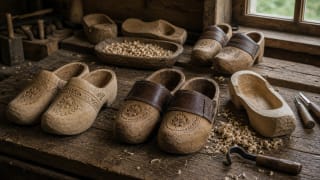
Leather crafts never worked alone. The fur worker needed a cooper's tub for fermenting hides, while shoemakers and saddlers needed blacksmith-made rivets, buckles, and fittings. Footwear often joined several crafts: a clog-maker shaped the wooden sole and a leather master added the leather upper.
Cultural place and how to evaluate today
In culture, leather and fur objects had practical and symbolic value. A fur coat was an expensive garment, repaired, passed on, and preserved; good harness or a saddle showed the farm's prosperity. Sheepskin was unique because it gave both wool and leather, showing the thrift of traditional material use.
From the late nineteenth century, industrial leather production began to displace hand leather work, and from the second half of the twentieth century the fur industry displaced fur work. Individual leather workers nevertheless survived into the second half of the twentieth century; today both crafts live through museum education, national heritage products, and individual masters.
When assessing a handmade fur or leather object, it is worth asking whether old technological logic is visible. Traditionally dressed sheepskin is soft, with healthy wool firmly rooted; brown dye was historically associated with alder bark, though undyed white sheepskin is also authentic.
In leather goods, distinguish plant-tanned leather from modern industrial leather. Vegetable-tanned leather is usually firm, with a distinctive smell and patina. When the exact historical tanning recipe is unknown, it is more honest to say it is partly reconstructed than to present a guess as fact.
Respect for the craft also means accurate terms. Fur work and leather work are not the same: the first preserves wool for fur clothing, while the second removes hair and tans leather for footwear, belts, harness, and saddles.