- Field
- Preparing wool and flax fiber for thread in Lithuanian household textile work
- Type
- textiles
- Heritage status
- well attested
- Context
- Wool, flax, carders, carded batt, distaff, spindle, spinning wheel, thread, yarn, winter gatherings
Spinning, Wool carding, Twisting thread, Yarn making, Carding and spinning
Spinning and Wool Carding forms and objects
Carded Wool and Karšinys: A layer of wool opened and arranged with carders; from this karšinys, a sliver or roving is formed for further spinning.
Yarns: Carded and Worsted: Spun threads include bulkier carded woolen yarns from uncombed fiber and finer worsted or linen yarns from straightened, combed fiber.
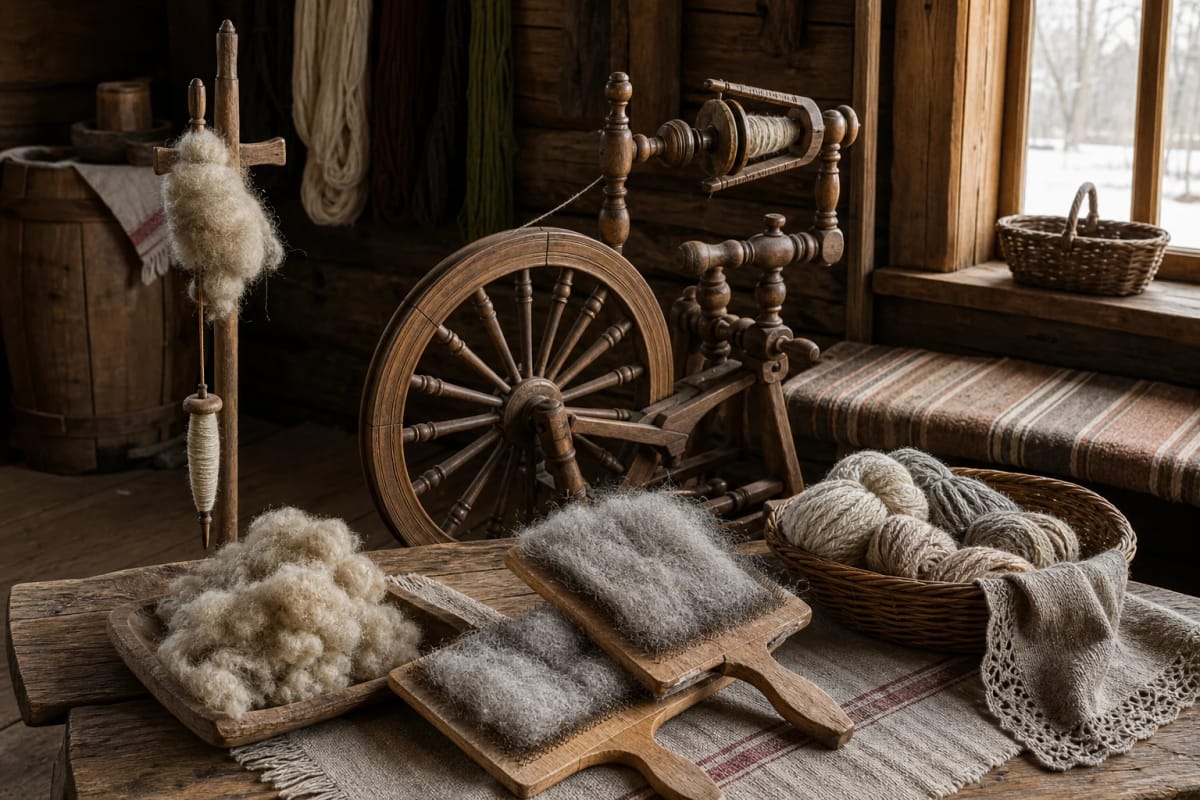
Spinning Tools: The distaff and spindle for hand spinning, the foot-treadled spinning wheel, and carders for preparing wool all belong to the textile work chain.
Thread for Later Work: Spun wool and linen threads used for weaving, knitting, embroidery, cordage, and other household textile work.
What Are Spinning and Wool Carding?
Spinning twists thread from separate fibers: as the spinner draws fiber from a bundle and twists it, a loose mass becomes strong continuous thread. Carding is the earlier preparation, especially for wool, in which fiber is opened, straightened, and arranged so it can be spun evenly.
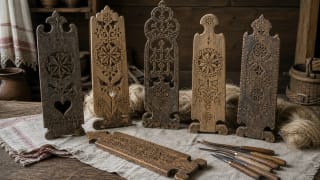
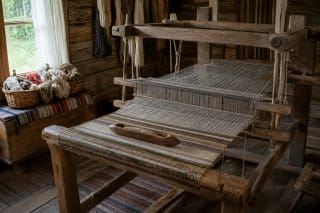
The focus here is the process and work culture rather than the tools as isolated objects. Distaffs and prieverpstės are described separately as carved and ornamented objects; in spinning they appear in use, as thread is born in the spinner’s hands. Spinning also differs from weaving: spinning makes thread, while weaving turns thread into cloth.
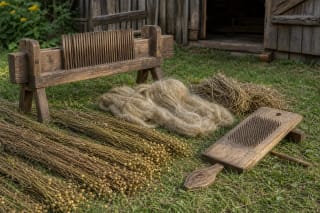
Only well-prepared raw material could be spun. Flax first had to be retted, broken, scutched, and combed, while wool had to be shorn, washed, and opened. Without earlier fiber preparation there is nothing to spin, and without spinning there is no thread for weaving, knitting, or embroidery.
Carding: How Fiber Becomes a Batt
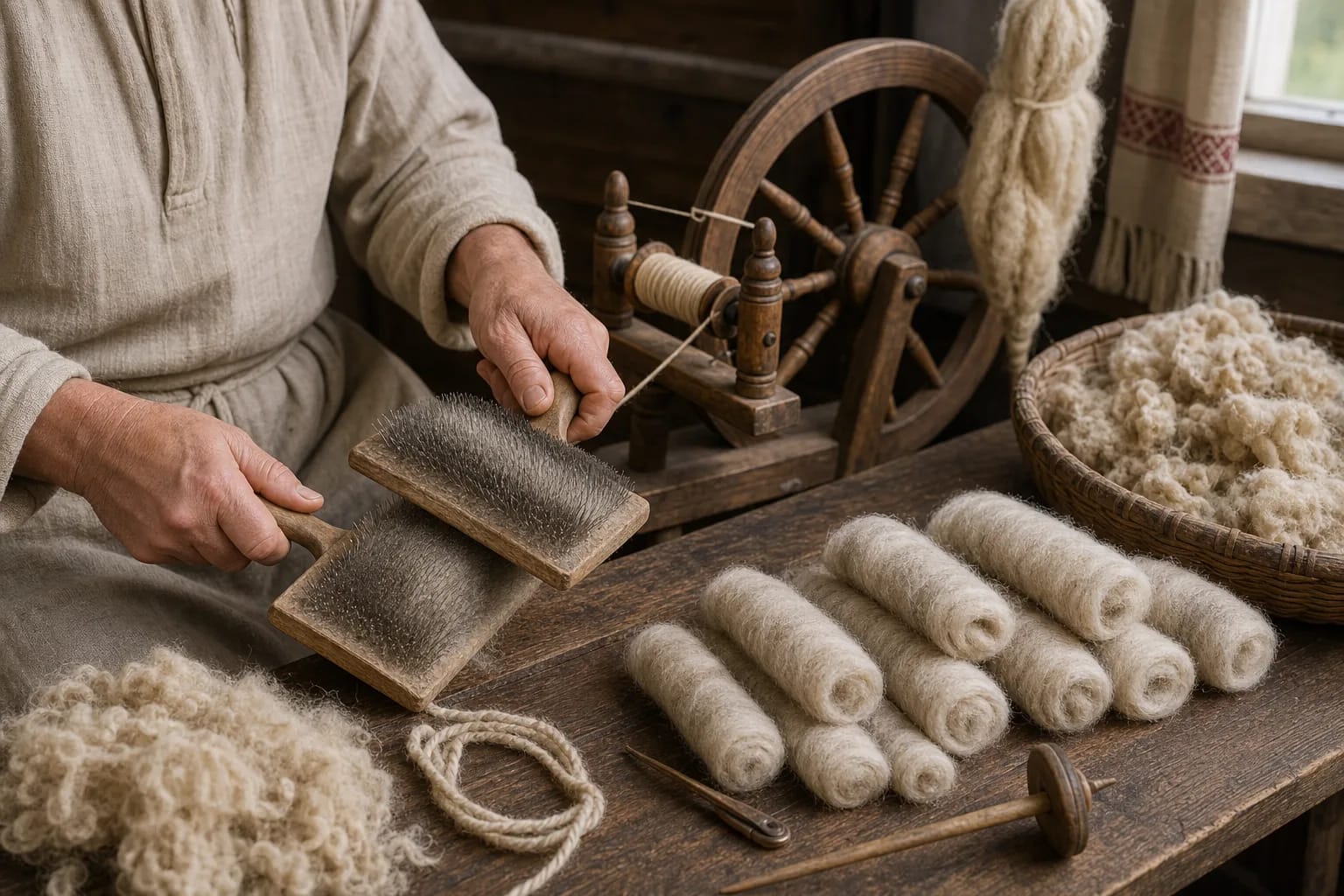
Carding forms an even layer of textile fiber called karšinys. It is one of the basic processes for yarn, felt, and nonwoven materials. Tufts of fiber are passed through carders so they are separated, arranged, and prepared for further work; the resulting layer becomes a sliver or roving that can be spun.
In mechanical carders, fiber moves between metal cylinders covered with saw-tooth or needle carding cloth. The tufts are broken into individual fibers, straightened, cleaned of short fibers and impurities, and blended into a more uniform mass.
At home, wool was often carded with hand carders: two boards set with many wire teeth. Mechanical hand-cranked carding machines appeared in Lithuania in the early 20th century; before that, carding largely remained hand work done alongside other winter textile tasks.
Spinning with Distaff and Spindle
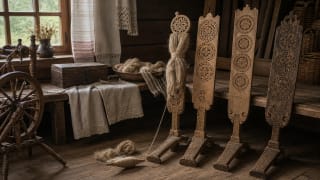
The oldest and longest-surviving Lithuanian spinning method used a distaff and spindle. A traditional distaff has a 40-50 cm upper head, or prieverpstė, for the fiber bundle, and a lower leg or priesėdas up to 70 cm long, on which the spinner sat. The spindle is a small wooden or clay whorl-like tool whose weight and rotation twist the fiber.
Spinning required constant hand movement and good fiber. The spinner drew fibers from the bundle with one hand, turned the spindle with the other, and wound on the twisted thread. Too little twist made the thread break; too much made it kink. Even thread of consistent thickness showed skill and patience.
In this process the distaff and prieverpstė are tools, while their ornament, openwork, and gift meaning belong to separate pages. Their shape is practical: the head holds the fiber bundle, and the lower part is held by the spinner’s body weight so the hands stay free.
The Spinning Wheel: Speeding the Work
A later and more productive tool was the spinning wheel, with a 50-80 cm wheel driven by a foot treadle. Rotation passed through a leather belt or waxed cord to the bobbin, which twisted and wound the thread. Horizontal and vertical wheel types were both known.
Spinning wheels were used in Lithuania from the late 17th or first half of the 18th century and gradually replaced the distaff. They likely reached Žemaitija and Užnemunė through Prussia, first spreading in Lithuania Minor. At first they were expensive and used in manors and manufactories, later becoming accessible to many peasants.
Wheels were made by craftsmen from ash, linden, and alder, joining textile and woodcraft. K. Donelaitis's poem 'Metai' mentions a foot-driven spinning wheel called a vindas. They were used not only for spinning but also for plying several thinner threads together. By the late 20th century, industrial yarn production had largely displaced them.
The Process Step by Step
Wool’s path to thread began with shorn, washed, and dried wool. It was first loosened, then carded until it became an even karšinys. A fiber bundle could then be fixed to a distaff or spinning wheel, and spinning began as fibers were drawn and twisted into thread.
Flax followed a different path. Fine linen or tow yarns could be spun wet from moistened rovings; moisture helps long flax fibers lie smoothly and gives a finer thread. Before spinning, flax was combed so long fibers separated from shorter tow.
Spun thread was often not fully finished. Two or more thin threads could be plied together for stronger yarn, especially with a spinning wheel. The yarn might then be wound, washed, bleached, or dyed before reaching the loom or knitting needles.
Types and Uses of Yarn
Yarns differ according to fiber and preparation. Carded yarns spun from uncombed fiber are softer, fluffier, and bulkier; carded woolen yarns suited warm, heavier cloth and knitted objects.
Finer and smoother yarns come from combed, straightened fiber. Short fibers and impurities are removed, and the remaining fibers lie parallel. Such yarns suited fine linen cloth, shirts, tablecloths, and other white household textiles. Fine linen yarns were often spun wet.
The intended object determined thread quality. Festive white fabrics needed fine, smooth thread; everyday, work, and warm fabrics could use thicker yarn. A good spinner adapted the same wool or flax to different future uses.
Spinning, Women, and Winter Gatherings
In Lithuania spinning was mainly women’s work and was done mostly in winter, free from field labor. Women spun for their own families and, during serfdom, fulfilled spinning obligations for the manor. Girls learned from mothers, grandmothers, and neighbors; even thread showed patience, order, and readiness for household work.
Spinning was also communal. Until the late 19th century, and in some places into the first half of the 20th century, women gathered in one house to spin together at vakarones. They competed, told stories, sang, and shared food.
The practice is old: J. Łasickis described women’s communal spinning in the 16th century in his treatise on Samogitian and other gods, published in 1615. Vakarones connect spinning with Advent and winter evening culture: songs, stories, learning, and young people’s relationships all happened around the work.
From Household Spinning to Manufactories
Larger-scale production grew alongside household spinning. Spinning manufactories began in the 18th century; Count A. Tyzenhauzas established one of the first in Gruzdžiai and later in Grodno. In the 19th century some manors spun yarn, and in the early 20th century factories such as Juodupė’s woolen-cloth factory and other small enterprises did the work. Most woolen and linen weaving enterprises founded in the first half of the 20th century had their own spinning mills.
In the second half of the 20th century, large spinning and weaving factories were built in Vilnius, Panevėžys, Kaunas, Alytus, and Marijampolė. Industrial production used machines for the same basic stages that a village spinner managed by eye and hand: opening, cleaning, carding, combing, drawing into roving, and spinning thread.
Industrial yarn gradually displaced household spinning. Distaffs, wheels, and vakarones retreated from daily life, but the comparison reveals the craft’s scale: what a factory divides among machines, one woman once did with carders, distaff or wheel, and a long winter evening.
How to Recognize and Evaluate It Today
Today spinning can be seen in museums, craft centers, folklore and national-costume communities, and folk artists’ workshops. Handspun thread should be judged by evenness, twist, and suitability for purpose, not by being uneven simply because it is handmade.
The process should be distinguished from the tool. A distaff or wheel on a shelf is an object; its meaning appears when fiber becomes thread. It is also worth distinguishing carded and worsted yarn, wool and linen thread, household and industrial production.
The most valuable contemporary practice keeps real technology alive: well-prepared material, even carding, a comfortable tool, and a clear future use in cloth or knitting. Spinning remains a living link between flax or wool and finished textile.