- Field
- Easter folk art and egg-decorating tradition
- Type
- folk art
- Heritage status
- living tradition
- Context
- margučiai, Easter eggs, wax-resist decoration, scratched eggs, plant dyes, Easter, egg tapping, egg rolling, spring renewal, family patterns
Lithuanian Easter eggs, Wax-decorated eggs, Scratched Easter eggs, Plant-dyed eggs
Margučiai forms and objects
Wax-decorated margučiai: Easter eggs whose patterns are written with hot wax before dyeing or between dyeing stages.
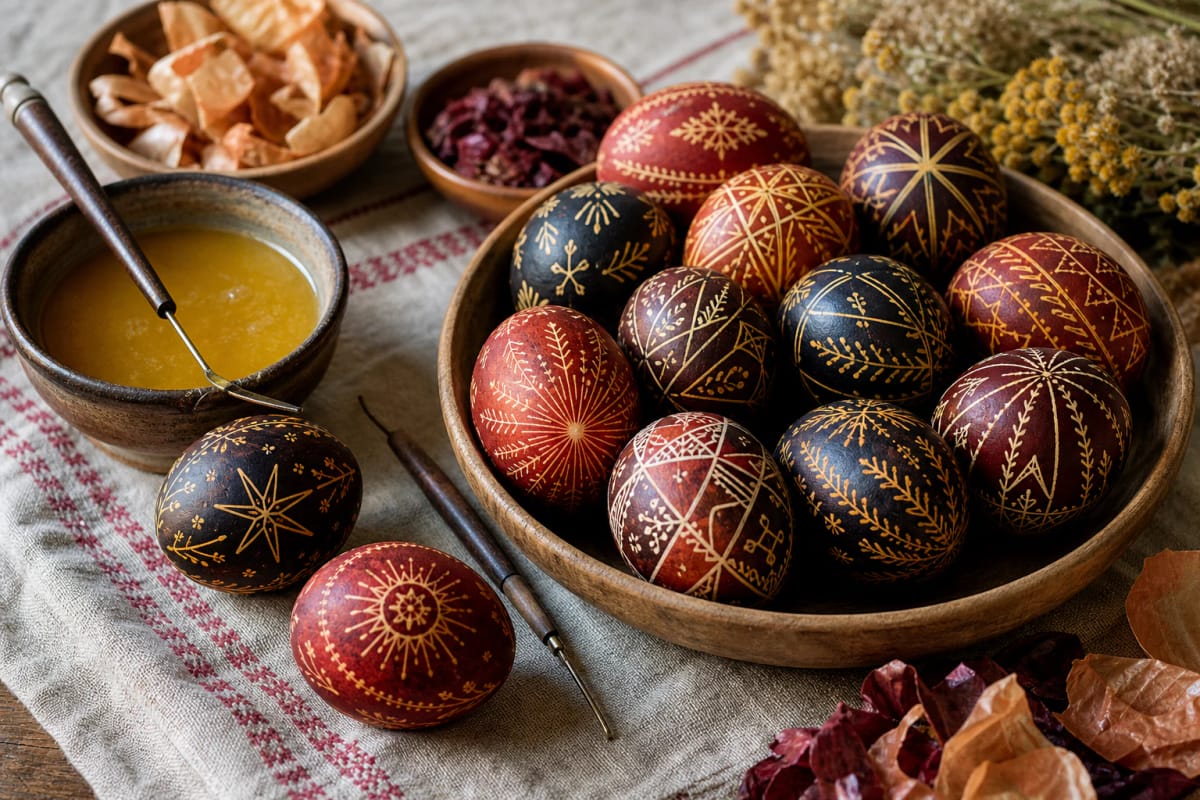
Scratched margučiai: Dyed eggs whose pattern is scratched through the color with a sharp tool, revealing the pale shell.
Plant-dyed margučiai: Eggs colored with onion skins, bark, leaves, hay, berries, beetroot, and other plant materials.
Game eggs: Margučiai used for Easter tapping, rolling, gifting, and family games, not only for display.
What are margučiai?
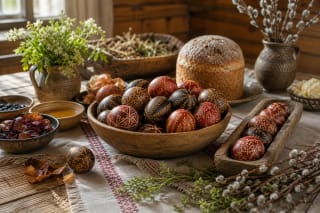
Margučiai are Easter eggs dyed and decorated with patterns. In Lithuanian tradition they are signs of the festive table, gifting, games, and spring renewal. The egg matters here not only as food, but as a symbol of life, beginning, and family celebration.
The two best-known traditional decorating techniques in Lithuania are wax writing and scratching. In the first, the pattern is made with hot wax before dyeing or between dyeing stages. In the second, an already dyed egg is scratched with a sharp tool. VLE distinguishes three types of margučiai: dyed single-color eggs, wax-written eggs, and scratched eggs; single-color eggs are known throughout Lithuania, while the decorating tradition survived longest in Suvalkija, Žemaitija, and Western Aukštaitija.
A margutis is a small object, but it contains much culture: plant dyes, patterns passed down in families, Easter morning, children's games, gifting, competitions, fortune guesses, and the precise hand of a folk artist. VLE notes that egg dyeing in Lithuania is mentioned already in one hymn by Martynas Mažvydas in 1549, and that folklore gave the egg magical power: even in the late nineteenth century farmers sacrificed an egg to Žemyna in the first plowed furrow, and on Jurginės livestock driven into fields stepped over dyed and undyed eggs placed under the barn threshold.
Wax-decorated margučiai
In the wax technique, dots, short lines, arcs, sunbursts, stars, crosses, plant twigs, or geometric signs are drawn on the egg with hot wax. The wax covers places that must remain light or keep an earlier color.
A simple method is to dye the egg in one color after the wax pattern has been written on it. A more complex method works in several stages: the egg is dyed a light color, part of the pattern is covered with wax, then it is dyed darker, written again, and so a multi-colored ornament is built.
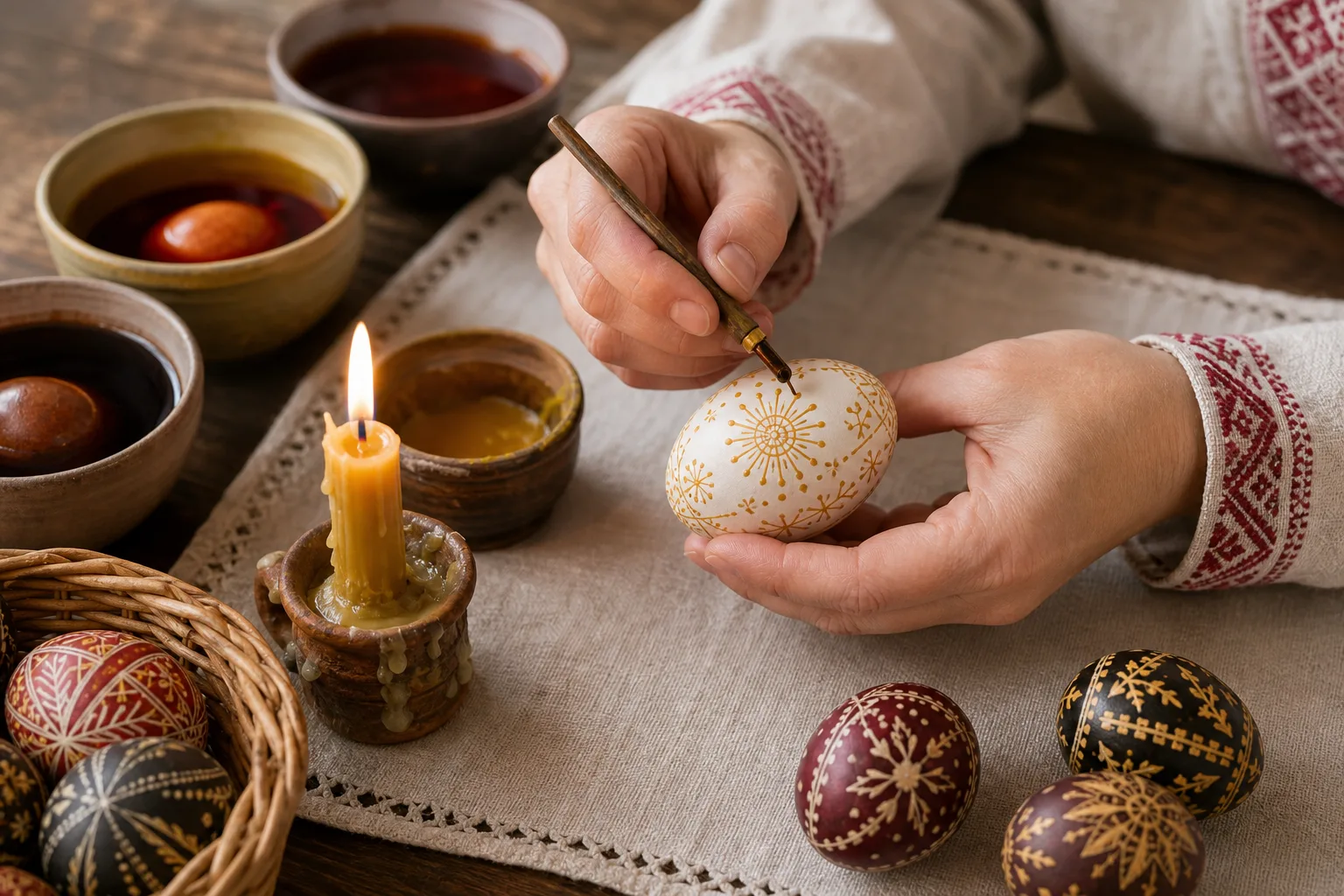
The tool is often a needle fixed to a little stick, a pin head, a small metal tube, or another heat-holding writing tool. The key is for the wax to be hot enough and flow evenly, but not drip into accidental spots.
Scratched margučiai
The logic of a scratched margutis is the opposite of the wax technique. The egg is first dyed in a dark or rich color, and then the pattern is scratched out, exposing the pale shell. Scratching can produce very fine lines, shadows, feather-like leaves, and the impression of engraving.
Tools may include a small knife, needle, razor blade, or special sharp tool. The egg must be firm enough, and the hand very steady. One careless movement can leave a groove that is too deep or chip the shell.
Scratched margučiai often look more graphic than wax-decorated ones: line, density, and the contrast of light and dark matter here. This technique is especially suitable for combinations of plant, bird, sun, and fine geometric motifs.
Plant dyes
Until the twentieth century margučiai were often colored with plant dyes. Onion skins give brown, orange, and reddish tones; alder or oak bark gives darker earth colors; birch leaves and hay give yellowish or greenish tones; berries and beetroot give pink and violet nuances.
Later brighter aniline and other purchased dyes spread. They made stronger contrast possible, but in traditional aesthetics plant dyes preserve special value: their color cannot be fully controlled, so each egg has a slightly different tone.
Plant dyes work best with patience. A decoction has to be prepared, the shell color judged, sometimes acid or other fixing agents added, and the egg soaked longer. It is a slow process, but it connects the margutis with the kitchen, family, and spring plants.
Margučiai patterns
Lithuanian margučiai often use dots, short lines, arcs, triangles, rhombi, crosses, sunbursts, stars, bird tracks, rue leaves, plant twigs, little snake or grass-snake lines, horns, and drop shapes. The pattern often turns around the egg like a small map of the universe.
Sunbursts and stars are connected with light, spring, and renewal; plant motifs with life, leafing, and fertility; while dots and short lines help create rhythm. Still, patterns should not be translated into one unchanging dictionary: meaning is also created by family tradition and the maker's hand.
The ornament of a margutis has to adapt to the egg's shape. A straight line becomes an arc here, and symmetry constantly bends over the round surface. A good margutis therefore shows not only drawing skill, but also a sense of form.
Colors and their meanings
In folk explanations red is often connected with life, joy, and blood; green with vegetation and spring; yellow with the sun or grain; black with the earth; and blue with the sky or water. Such explanations help understand color symbolism, but they are not the only ones.
The colors of margučiai were also determined by materials. Onion skins give one palette, chemical dyes another, and the shell color can change the final result. Sometimes color meaning is therefore not mythological but very practical: people used what the household had.
The best margučiai often work through contrast. A dark ground lets a scratched white line stand out, while a light shell under wax dots becomes the light of the ornament. Color and technique are inseparable here.
The Alytus-region wax-decorating tradition
Lithuania's Intangible Cultural Heritage Inventory singles out the tradition of wax decorating Easter eggs in families around Alytus. This is important because margučiai are widespread in Lithuania, but the Inventory shows a concrete living place of transmission, families, and lines of skill.
In the Alytus region, wax decorating is connected with family teaching: children watch how elders hold the egg, heat the wax, place dots and short lines, and later take over the rhythm themselves. A tradition is alive not when a pattern is merely copied, but when a person understands the action.
This example helps speak responsibly about margučiai. It is not enough to write that Lithuanian Easter eggs are this or that. Specific places, families, teachers, museum education, and folk artists who sustain the tradition today must be seen.
Margučiai in Easter customs
At Easter margučiai are gifted, tapped, rolled, compared, and kept. Egg tapping tests strength and luck: the person whose egg does not crack wins. Rolling requires aim and becomes a game for children and adults.
A margutis can be thanks, greeting, a family member's gift, a treat for a guest, or a small wish. The most beautiful margučiai were therefore often not eaten immediately, but kept for a time as a memory of the holiday.
This playful side is important: a margutis is not only folk art for a display case. It is born in the family kitchen, travels to the Easter table, enters children's hands, and lives through action.
How to present margučiai responsibly
Responsible presentation distinguishes techniques: a wax-decorated, scratched, plant-dyed, or contemporary decorated egg is not the same. All forms can be beautiful, but the traditional context has its own materials, tools, and sequence of actions.
It is also worth avoiding overly certain translations of patterns. It is better to write that a motif is associated with the sun, plant, or life than to claim that every sign always means one and the same thing. Margučiai are a field of family, regional, and makers' creativity.
The best way to understand margučiai is not only to look at photographs, but to try writing a few wax dots, dyeing with onion skins, scratching a line, and playing an Easter game. Then it becomes clear why a small egg requires great patience.