- Category
- Folk Art and Identity
- Reading time
- 14 min.
- Sources
- Encyclopedic and ethnological research sources
What a Sash Is and Why Its Patterns Matter
A sash is a decorative belt-like clothing element, and Lithuanian sashes, according to the Universal Lithuanian Encyclopedia, belong to one of the oldest kinds of Lithuanian folk textile. Peasants, both women and men, wore them until the mid-nineteenth century, and in the late nineteenth and early twentieth centuries the sash became part of national dress. Traditional sashes were 2-3 meters long and 2-20 centimeters wide, woven from homespun linen, wool, or cotton thread. The earliest fragments of twined sashes have even been found in a grave dated to the fourth-fifth century BC, so the tradition reaches back millennia.
A sash pattern is not accidental. It is a rhythmically repeated sequence of signs, or motifs, running along the entire long strip of cloth. Because of this long, repetitive structure, sashes are among the best places to learn Lithuanian ornament: in one textile you can see how an individual sign becomes a system. This article explains how to read such a pattern and gives a motif glossary based on scholarly research.
The most important caution should be read at the start: pattern meanings are interpretive. Ethnologist Vytautas Tumėnas, who has studied the ornament of pattern-woven sashes in greatest detail, stresses that form outlives remembered content; a sign can survive for centuries even after its original meaning is forgotten. Meanings here are therefore presented not as the "true secret" of a sign but as researchers' reconstructions and folk explanations.
How Sashes Were Used: Rituals, Gifts, Respect
A sash encircles, binds, and marks, so its purpose was far wider than clothing decoration. Women used sashes to gird skirts, tie stockings, and lace bodices; men used them to gird shirts, trousers, and outer garments, and to tie footcloths. Sashes served as handles for food bundles, were used to swaddle babies, suspend cradles, and even lower coffins into graves. According to VLE, as many as 16 ways of tying a sash are known, and until the early twentieth century almost all rural women knew how to weave sashes.
Until the early twentieth century, the custom of giving a sash as a symbolic gift or offering remained alive. In southern Lithuania the sash was the most common wedding gift: the bride gave it to the wedding inviter, matchmaker, groomsmen, and neighbors. On the way to her husband's home, she tied a sash to a roadside cross or yard gate, and when going to the bathhouse for the first time she offered a sash to the bathhouse stoker. Sashes decorated baptismal markers and crosses and accompanied baptisms and funerals, so the sash naturally connects with transition, protection, and community bonds.
Tumėnas derives this symbolism from the sash's basic function: tying and joining. In his view, girding with a sash in ritual symbolizes elevation from everyday life to the level of sacredness, while a sash given by a woman marked friendship and connection. Interestingly, wedding and baptism customs involving sashes predominate in eastern Lithuania, while funeral customs predominate in the west. To this day, ornate sashes are still presented to honored guests and jubilee celebrants as signs of respect.
Weaving Technique: Pattern-Woven, Supplementary-Weft, Plaited, Twined
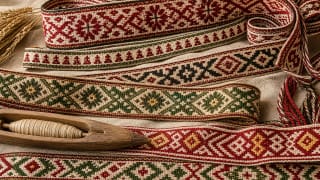
By production technique, VLE distinguishes woven, plaited, twined, and knitted sashes; woven sashes are further divided into pattern-woven, supplementary-weft, and plain. Pattern-woven sashes are characterized by complex geometric, sometimes plant, motifs; according to widespread ornaments, Dzūkian, Suvalkija, and Klaipėda-region pattern-woven sashes are distinguished. Supplementary-weft sashes are characterized by a rhythmically repeated sunburst motif, while plaited sashes stand out for color checkering, geometric rhombuses, or fir-tree motifs.
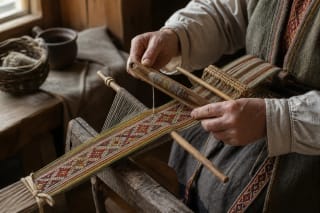
Technique directly determines pattern, so it cannot be separated from meaning. In pattern weaving, the ornament is selected by hand by controlling individual warp threads; in supplementary-weft weaving, additional colored threads are inserted only where the pattern appears; in plaiting, the pattern is born from the structure of the braid and its colors. A geometric rhombus or fir-tree sign is therefore often not a surface drawing but the very construction of the textile, created by the crossing of threads.
Technique also matters geographically. According to VLE, pattern-woven sashes were worn throughout Lithuania, supplementary-weft sashes in the south, especially the Alytus, Lazdijai, and Varėna areas, plaited sashes in northern and partly central Lithuania, and twined sashes in the east and southeast. In Lithuania Minor, so-called šimtaraštės, or hundred-pattern sashes, were woven with dozens of different motifs, sometimes with song verses. Knowing the technique and region makes the pattern easier to read accurately.
Reading Sash Composition: Edges, Rows, and the Central Motif
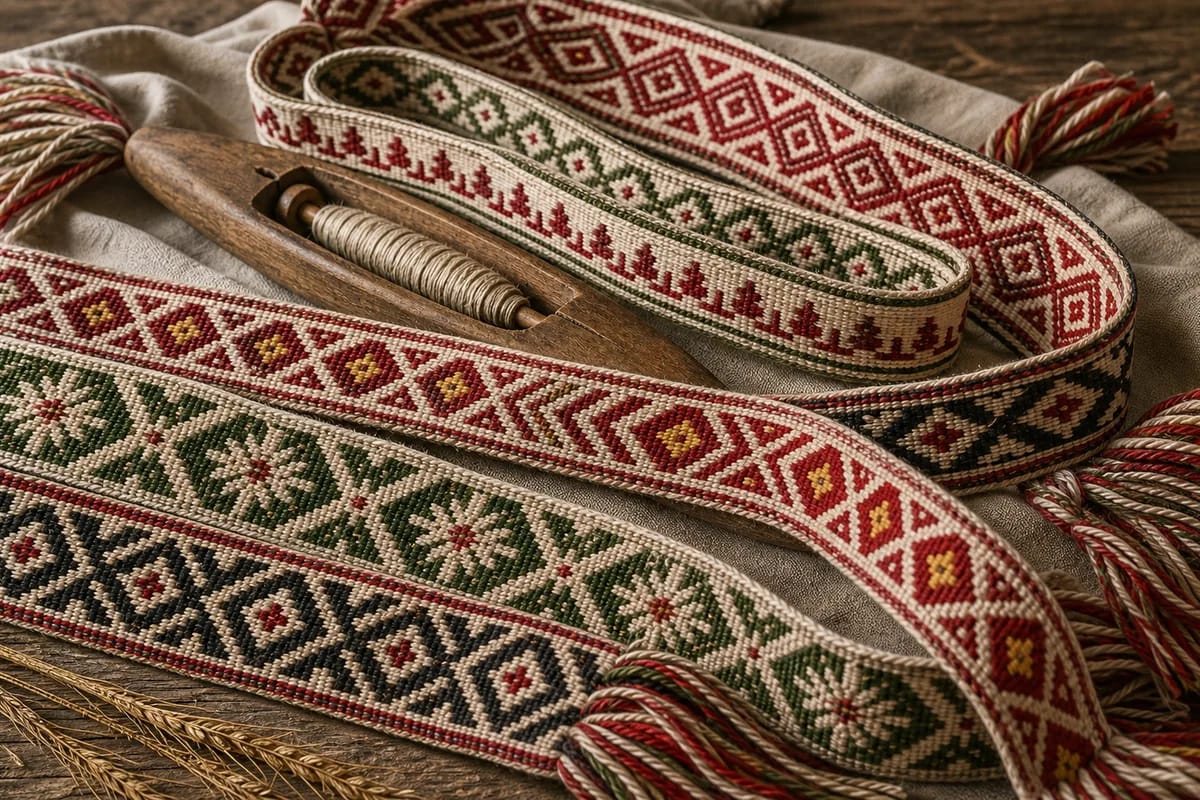
It is useful to read a sash as three parts. The edges usually have single-colored or multicolored stripes that frame the pattern. The main path of signs runs through the middle. At the ends, a sash usually finishes with tassels made from warp threads, while twined sash ends may be decorated with pom-poms. This order, frame, center, ending, helps distinguish what matters most in the pattern.
The pattern itself rests on symmetry and rhythm. According to VLE, Lithuanian folk art ornaments are symmetrical, rhythmic, architectonic in composition, and suited to the form and material of the object. In Dzūkian supplementary-weft sashes, pattern colors are often arranged in three rows, while motifs such as rhombuses, fir trees, and sunbursts repeat at a steady interval. When reading a sash, first find the unit of repetition: which sign forms the main rhythm, and which signs serve only as connectors or fillers.
Keep in mind that the same sign has many regional names. Tumėnas collected folk names for sash patterns: cat's paws, little rakes, little cucumbers, fir trees, little eyes, little roses, little stars, little grass snakes, little horses, little bears, little goat hooves. The same rhombus with projections may be called Salukė in one place, Roželė or Cat's Paw in another. Reading a pattern therefore means recognizing not only the form but also what the weavers themselves called it.
Rhombus and Little Eyes: A Sign of Earth and Fertility
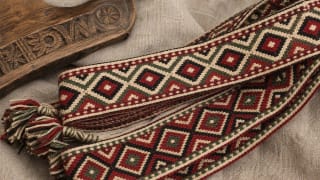
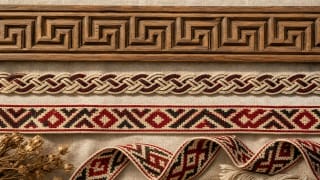
The rhombus is one of the most frequent motifs in Lithuanian sashes. Surveys of folk art symbolism explain it as a symbol of activity with many meanings: earth, sun, day, wreath, fire. Ornaments made of small squares or small rhombuses are often called akutės, little eyes, in folk terminology. The rhombus itself, especially with a dot in the middle, is associated in many traditions with a cultivated field and fertility.
Rhombuses with additions are especially expressive. In Tumėnas's typology, a rhombus with hooks, called Little Turtle, Little Frog, Spider, or Goat Hoof, and a rhombus with projections belong to the field of fertility symbolism; in Latvian and Slavic traditions the same signs are called little crayfish, little toads, or little goats. Images of these chthonic, or underworld, creatures are traditionally linked with the fertility of the earth and the force of life. In folk explanation, a hooked rhombus is sometimes interpreted as grass-snake eyes, though this is more a popular than a documented scholarly explanation.
It is important not to overstate the case: the rhombus is such a simple and universal form that it arises naturally from weaving structure in textile traditions around the world. The meaning of a specific rhombus should therefore be connected with its name, region, and composition, rather than being assigned one universal meaning. The same sign in a Dzūkian sash and a Lithuania Minor hundred-pattern sash may be interpreted differently.
Sunburst and Solar Wheel: A Motif of Light and Life
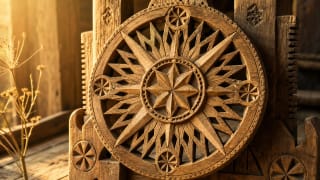
According to the LNKC publication on Lithuanian folk art, the sun motif is the most popular ornament motif in Lithuania. It appears on objects connected with ritual: sashes, Easter eggs, distaffs, and washing beetles. In wooden objects the sun is often shown as a six-pointed star within a circle, while a circle with rays is interpreted as a sign of the sun, fire, perfection, and eternity. According to VLE, the sunburst motif is precisely the most characteristic rhythmically repeated sign in supplementary-weft sashes.
In sash ornament, the sunburst is rarely a realistic circle with rays. More often it appears as a geometric form, a segmental star or a rhombus with projections. Tumėnas notes that weavers called this rhombus-with-projections pattern Salukė, Little Star, Little Rose, Little Briar, or Snowflake. The name Salukė is especially characteristic of Dzūkija dialect, and Latvians call the same pattern Saulīte. Thus the image of the sun in sashes is conveyed more through name and context than through a picture.
The sunburst's meaning is traditionally linked with warmth, light, life, and harvest. Because this sign is frequent on ritual objects and gifts, it suits the sash's function as wish and protection. Still, as with the rhombus, it is worth distinguishing documented solar symbolism from overextended readings: not every circle or little star in a sash was necessarily a conscious sun cult.
Star, Rose, and Segmental Rosette: Cosmic and Plant Sign
The segmental, usually six-pointed star is described in folk art symbolism as one of the world's oldest symbols of sun and light, known already in ancient Mesopotamia. It holds an important place in Lithuanian folk ornament: it decorated household objects, distaffs, and architecture, and in Žemaitija a segmental star above small chapels sometimes even replaced the cross. Rural people called it a sunburst or star, while its common Western European name is rosette or little rose.
In sashes, this sign often overlaps with the already mentioned rhombus with projections, so plant and cosmic interpretations intertwine. Tumėnas notes that in Baltic and Slavic tradition the names of this pattern correspond to the most meaningful plants and blossoms in folklore, especially the rose and oak, as well as to the sun, stars, and animals of wedding symbolism. This suggests that weavers could understand the little star as both a heavenly body and a blooming flower.
In practice, this means that "star," "rose," and "sunburst" in a sash are often the same geometric sign, just differently named. When reading the pattern, we should not sharply separate sky from vegetation: in folk thinking, light, blossoming, and life were connected. This is a good example of why sash meanings need flexible explanation rather than a single rigid dictionary.
Fir Tree, Teeth, and Little Rakes: Tree and Everyday Images
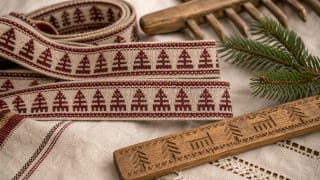
The fir-tree motif is one of the most popular motifs in pattern-woven and especially plaited sashes. It is made from diagonal strokes arranged like little branches and often runs along the whole sash in a continuous row. Researchers connect the image of the fir tree with a twig image and with world-tree symbolism, that is, with the idea of life's growth and a vertical structure of the world. At the same time the fir-tree form is one of the oldest geometric forms: according to VLE, Neolithic clay pots were already decorated with fir-tree patterns.
Beside the fir tree, so-called teeth are common: a row of pointed little triangles along the pattern edge. In ornament, teeth belong to band ornament and usually perform the role of framing or marking a boundary. The triangle in folk symbolism is interpreted as a sign of fire, water, man, and woman, so a row of teeth can be understood both as a protective boundary and as a simply decorative edge.
Little rakes are comb-like signs with several projections. Tumėnas collected their names: simpler forms are called Little Rakes or Combs, more complex ones Double or Broken Little Rake. On the basis of Lithuanian material, he connects this pattern with the symbolism of heavenly bodies. Fir trees, teeth, and little rakes show well how everyday objects and tree forms become rhythmic signs in sashes.
Grass Snake and Little Snake: S and Zigzag Signs of Fertility and Good Fortune
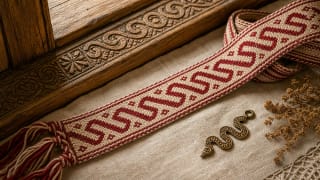
The grass snake or snake motif is found on crosses, distaffs, Easter eggs, and sashes. In sashes it is rendered geometrically, as a zigzag, wavy line, or S-shaped sign; sometimes a double grass-snake motif even forms a swastika shape. In ancient Baltic mythology, the grass snake is associated with the fertility of earth, people, and livestock, with good fortune, wellbeing, and the dead. Marija Gimbutas wrote that in prehistoric times the deity Snake was worshipped as a giver of hearth, happiness, health, and fertility.
Researchers explain the grass-snake sign as a symbol of vital energy and renewal. The grass snake is also connected with the goddess Laima, a link visible both in pattern signs and in myths. The grass snake was considered a mediator between sky and earth, capable of "drawing out" rain, so a wavy or zigzag sign in a sash fits images of life, rain, and harvest.
Zigzags and waves are also among the oldest geometric ornaments in their own right; the wavy ornament is a classic example of band pattern. Not every wavy line in a sash is therefore a consciously depicted grass snake; often it is simply a rhythmic connecting form. The sign's name and the context of the specific sash help distinguish documented grass-snake symbolism from a simple wave filler.
World Tree, Birds, Little Horses, and Crosslets
The world tree is an image common to many peoples, joining the layers of the world: heavenly bodies at the crown, earth in the trunk, and the underworld in the roots. In Lithuanian art it is shown surrounded by birds, grass snakes, and blossoms. In sashes, this image is usually represented by a symmetrical plant motif, a plant in a pot, tulip, or lily. The LNKC survey treats the potted plant as one of the most popular Lithuanian folk art motifs, widespread from the sixteenth-seventeenth centuries; tulips and lilies decorate dowry chests, textiles, and crosses.
Zoomorphic signs are also common in sashes, though stylized. Birds are among the oldest ornament motifs; in sashes they are usually abstract and rarely recognizable as a particular bird. According to LNKC, the horse-head motif is second in popularity after the sun; in Tumėnas's typology, little-horse patterns, a roof-like form with hooks called Little Horses or Little Colts, are linked with symbolism of duality and mediation. Both birds and little horses are often arranged in symmetrical pairs around a central sign.
Crosslets and geometric crosses are among the most common but also most multivalent signs. In folk symbolism, the cross is traced to a fire sign in a pre-Christian community, while from the fourth century it became a symbol of Christian faith. The fire cross, a swastika-shaped sign, deserves separate mention. Historically, in Baltic and Latvian ornament it was a sign of the sun, Perkūnas, fire, motion, and good fortune, known in many ancient cultures; it must be explained historically and carefully, separating its old Baltic meaning from twentieth-century political associations.
Color Meanings: Red Dominance and Color Combinations
Color in a sash is as important as form. Most often the ground of a sash was made from white or yellowish linen threads, while the pattern was selected in colored woolen threads. Old Dzūkian sashes were dominated by green, red, and purple pattern colors, while in Lithuania Minor the large geometric pattern used red, cherry, dark blue, or black. Red traditionally dominates and is considered the most important color, linked with life, fire, and protective force.
Until the nineteenth century, textiles were dyed with natural dyes: plant blossoms, roots, bark, and iron ore, so early sash colors were more restrained. With the spread of aniline dyes in the nineteenth century, sashes became brighter and more colorful. In Lithuanian folk textiles, according to VLE, warm colors were often paired with cool ones: red with green, yellow with purple, black with white. Such contrast helps the pattern sound clearly and brings out the rhythm of the signs.
Overly strict tables of color meanings should be avoided. The colors of a specific sash depended on region, period, fashion, dye availability, and the weaver's own taste, so the same red could carry more weight in one area than another. Color, like form, is best read together with technique, region, and purpose. Only by combining all of these do we get a reliable rather than guessed reading of the sash.