- Category
- Animal and Household Protection Signs
- Domain
- Žaltys, snake, S-shaped ornament, household protection, water, winding line
- Source status
- folkloric
little žaltys pattern, little snake, S ornament, winding pattern
What is the little žaltys pattern?
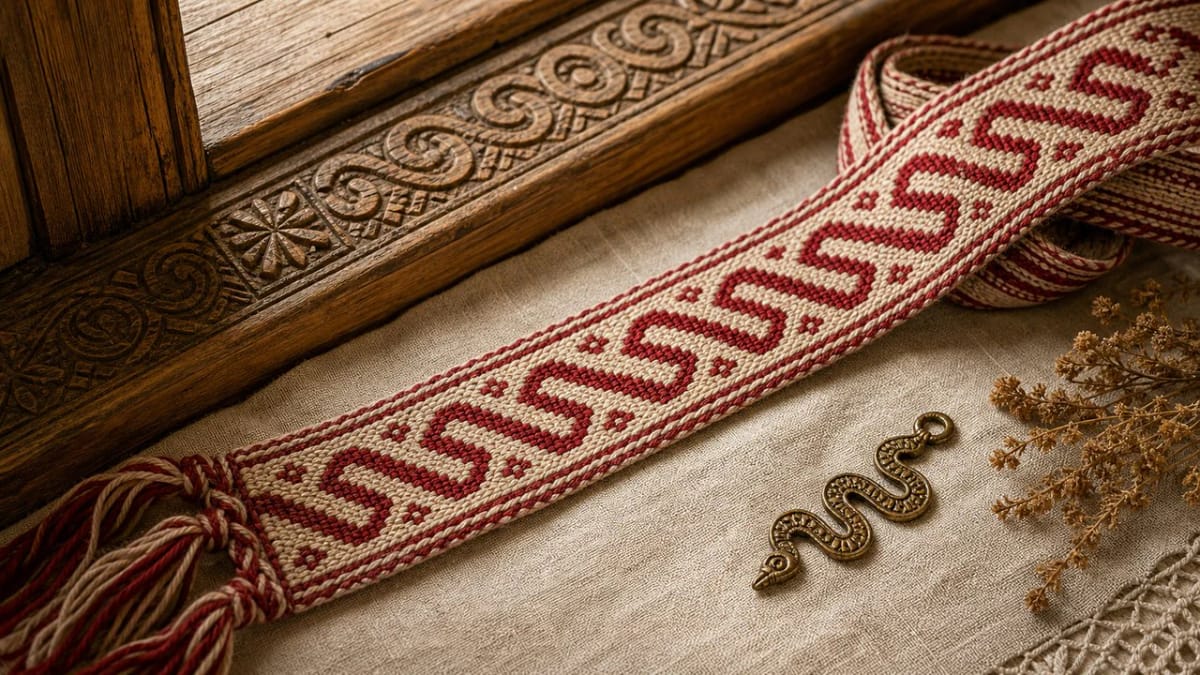
The little žaltys or little snake is a winding, S-shaped, or wave-like ornament. It can be very simple: a single line, a repeated S sign, or an entire winding border of a woven sash.
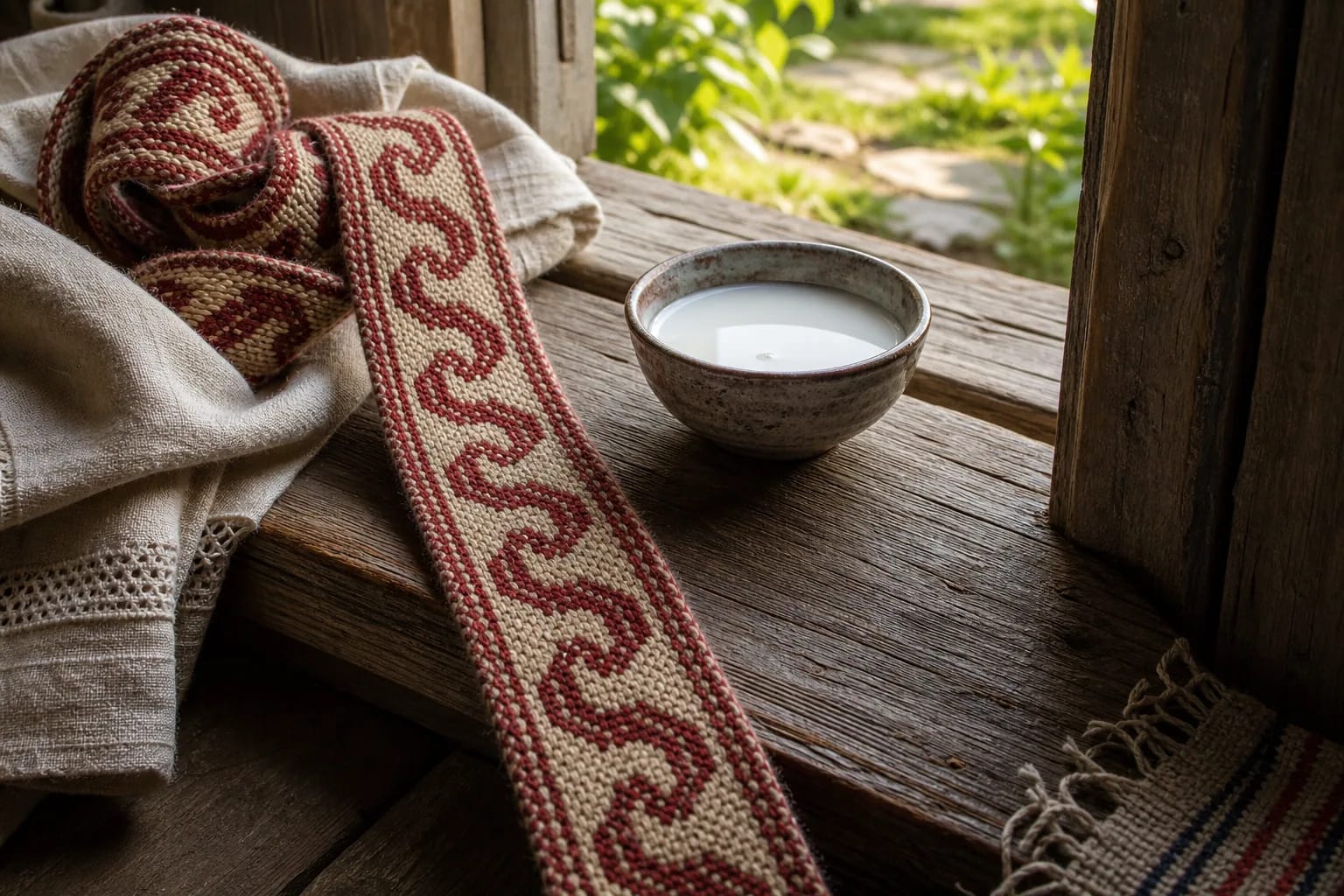
In Lithuanian tradition the žaltys is a strong folkloric image connected with household protection, luck, earth, and threshold. For that reason the little-snake pattern has a clear symbolic field.
Žaltys and the home
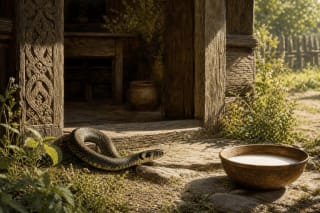
In Lithuanian stories and customs, the žaltys often appears as a household guardian. It is not a merely dangerous snake, but a sacred being that must not be harmed.
When a winding line is read as a little žaltys, it may mean household protection, the nearness of life to the earth, and the boundary between inside and outside.
The S pattern and the bend of water
The S shape is not only a snake. It may recall water, a wave, a river bend, or a plant stem. For that reason the meanings of little žaltys, little snake, and S pattern overlap.
To interpret precisely, one must look at the object. If the pattern appears near a threshold or in a context of household protection, the žaltys meaning is stronger; if it runs as a border ornament in a sash, it may be broader linear decoration.
Ornament and žaltys symbolism
The mythological žaltys, or grass snake, and a snake-shaped ornament are distinct subjects. Here the graphic form, the technique of weaving or carving, and the relation to a repeated line matter.
The little-snake ornament and S sign show how the mythological image of the žaltys moves into the language of weaving, carving, and repeated line. The little žaltys and little-snake motif appears on distaffs, distaff boards, dowry chests, sashes, shutters, and margučiai, often where household protection is important, so it is also read as a protective sign guarding life and the homestead.