- Category
- Sky Symbols
- Domain
- Light, warmth, life, day cycle, yearly wheel, folk art
- Source status
- well attested
sunburst, solar disk, sun sign, solar sign
What do the Sun and sun wheel mean?
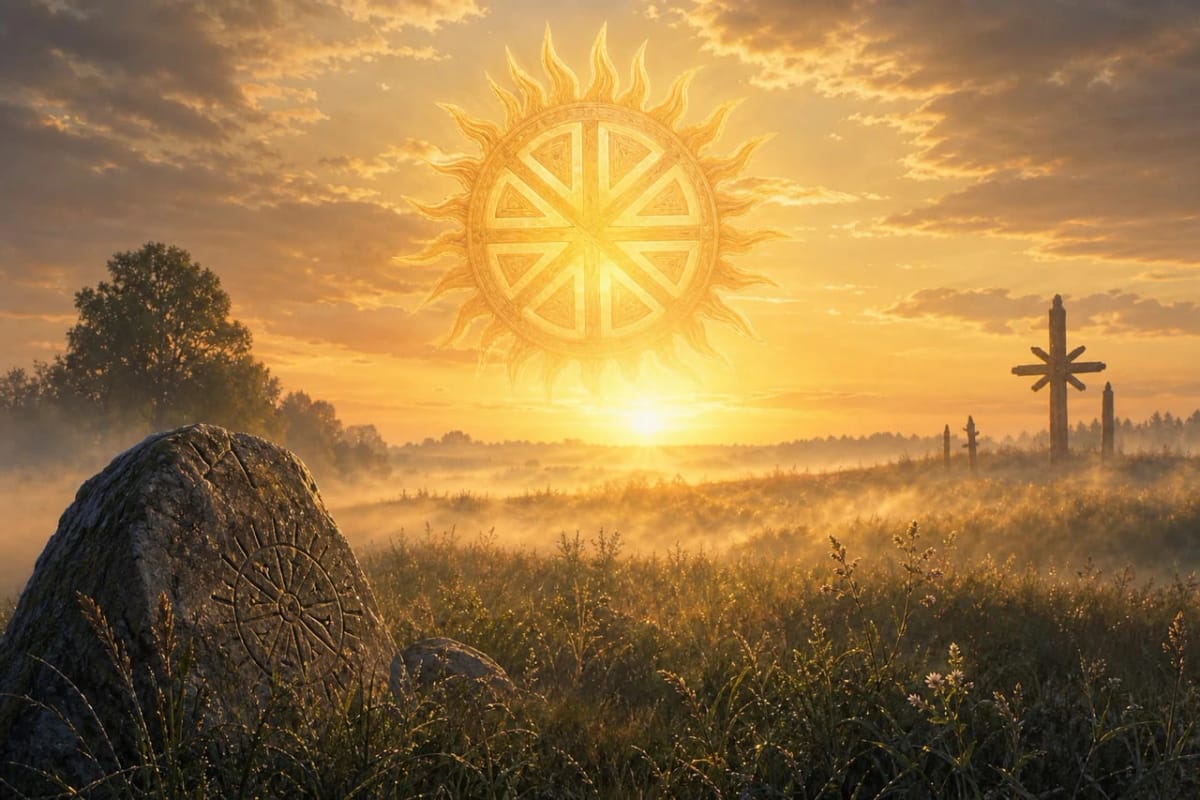
In Lithuanian mythology the Sun is not only a heavenly body. It is connected with light, warmth, the order of day, the support of life, and the rhythm of the year. The sun wheel therefore becomes a useful symbol: in one sign it shows movement, return, renewal, and the living nature of the world.
The sun wheel can also be understood as a sign of time. The wheel recalls that day returns after night, summer after winter, and festivals annually restore the same cosmic order. For that reason the symbol works best not in isolation, but together with Rasos, Christmas, Easter, songs, and folk art.
The Sun in sources and folklore
The Visuotinė Lietuvių enciklopedija article on Sun cult mentions written testimony about honoring the Sun and also stresses that in Lithuanian tradition the Sun is especially vivid in folklore, calendar rites, and folk art. This is an important cautious boundary: we are not dealing with one surviving dogmatic myth, but with a widely dispersed network of images.
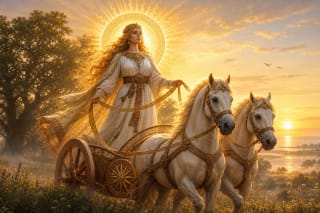
In Lithuanian songs the Sun is often personified: it rises, sets, warms, looks, weeps, travels, and is sometimes addressed in maternal terms. In a frequent image, by day the Sun rides through the sky in wheels or a carriage, and at night it sails by boat across the sea to the east; this motif of the heavenly carriage and ship has been studied by Nijolė Laurinkienė. Songs also mention the Sun's daughters, who weave and hang linens to dry, and at the solstice people say that the Sun 'rolls.' This poetic layer lets the Sun be read as a living heavenly being and as a symbol that sustains the rhythm of human life.
The sun wheel in folk art
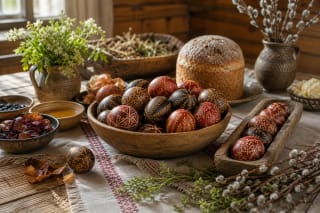
In folk art, sunburst and sun-wheel forms appear in cross-crafting, woodwork, margučiai, textiles, and other signs. Here the Sun works as a sign of light, care, and cosmic order, but it should not be mechanically translated into one closed meaning.

In ornament, the sunburst often joins with cross, wheel, rays, plant motifs, or star motifs. In the Christian period these signs could merge with new meanings, so their meanings are layered rather than a single, unchanging ancient code.
Sun, dew, fire, and the yearly wheel
At the Rasos festival, solar symbolism is felt through the longest day, bonfires, dew, herbs, and waiting for morning. In the winter festival cycle, what matters is not excess Sun but its return: the time of shortest days becomes a threshold into lengthening light.
Thus the Sun and sun wheel join opposite poles: summer fullness and winter promise, daytime clarity and the overcoming of night, heavenly light and earthly fire. This is one of the best symbols for explaining the logic of Lithuanian calendar culture.
How should this symbol be read today?
Today the Sun sign is often used as a sign of Lithuanianness, life, light, and heritage. It suits education, festival explanations, and reading folk art, but overly simple lists should be avoided, where every ornament receives only one meaning.
The best way to explain the Sun is through context: is the page discussing a song, festival, cross-crafting, margutis, mythological goddess, or the yearly cycle? The same sign can retain a general direction of light and life, while its specific meaning depends on place and custom.