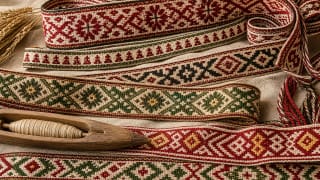
- Category
- Band and boundary ornaments
- Domain
- Braid, meander, band ornament, boundary, road, textiles, wood decoration
- Source status
- well attested
braid pattern, meander, band ornament, border pattern
What are braid and meander?
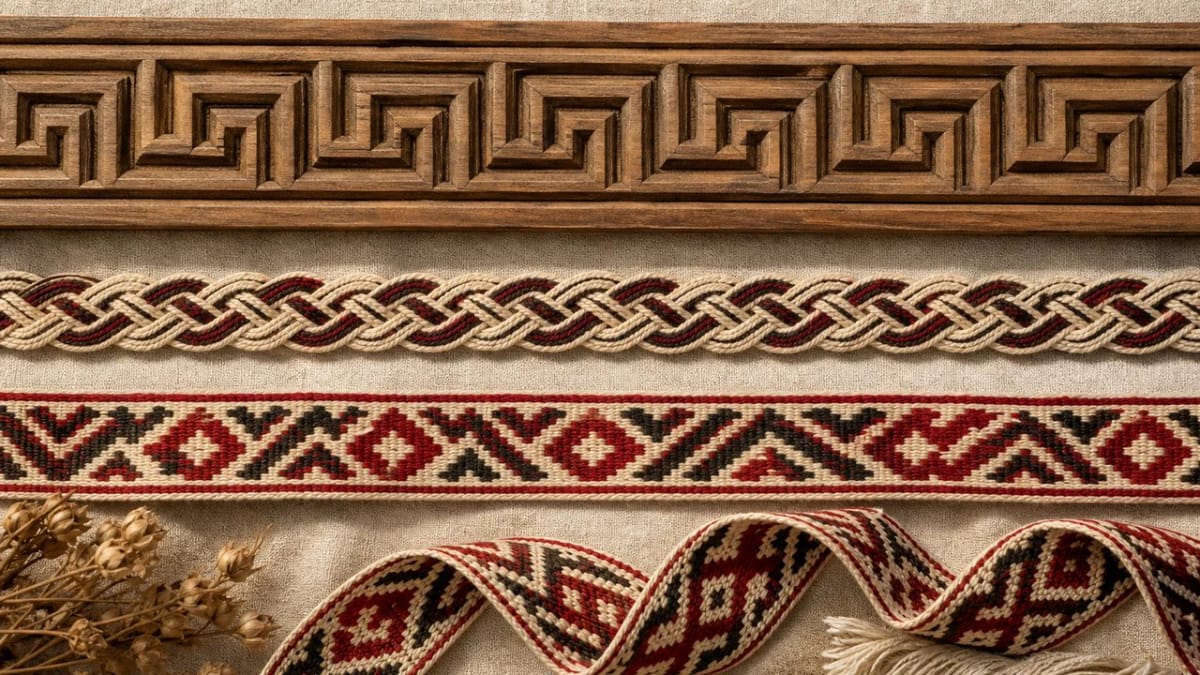
A braid is a motif of interlaced lines or strips, while a meander is an angular, continuously winding ornament. Both often work as a border, edge, or band pattern.
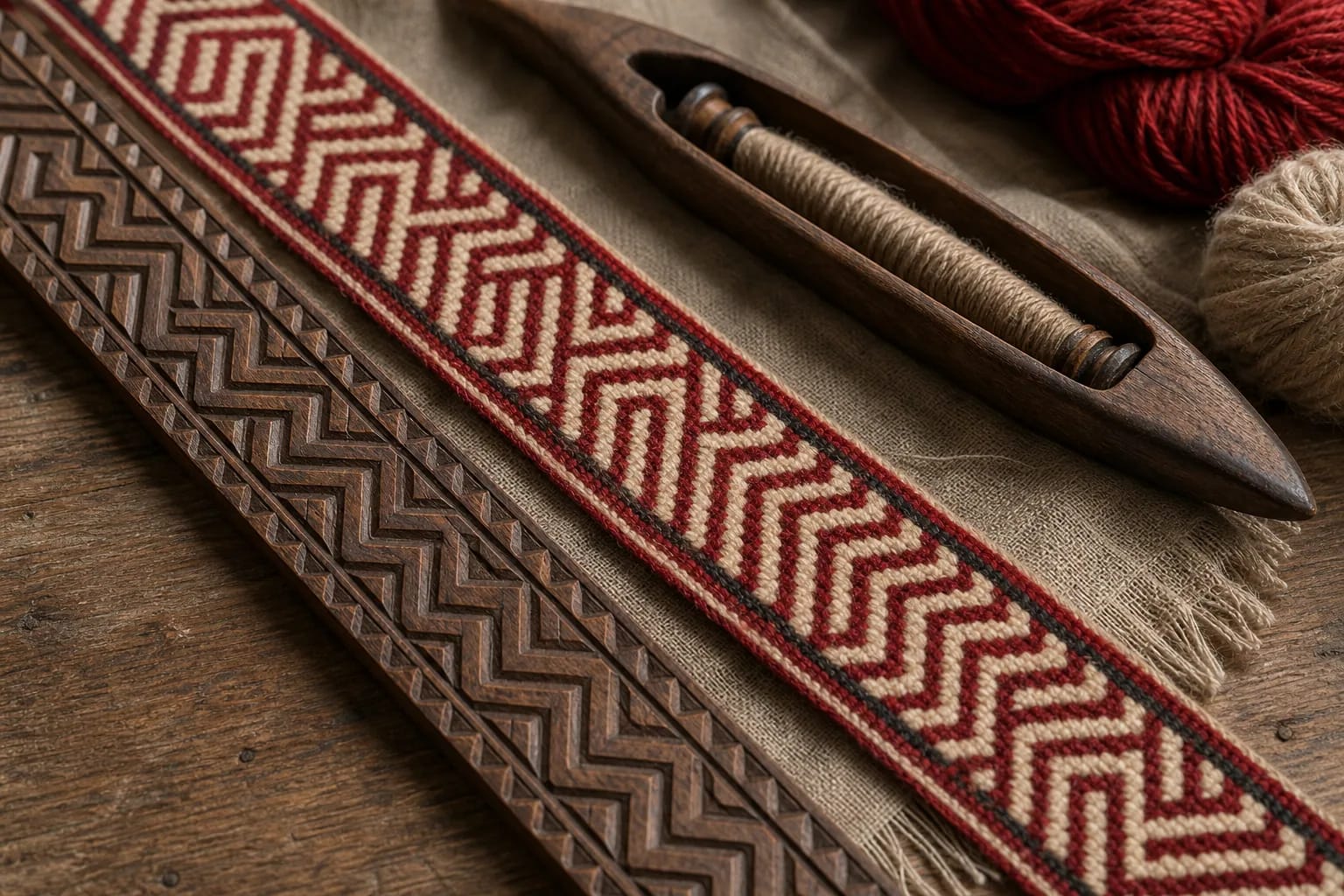
In Lithuanian folk art such patterns matter because they join decoration and boundary. They can protect the edge, frame the center, or show an unbroken bond.
Boundary and protection
A border in folk art is not only a technical detail. When it covers the edge of a textile, chest, wooden object, or Easter egg, it can be read as a protective band.
The braid expresses the idea of connection especially well: strands interlace, hold together, and form one strong sequence. Braid and meander motifs are very old, found already on prehistoric Baltic bronze objects and ceramics, while the braid itself seems to repeat the structure of weaving and plaiting from which it arose.
Road and continuity
By its form, the meander resembles a road, bend, or sequence of a long journey. For that reason it can be connected with transition, movement, and the continuous flow of time.
In sashes this meaning becomes stronger because the sash itself is a long, wearable or giftable sequence of signs.
Band pattern as a system
A band pattern is not only one motif. It is a whole compositional logic: signs move in a row, repeat, hold to the edge, and create a visual path.
Braid, meander, and band patterns share a feature: their lines repeat or continue along an object’s edge. This connects them with ideas of continuity and boundaries.