- Place
- Vilnius City Municipality
- Region
- Vilnius
- Type
- Vilnius artistic quarter and walking route
- Address
- Užupis, Vilnius
- Coordinates
- 54.68060, 25.29690
Užupis
The quarter across the Vilnia
Užupis is a Vilnius district east of the old town, separated from it by the Vilnia River. VLE notes that it is one of Vilnius' oldest districts, grown along the important Vilnius-Polotsk road even before Gediminas' time.
The name is simple: beyond the river. After the city wall was built in the early sixteenth century, Užupis stood outside the old-town boundary and grew as a craftsmen's suburb. In the 1990s artists settled here and galleries opened, so the district became known as Vilnius' artists' quarter and is often compared with Montmartre or Christiania.
A symbolic republic
Užupis Republic's independence is symbolically celebrated on April 1, April Fools' Day. It is not a state in legal terms, but a cultural identity with a flag, president, and constitution. The date deliberately emphasizes humour and creative freedom.
On April 1, Užupis is livelier and more crowded. VLE also mentions White Tablecloth Day, celebrated on the second day of Easter, when tables by the Vilnia are covered with white cloths. Choose another day for quiet, or those dates if you want the tradition.
The Užupis Constitution
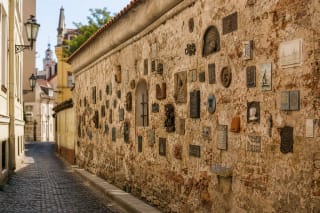
One of the key stops is the Constitution wall on Paupio Street, where the text is displayed on mirrored plaques in many languages. The Constitution was proclaimed on April 1, 1998 and written by Romas Lileikis, who became the district's president, and foreign minister Tomas Čepaitis.
Different sources give slightly different article counts, around 39-41, plus three slogans: do not defeat, do not fight back, do not surrender. The text has been translated into more than twenty languages, and more than forty plaques now hang on the wall; one of the newer ones is the Constitution in Hebrew. It works best as a slow-reading place, not only a photo background.
Angel, Mermaid, and bridges
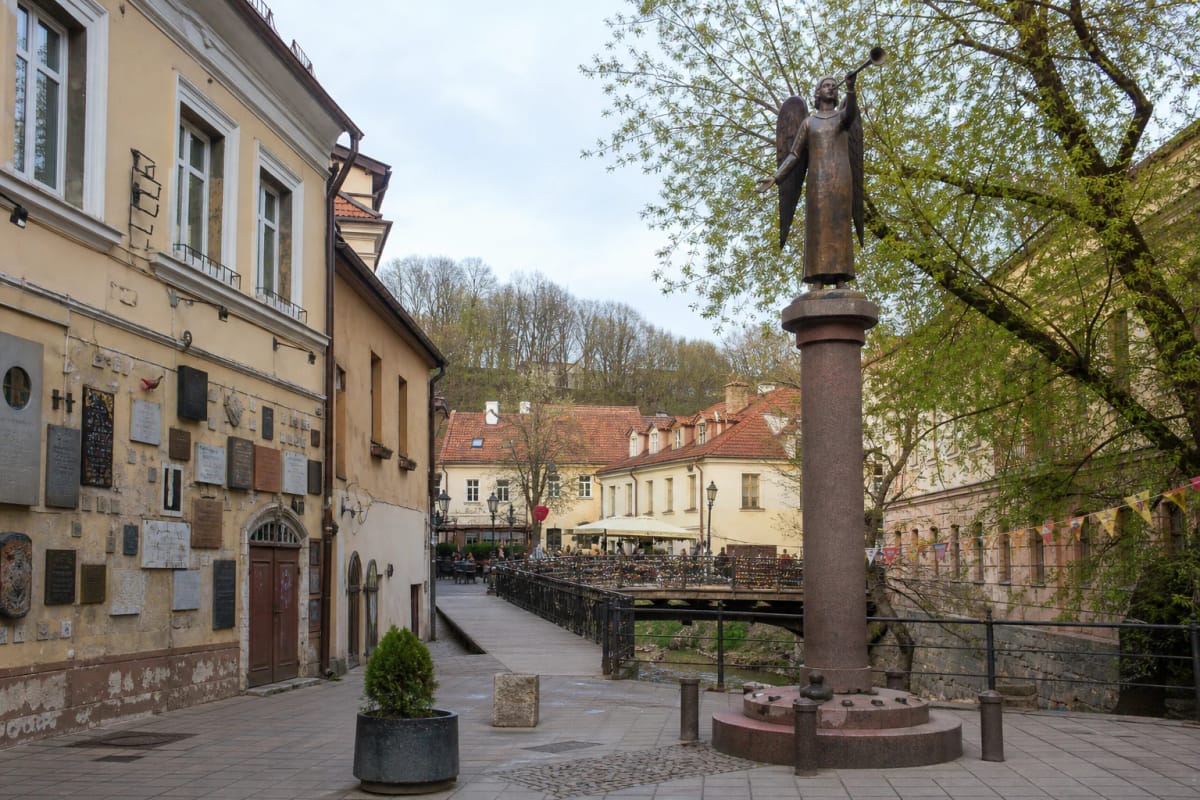
The Užupis Angel is the district's clearest symbol. VLE states that the 8.5 m sculpture was erected in 2001 by sculptor R. Vilčiauskas and architect A. Umbrasas. A walk should also include the Užupis Bridge, the Vilnia riverside, the Užupis Mermaid, Tibet Square with the Dalai Lama XIV mosaic unveiled in 2013, and the Galera art incubator.
These are not separate museum exhibits. They work as route points that help you feel the district's scale, from the bridge and river to narrow streets and courtyards. VLE also mentions the Jonas Mekas Visual Arts Centre in Užupis, established in 2007.
How to walk Užupis
Užupis is best visited on foot. The district is small, but much of its character is in details: gates, walls, small galleries, courtyards, cafes, and bends of the river.
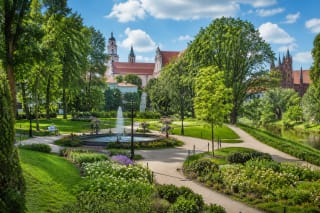
Start from the Užupis Bridge or Bernardine Garden side, continue to the Constitution wall and the Angel, then move through art spaces and back toward the old town.
What not to expect
Užupis is not a sterile tourist attraction. It is a lived-in district where everyday Vilnius life exists beside art signs and visitor routes.
Respect private courtyards, avoid photographing people too closely, and remember that the district's appeal is not only the souvenir idea of a republic but a real urban environment.