- Place
- Vilnius City Municipality
- Region
- Vilnius
- Type
- late-Gothic red-brick church in Vilnius Old Town
- Address
- Maironio g. 8, Vilnius
- Coordinates
- 54.68320, 25.29330
Saint Anne's Church, Šv. Onos bažnyčia
A red-brick sign of Vilnius
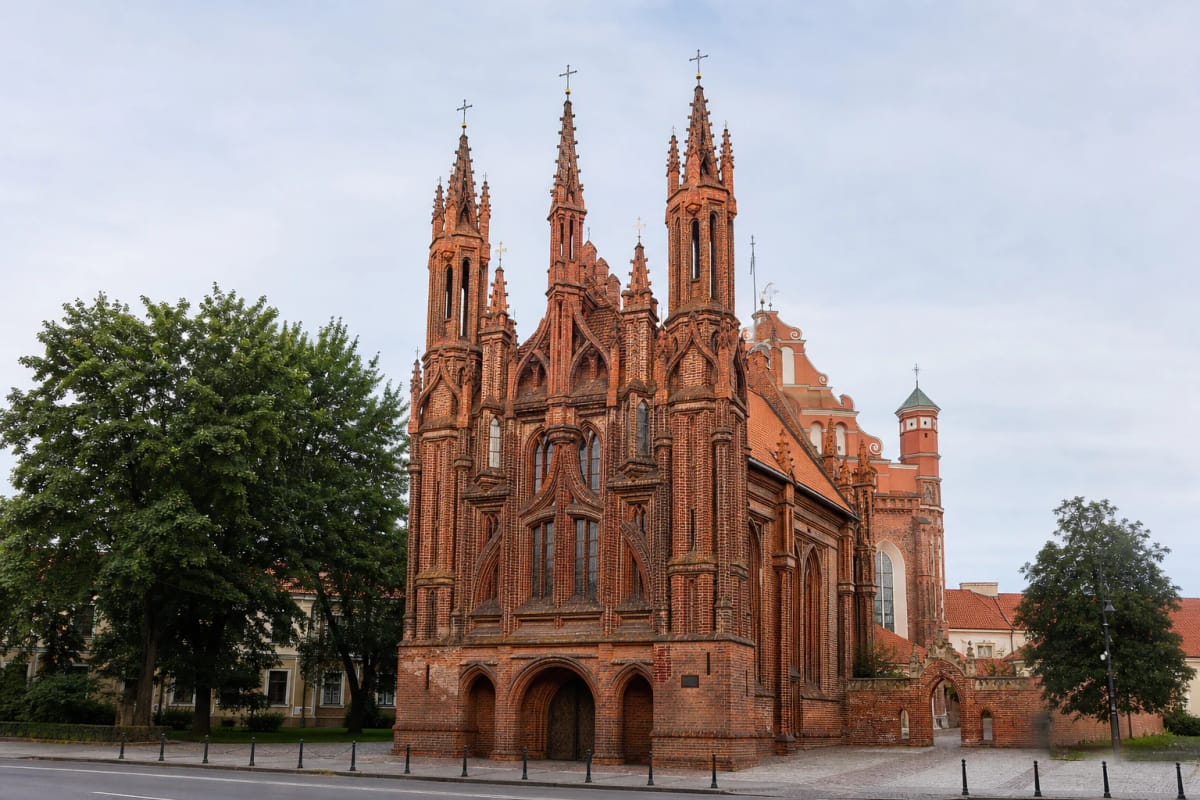
St Anne's Church is one of the easiest buildings to recognize in Vilnius Old Town and one of Lithuania's strongest examples of late, so-called flamboyant Gothic. The present brick church is dated to about 1495-1500, and the appearance of its main facade has remained almost unchanged for more than five centuries.
The facade is small but intensely worked: pointed arches, vertical pinnacles, brick patterns, and a lace-like silhouette make the building seem lighter than brick should allow. This effect comes from technical mastery: about 33 different shaped-profile bricks were created for the facade, making it possible to form complex wavy and flame-like contours.
Context of the Bernardine ensemble
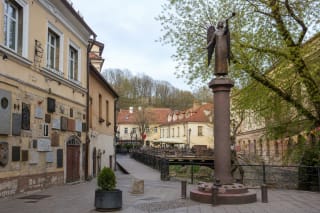
St Anne's Church should be seen together with the Bernardine Church and monastery complex. One church is a compact Gothic accent, the other is the larger volume of the ensemble, and their relationship creates the whole Maironio Street view.
For that reason, it is best not to rush into photographing only the facade. Walk around and notice how the red-brick St Anne's fits into the directions of Bernardine Garden, the Vilnia River, and the old town.
Part of the UNESCO old town and a protected heritage site
The church lies within the UNESCO-protected Vilnius historic centre and is listed in Lithuania's Register of Cultural Property as a state-protected heritage object. UNESCO values Vilnius Old Town for its architectural layers from several periods and for the city's development, and St Anne's Church is one of the clearest Gothic accents in that context.
It is a useful place to see clearly that Vilnius is not only a Baroque city. In the old town, Gothic, Renaissance, Baroque, and Classicism stand beside one another, and St Anne's is the calling card of the Gothic layer. The church burned and was renewed several times across the centuries, with reconstructions from the sixteenth to nineteenth centuries, but the main facade survived. The adjacent neo-Gothic bell tower was built later, in 1871-1874, to a design by architect Nikolai Chagin.
The Napoleon legend
A story often repeated about St Anne's Church says that Napoleon, in Vilnius in 1812, wanted to carry it to Paris in the palm of his hand. This is a popular legend without reliable historical confirmation, so it should be understood as a story about the beauty of the facade rather than as documented fact. The documented reality is more modest: during the 1812 campaign, the church was handed over to the French cavalry and used for military needs.
The legend still shows how strongly the facade affects visitors. Even a brief stop at the church often becomes one of the most memorable views in Vilnius Old Town.
How to visit St Anne's Church
Entry to the church is usually free, but visiting hours depend on the weekday and services. Before going inside, check current information from the Vilnius Archdiocese or parish.
If a service is taking place, leave detailed viewing for later or behave quietly. For many travellers, the exterior alone is enough: the facade is the main architectural experience.
Best viewpoints
The classic angle is from Maironio Street, where the whole facade is visible. For wider context, step back so the Bernardine complex appears in the frame as well.
Morning or evening light brings out the brick texture better. At midday the red brick can look flatter, especially on an overcast day.