
Lithuanian city guides
Vilnius
Vilnius is Lithuania's capital at the meeting of the Neris and Vilnia rivers, the former heart of the Grand Duchy of Lithuania, known for one of Central Europe's largest surviving old towns and a historic centre inscribed on the UNESCO World Heritage List in 1994.
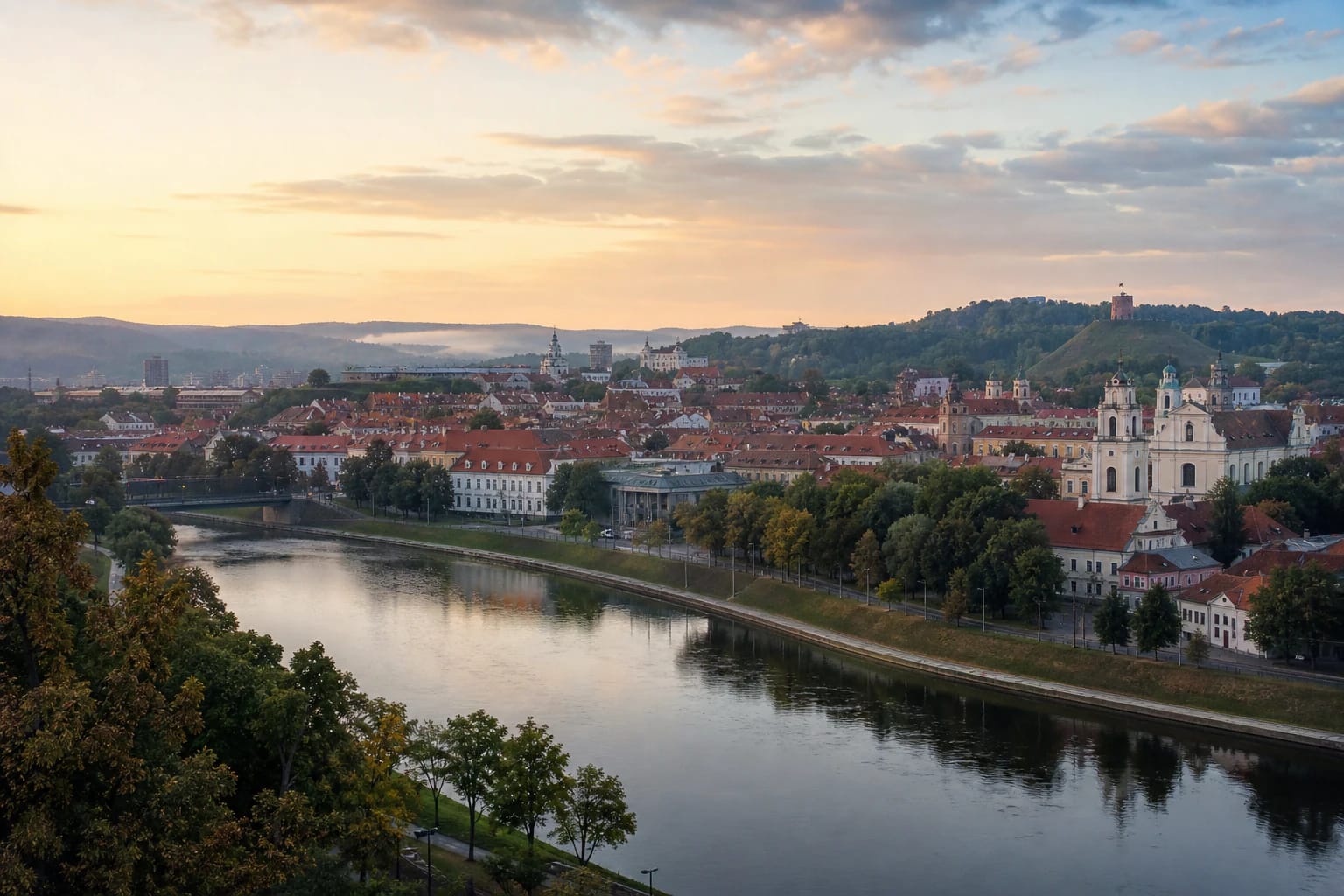
Vilnius
Where to start
Choose a place, compare visiting times or explore the area on the map.
Key places to visit in Vilnius:
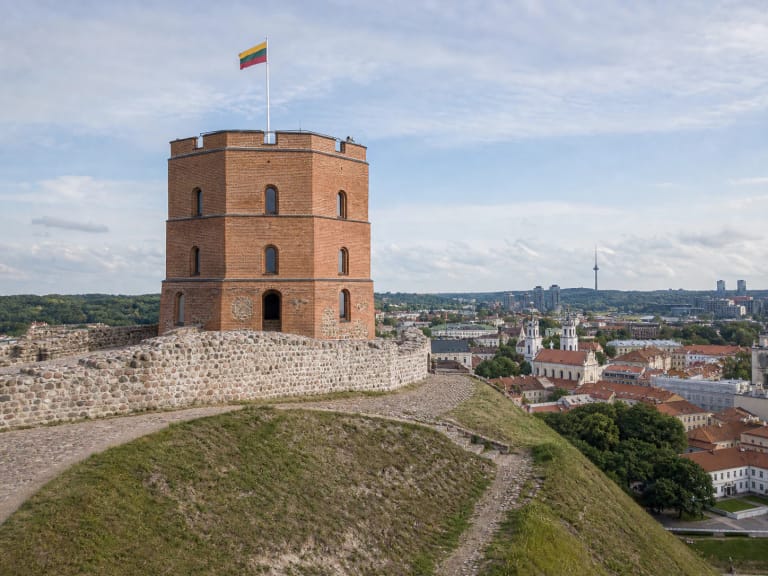
Gediminas Castle Tower
Gediminas Castle Tower on Castle Hill is the last strong visible sign of Vilnius Upper Castle and one of the best places to understand the capital…
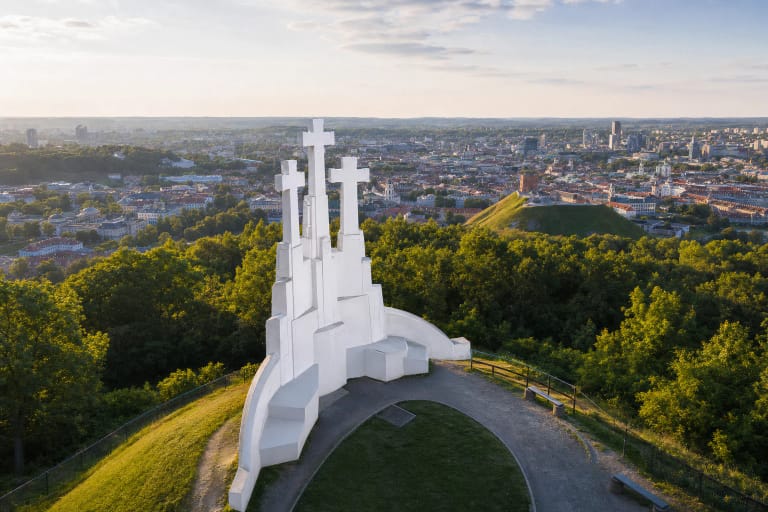
Hill of Three Crosses
The Hill of Three Crosses in Vilnius combines one of the city's best panoramas with a martyr legend, the 1916 monument, Soviet destruction, and 1989…
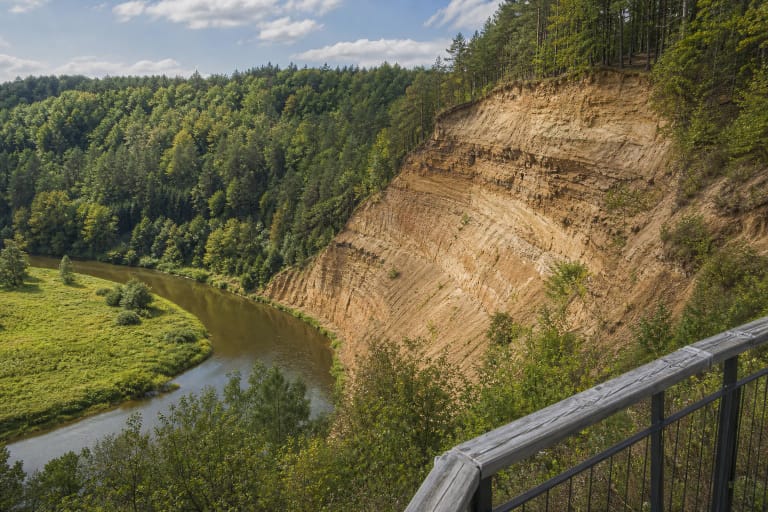
Pūčkoriai Outcrop
Pūčkoriai Outcrop is Lithuania's highest outcrop in the Vilnia valley: a 65.2 m high geological natural monument and one of the strongest viewpoints…
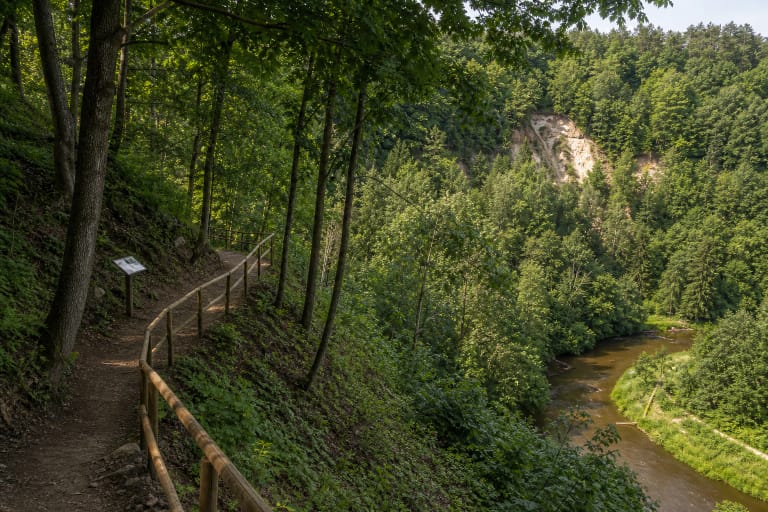
Pūčkoriai Nature Trail
Pūčkoriai Nature Trail in Pavilniai Regional Park links the Vilnia valley, Belmontas, Pūčkoriai Outcrop, slopes, and historic objects into one…
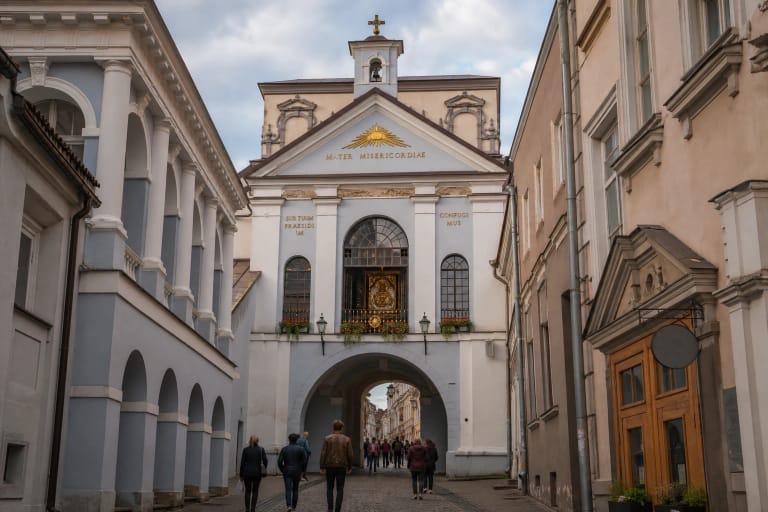
Gates of Dawn
The Gates of Dawn are the only surviving gate of the Vilnius city wall and one of Lithuania's most important pilgrimage sites, where the image of Our…
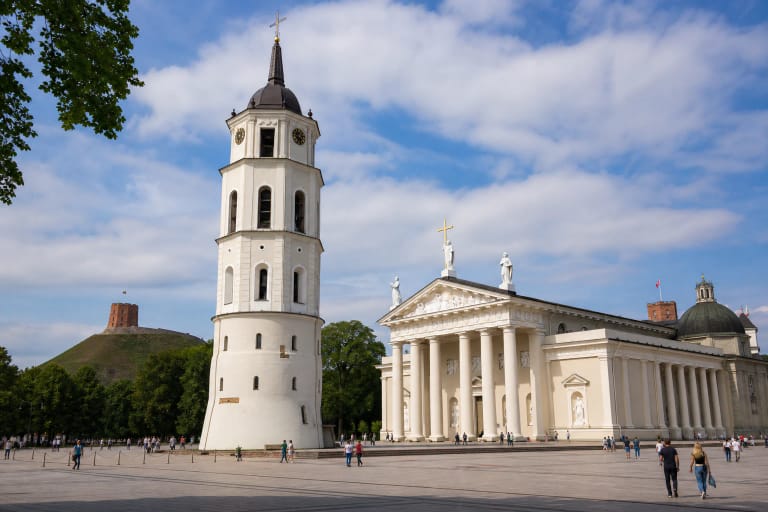
Vilnius Cathedral and Bell Tower
Vilnius Cathedral and Bell Tower form the central sacred and state-memory ensemble of the capital: neoclassical facade, crypts, St Casimir's Chapel,…
All places in this guide
Places on the mapGediminas Castle Tower1-1.5 hoursHill of Three Crosses45-90 minutesPūčkoriai Outcrop45-120 minutesPūčkoriai Nature Trail1-3 hours, depending on the chosen loopGates of Dawn20-60 minutes, longer if attending servicesVilnius Cathedral and Bell Tower45-120 minutes, longer with crypts or bell towerSt Anne's Church20-60 minutes, longer with the Bernardine ensembleVilnius University Ensemble45-120 minutes, longer with the bell tower or a guided tourUžupis Republic1-3 hours on footPalace of the Grand Dukes of Lithuania1.5-3 hoursVilnius TV Tower1-2 hoursMO Museum1-2 hoursLukiškės Prison 2.01-2 hoursBernardine Garden45 minutes to 1.5 hoursLiteratų Street15-40 minutesMarkučiai Manor1-2 hoursSapieha Palace1-2 hoursTrakų Vokė Manor1-2 hoursVerkiai Manor Estate1.5-3 hoursGlass Quarter in Vilnius30-90 minutes; longer when combined with Town Hall, Vilnius University, and a Jewish heritage routeVilnius Town Hall30-60 minutes for the exterior and square; longer with an event or guided visitBastion of the Vilnius Defensive Wall45-90 minutes; longer with the Subačius viewpoint and Gates of DawnPresidential Palace in Vilnius20-45 minutes for the square and facade; longer with a guided tourRasos Cemetery45-120 minutes; longer with an All Souls' Day or historical-memory routeBernardine Cemetery in Vilnius30-90 minutes; longer with an Užupis and Rasos Cemetery routeVilnius Calvary Way of the Cross2-4 hours; longer if walking the full prayer routeVilnius St Casimir's Church20-60 minutes; longer for services or a guided visitVilnius St Catherine's Church20-45 minutes for the exterior; longer with a concertDominican Church of the Holy Spirit in Vilnius20-60 minutes; longer if attending services or visiting the cryptsSt Faustina's House20-60 minutes; longer when combined with the Divine Mercy ShrineChurch Heritage Museum1-1.5 hours; allow up to 2 hours with an audio guide or guided tourMoney Museum in Vilnius45-90 minutes; plan longer with an education session or guided tourNational Gallery of Art1.5-2.5 hours; longer with temporary exhibitionsRadvila Palace Museum of Art1-2 hours; longer with temporary exhibitionsKazys Varnelis House-Museum1-1.5 hours independently; longer with a guide to the wider exhibitionSamuel Bak Museum1-1.5 hours; longer with a guide or when combining with other museum branchesMuseum of Lithuanian Jewish Culture and Identity1.5-2.5 hours; longer if you move slowly through every exhibitionVilnius Railway Museum1-1.5 hours for the museum; allow up to 2 hours with the Track ParkWooden Urban Architecture Museum in Vilnius45-90 minutes; longer with an education session or consultationCECHAS VILNIUS Gallery45-90 minutes, depending on the exhibition and eventHouse of Signatories45 minutes to 1.5 hours, depending on the visiting rules in force at the timeTuskulėnai Peace Park1.5-2.5 hoursPaneriai Memorial1-2 hoursVilnius Church of St Peter and St Paul30-90 minutes; longer if you spend time on the interior iconographyVilnius St John's Church and Bell Tower45-120 minutes; longer with the bell tower and university courtyardsVilnius Holy Spirit Orthodox Church20-60 minutes; longer if combined with the Gates of Dawn routeEnergy and Technology Museum in Vilnius1.5-3 hours; plan longer with educational activities or childrenMuseum of Occupations and Freedom Fights1.5-2.5 hours; allow more time for sensitive contentVingis Park1-3 hours, longer on event daysBelmontas Mill1-3 hours, depending on the trailVilnius St Nicholas Church20-30 minutesVilnius Church of St Francis of Assisi (Bernardine Church)30-45 minutes for the church; 1-1.5 hours with the St Anne ensembleVilnius Missionaries Church30-45 minutes for the exterior and panoramaVilnius St Teresa's Church20-30 minutes, often together with the Gates of DawnMuseum of Applied Arts and Design1-1.5 hoursAntakalnis Cemetery1-1.5 hoursVilnius Choral Synagogue30-45 minutes, often with a guided visitVilnius Basilian Monastery and Holy Trinity Church30-45 minutesTrinapolis Church and Trinitarian Monastery30-45 minutes for the exterior and surroundingsSapieha Park45 minutes-1.5 hoursPavilniai Regional Park2-4 hours for the Pūčkoriai loop; a full day for several trailsNaujoji Vilnia Deportation Memorial15-30 minutesHalė Market30-60 minutesVilnius University Botanical Garden in Kairėnai2-4 hoursVilnius Ghetto Memorial45 minutes to 1.5 hours, self-guided in open streetsGreen Lakes (Balsys) Nature Trail2-4 hours for the roughly 10 km loop around BalsysCentre for Civil Education90-150 minutes; 3-4 hours to open a substantial share of the digital material in sequenceVilnius Picture Gallery1.5-2.5 hours; approximately 3 hours with a temporary exhibition or palace-history tourAdam Mickiewicz Memorial Museumcurrently closed; check the official reopening notice before planning a visitLithuanian National Opera and Ballet Theatre2-4 hours depending on the performance; about 1.5 hours only for an announced tourEvangelical Lutheran Church in Vilnius30-45 minutes; longer for worship or a concertSt Joseph Church in Pilaitė, Vilnius20-40 minutes for the exterior and interior, if the church is openŽvėrynas Bridge20-40 minutes; 1-2 hours with a Neris riverfront and Žvėrynas walkŽirmūnai Beach1-3 hours for relaxing, sport, and swimming only when the latest official notices permit itTauras Hill45-90 minutes; 1.5-2 hours with the Lutheran Garden and Lukiškės SquareVilnius Japanese Garden1 to 1.5 hours; longer during blossom or with childrenKalnai Park Open-Air Stage30-60 minutes for a non-event visit; according to the organiser's programme during an eventPlikakalnis Outcrop45 minutes to 2 hours, depending on which trail sections are openVingriai Springs Square20-45 minutes; about 1.5 hours with the MO Museum surroundings and the nearest part of the Old Town(AV17)GALLERY45–90 minutesToy Museum Vilniusabout 1 hour; allow 1-1.5 hours for slower exploration and more time with the hands-on displaysContemporary Art Centre, Vilnius1.5-2.5 hours for the exhibitions and building; about 20-40 minutes for the free Sculpture Courtyard when there is no time for the galleriesCastellan's House, Vilnius1.5-2 hours for the exhibition and architectural layers; about 2.5 hours for a slow visit using the audio guideVokiečių 6, Vilniusabout 1-1.5 hours for one temporary exhibition and the reading room; longer for a tour, education session, or eventVytautas Kasiulis Museum of Art1-2 hours; longer with a guided visit, workshop or several temporary exhibitionsOpen Gallery, Vilnius30-45 minutes for a short circuit or about 1.5-2 hours with the long audio guide and outlying worksChiune Sugihara Sakura Park, Vilnius30-60 minutes; longer for a picnic, photography, or a combined visit with the National Gallery of Art and the Neris riverbankLukiškės Square45-90 minutes for the square and its historical markers; 2-3 hours when combined with the Museum of Occupations and Freedom FightsVincas Kudirka Square30-60 minutes; 1.5-2.5 hours when combined with a Gediminas Avenue walk between Cathedral and Lukiškės squaresVilnius Museum of Illusions1-1.5 hours; allow up to 2 hours with children, photography, or explanations from gallery staffAutomuziejus Vilnius1.5-2.5 hours independently; a detailed guided tour takes approximately 1.5-2 hoursWhite Bridge in Vilnius20-45 minutes for the bridge; 1.5-3 hours with the right-bank sports grounds and riverfront pathZoopark Vilnius1.5-2.5 hours; longer if you plan around public or keeper feeding timesKing Mindaugas Bridge15-30 minutes for the bridge; 1.5-3 hours with Gediminas Hill, Cathedral Square, and the Neris embankmentSubačius Observation Deck20-40 minutes for the panorama; 1.5-3 hours with Kūdrų Park, Užupis, and the Bastion of the Vilnius Defensive WallOzo Park45 minutes to 1.5 hours for a pond walk; up to 2 hours including play or sports areasLiepkalnis2-4 hours for an open-season ski session; longer with equipment hire or a lessonReformatų Park45 minutes to 1.5 hours; longer if you read each heritage marker and combine the park with nearby New Town sightsHouse of Histories, Vilnius1-1.5 hours for one exhibition; 2-3 hours for two exhibitions and a slower look at the buildingAdventica Vilnius2-4 hours; a day ticket suits children who need longer breaks and want to repeat favourite areasVilnius Airport Plane-Spotting Site30-90 minutes, best timed around the current flight schedule and wind directionUNO Park Vilnius2-3 hours; the official time allowance depends on ticket category and course choiceVU Botanical Garden Vingis Branch1-2 hours, or up to three during an exhibition, guided tour, or flowering eventSapieginė Nature and Recreation Trail1.5-2.5 hours depending on pace, surface and route choicesBelmontas Adventure Park2-3 hours including registration, briefing and selected coursesM. K. Čiurlionis House in Vilnius30-60 minutes; longer for a concert, lecture, or virtual-reality sessionUžupis Art Incubator30-60 minutes; longer for an exhibition or eventCathedral of the Dormition in Vilnius20-45 minutes; longer during a service or for a detailed architectural visitVilnius Amber Museum-Gallery30-60 minutesLithuanian Theatre, Music and Cinema Museum1-2 hours; longer when combining several exhibitions with a Muzeoteka tourLithuanian Art Centre TARTLE60-90 minutes independently, or according to the guided-tour lengthSensory Art Centre in Vilniusabout 50 minutes per session; arrive at least 10-15 minutes earlyGreen House Holocaust Exhibition60-90 minutes; the guided tour lasts about 60 minutesLithuanian Customs Museum60-90 minutes according to the pre-arranged programmeLithuanian Culinary Heritage Museum45-75 minutes; the official tour lasts about 45 minutesChurch of Saints Constantine and Michael in Vilnius15-35 minutes; longer during servicesVincas Mykolaitis-Putinas Museum30-50 minutes independently or 60-75 minutes on the Mykolaitis-Putinas tourTerra Recognita Gallery25-50 minutes; longer for a conversation about the work or choosing an original pieceVDA Titanikas Exhibition Halls40-80 minutes; longer during graduate shows or several openingsVilnius Church of Our Lady of the Sign20-40 minutes; longer for a service or a walk through the Žvėrynas approachesVilnius Evangelical Reformed Church20-40 minutes, longer for worship or a concertChurch of Divine Providence in Vilnius20-35 minutes outside servicesChurch of St Ignatius in Vilnius25-40 minutes outside servicesAll Saints Church in Vilnius30-50 minutes outside servicesChurch of St Raphael the Archangel in Vilnius30-45 minutes outside servicesFranciscan Church of the Assumption in Vilnius40-60 minutes outside servicesOrthodox Church of St Alexander Nevsky in Vilnius25-40 minutes outside servicesChurch of Blessed Jurgis Matulaitis in Vilnius30-50 minutes outside servicesOrthodox Church of St Nicholas in Vilnius25-40 minutes outside servicesLithuanian National Drama Theatre2-3 hours for a performance; 10-20 minutes for the facade and the Three MusesLithuanian National Philharmonic Society1.5-2.5 hours for a concert; about 1 hour for a pre-arranged tourChurch of Saints Philip and James in Vilnius30-60 minutes for the church; another 15 minutes for a seasonal short carillon recital“Erasmus+” Wall “It Is Never Late____”20-40 minutesGėlių Street CeramicsAbout 2 hours; children under 7 often need about 1 hourLaser Arena1.5-2 hours including briefing and several gamesUžupis Cat5-15 minutes; 45-90 minutes with an Užupis art and history walkVileišiai Palace15-30 minutes for the exterior; about 1-1.5 hours for a pre-arranged tourNaujoji Vilnia Burial Mounds30-45 minutes; longer when combined with a hike through Barsukynė or the Vilnia valleyChurch of Jesus the Redeemer in Vilnius20-40 minutes; longer for a service, concert, or community eventPavilnys Church of Christ the King and St Thérèse20-35 minutes; longer during Mass or a parish feastZemach Shabad Monument10-20 minutes; 30-45 minutes when exploring the surrounding former Jewish-quarter street planHilarijus Raduškevičius Palace15-25 minutes for the exterior; according to programme when attending an eventNeris Oxbow Valley45-75 minutes for the ponds and boardwalk loop; up to 2 hours including play or sports areasTuputiškės Serpentine15-30 minutes for the road itself; 45-90 minutes when walking safely from Pavilnys and combining it with another sightVilnius Shrine of Divine Mercy30-60 minutes for the architecture, original painting, and quiet prayer; longer for Mass or adorationPūčkoriai Hillfortabout 30-60 minutes for the hillfort; 1-3 hours with a chosen loop of the Pūčkoriai Nature TrailDvarčionys Geomorphological Reserve1-2 hours for a walk along a chosen edge of the reserve; longer for an unfamiliar routeKučkuriškės Hillfort45-90 minutes to find the hillfort, climb it, and read the platform relief; longer when combining it with a Vilnia valley routeŠeškiuko Lakeletabout 30-60 minutes; longer if you walk along the entire Šeškinė EskerŠeškinė Slopes Geomorphological Reserveabout 1-2 hours; longer if combined with Šeškinė Esker and the city's green routesLake Balsys2-4 hours for the lakeshore, viewpoint, and recreation; less if you visit only the main beachGreen Lakes3-5 hours for several lake perspectives, a beach, or a trail; longer with Verkiai ManorLake Balžis3-4 hours for one beach, a walk, and a quiet lakeside breakLake Tapeliai3-5 hours for swimming, a walk, and a lakeside breakKaroliniškės Landscape Reserve1-3 hours for a chosen trail; longer if you combine the reserve with Vingis Park or the Plikakalnis areaPanerių Erosion Hills Landscape Reserve2-4 hours for a chosen woodland route; longer if you combine nature with Panerių cultural heritageRibiškės Landscape Reserveabout 3-4 hours for the 6 km loop with climbs and stopsBukčiai Forest Park2-4 hours for a chosen 6-8 km route; allow at least 1 hour for a shorter walkBalžis Beach II2-3 hours for swimming, quiet rest, and a short workoutTapeliai Beach II3-5 hours for swimming, barbecuing, walking, and quiet restBalžis Beach I2-4 hours for swimming, relaxing, and walking by the lakeValakampiai Beach I2-5 hours for swimming, sport, a picnic, and a walk along the NerisValakampiai Beach II2-4 hours for quiet recreation, swimming, walking, and a picnicVerkiai Regional Park2-4 hours for one park sector; a full day for several routes and heritage sitesLake Antavilis30-60 minutes at a lawfully accessible shore; longer only when combined with other Antaviliai forest sitesGariūnai Viewpoint30-60 minutes at the viewpoint; longer if you walk the Paneriai hillsRokantiškiai Viewpoint30-60 minutes at the viewpoint; longer if you continue into Pavilniai Regional ParkVisoriai Forest Park45-90 minutesŽemyna Square20-45 minutesVolandos Gallery30-60 minutesAP Gallery45 minutes-1.5 hours, depending on the exhibition or eventDūmų Fabrikas1-2 hours during an event, or 30-45 minutes for the exteriorVerkiai Park Waterfall30-60 minutes for the waterfall and mill area; longer with the Verkiai Manor routeBeatričė's House45-90 minutes, depending on the display and programmeRomain Gary Monument10-20 minutesBekešo Hill45-90 minutesBalsiai Mythology Park45 minutes-1.5 hoursPilaitė Windmill20-45 minutesJonas Mekas Visual Arts Center45 minutes-1.5 hoursLabyrinthus45 minutes to several hours, depending on the scenarioBastėjos Hill20–40 minutes; longer around sunset or when combined with an Old Town routeTamsu Baisuabout 1.5-2 hours; depending on preparation and the selected scenarioVU Observatory of Ideasup to 1.5 hours on a registered tourMargutis (Egg) Sculpture10-20 minutesPaupys1-3 hoursPew Pew VR Arena1-2 hoursAdam Mickiewicz Monument20-40 minutes; longer if combined with a Bernardine-quarter routePaneriai Railway Tunnel30-60 minutes for a safe exterior view, if access is possible at the timeVašingtono Square Fountain20-45 minutes, or longer if you explore the whole squareGalerija VARTAI45-90 minutes for an exhibition; longer if you combine it with an event or an Old Town cultural routeGODÒ Gallery45-90 minutes for the current exhibition; longer if a talk or event is taking placeHADO Arena Vilnius1.5-2 hours for a reserved session with briefing; longer if you combine it with Vilnius OutletLAVA FLOOR by SMART GAMESone hour of play plus time for instructions and changing shoesMažųjų karalystė1–3 hours depending on free play or a booked celebrationLithuanian Police Museum45–75 minutes; allow the time confirmed by the museum for a group programmeRobo Arena Vilnius1-2 hoursAlisa Children's Play World1-3 hoursAltanas Hill30-60 minutes
About this area
Vilnius is Lithuania's capital and largest city, set in south-eastern Lithuania where the Neris and Vilnia rivers meet. It is an old, layered city: the medieval political centre of the Grand Duchy of Lithuania, a Baroque capital, a major Jewish cultural centre, and a place marked by occupation, the Holocaust, and the January 13 defence of freedom. For visitors, Vilnius is unusually walkable: the castle hill, cathedral, university, churches, old streets, and Užupis all sit within a compact historic centre.
Vilnius identity and geography
Vilnius spreads through the hilly valley of the Neris and Vilnia rivers. The city's name is linked with the Vilnia, and the relief of hills, valleys, and river bends shaped the early city around Castle Hill and Cathedral Square. Today Vilnius is Lithuania's largest city and its main centre of government, culture, education, and business.
The city is defined by contrasts: dense old-town streets sit close to green spaces such as Vingis Park, Pavilniai and Verkiai regional parks, and the Green Lakes area. For a first orientation, climb Gediminas Castle Tower, the Hill of Three Crosses, or one of the old-town viewpoints and read the city from above.
History: from Gediminas' letters to the capital
Vilnius was first mentioned in written sources in 1323, in letters of Grand Duke Gediminas inviting merchants, craftsmen, and monks to the city. It is said that Gediminas founded Vilnius after a dream of an iron wolf howling like a hundred wolves, which the priest Lizdeika interpreted as a sign to build a strong capital. This legend is best taken as part of the city's self-image rather than as a historical fact.
In the Middle Ages Vilnius became the capital and political centre of the Grand Duchy of Lithuania. Vilnius University was founded in 1579 and became one of the oldest universities in Central and Eastern Europe. From the sixteenth to eighteenth centuries, Baroque architecture flourished here, giving the city its high towers, restless facades, and spiritual skyline.
Later centuries brought losses and revivals: after the partitions of the Polish-Lithuanian Commonwealth, Vilnius passed to the Russian Empire; between the wars it was under Polish administration; under Soviet rule it became the occupied Lithuanian capital. In January 1991, freedom defenders died at the Vilnius TV Tower, and that memory remains part of the city's identity.
Old Town and UNESCO heritage
Vilnius Old Town is one of Central Europe's largest surviving historic centres and was inscribed on the UNESCO World Heritage List in 1994. Gothic, Renaissance, Baroque, and Classical layers meet here, while the street network still keeps much of its medieval structure. A clear first route begins at Cathedral Square and follows Pilies and Didžioji streets toward the Gates of Dawn.
The main old-town anchors are Vilnius Cathedral and its separate bell tower, the Palace of the Grand Dukes, Gediminas Castle Tower, the Vilnius University ensemble with its thirteen courtyards and the St Johns' Church bell tower, St Anne's and the Bernardine ensemble (Gothic), St Peter and St Paul's Church in Antakalnis (Baroque), and St Casimir's and the Missionaries' churches. The tale that Napoleon wanted to carry St Anne's Church to Paris in his palm is a good city legend, not a documented fact.
On the edge of the old town, across the Vilnia, lies Užupis: once a craftsmen's suburb and later a bohemian quarter, now a symbolic republic with its own constitution. It is one of the easiest places to feel contemporary Vilnius alongside the old city.
Jewish heritage and twentieth-century memory
For centuries Vilnius was one of Europe's most important Jewish cultural centres and was known as the Jerusalem of Lithuania. The Vilna Gaon lived here; yeshivas, publishers, printing houses, and Yiddish culture flourished. The old-town street network, the Choral Synagogue, and heritage markers still hold this layer.
During the Second World War, most of the Vilnius Jewish community was destroyed. Important memory places include the Vilnius Ghetto memorial in the old town and the Paneriai Memorial on the city's edge, where mass killings took place. The Museum of Occupations and Freedom Fights gives a wider account of twentieth-century occupations and resistance.
What else to see by theme
Museums and art: the Palace of the Grand Dukes and the Church Heritage Museum explain Grand Duchy and sacred art layers; MO Museum and the National Gallery of Art are strong for modern and contemporary Lithuanian art; the Money Museum and the Energy and Technology Museum work well for families.
Nature and viewpoints: the Vilnius TV Tower, the Hill of Three Crosses, and Pavilniai Regional Park viewpoints offer broad views, while Vingis Park, Bernardine Garden, and the Vilnius University Botanical Garden in Kairėnai are better for slower time.
Pantheons and memory: Rasos, Antakalnis, and Bernardine cemeteries are not only burial places but open-air history books where many Lithuanian cultural and political figures are buried.
Practical tips for visitors
The old town is best explored on foot. Distances are short, but cobblestones and slopes make comfortable shoes useful. Most churches can be entered free of charge when services are not disturbed; castles, towers, crypts, and museums usually require separate tickets.
The best season is late spring through autumn, when outdoor cafes and green views are at their strongest; in winter, Vilnius is especially atmospheric around Christmas. A realistic one-day route is Cathedral Square, Gediminas Tower, the university, Pilies Street, the Gates of Dawn, and Užupis. With more time, add Paneriai or the ghetto memorial and at least one major museum.
Vilnius: frequently asked questions
Why is Vilnius the capital of Lithuania?
From the Middle Ages, Vilnius was the political centre of the Grand Duchy of Lithuania and the grand duke's residence. That historical weight carried into the restored Lithuanian state.
When was Vilnius first mentioned in history?
Vilnius was first mentioned in written sources in 1323, in letters of Grand Duke Gediminas inviting merchants and craftsmen to the city.
Is Vilnius Old Town a UNESCO World Heritage Site?
Yes. The historic centre of Vilnius was inscribed on the UNESCO World Heritage List in 1994 as one of Central Europe's largest surviving old towns.
Why is Vilnius important in Jewish history?
Vilnius was one of Europe's major Jewish cultural centres and was known as the Jerusalem of Lithuania. It is associated with the Vilna Gaon, Yiddish culture, the ghetto, and the Paneriai mass-killing site.
What is Užupis?
Užupis is a quarter across the Vilnia River, once a craftsmen's area and later an artists' district, known for its symbolic Užupis Republic and constitution wall.
How much time should I spend in Vilnius?
You can walk the main old-town sights in one intensive day, but two or three days are better for museums, memorials, viewpoints, and green areas.
What architecture is Vilnius known for?
Vilnius has Gothic, Renaissance, Baroque, and Classical layers, but its Baroque skyline is especially distinctive.
Is Vilnius easy to explore on foot?
Yes. The most important old-town sights are compact and walkable, although cobblestones and slopes make comfortable footwear important.
Vilnius: what else to see
Vilnius Cathedral and Bell Tower
The Classical cathedral and its separate bell tower, the main landmark of Cathedral Square and a good starting point for an old-town route.
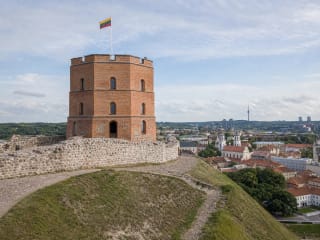
Gediminas Castle Tower
The surviving tower of the Upper Castle on Castle Hill and one of the best panoramas over the old town.
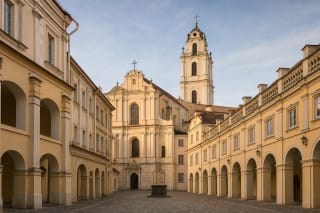
Vilnius University Ensemble
The courtyards, St Johns' Church, and bell tower of the university founded in 1579.
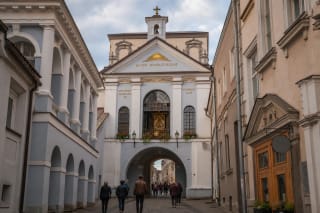
Gates of Dawn
The only surviving gate of the old city wall, with the Chapel of Our Lady of Mercy above the street.
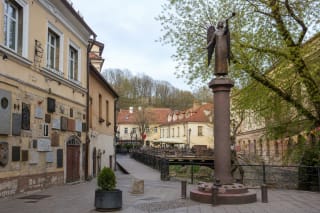
Užupis Republic
The bohemian quarter across the Vilnia River, with its own constitution and a living artist community.