- Place
- Utena, Utena District Municipality
- Region
- Utena District
- Type
- historic central square combining a ceremonial event space with a planted public garden
- Address
- Utenio Square, central Utena
- Coordinates
- 55.49515, 25.60149
- Visit duration
- 30-60 minutes; 1.5-2 hours with Utena Regional Museum and City Garden
- Best time
- June-September for the fountains and flower beds, or year-round for old-centre history; check the current schedule before travelling for a fountain show or event
Utenis Square, Uteni Square, Utena central square, Council Square
The long old-centre space is more than a fountain plaza
Utenio Square runs north to south, is enclosed by streets, and carries everyday pedestrian movement across it. It has no single main gate. Numbers 2, 3, 4, and 6 on Utenio Square identify different perimeter buildings rather than four separate attractions within the open space. This page's coordinate was converted from the LKS-94 point in the municipality's official 2025 tree-monitoring report and marks a representative part of the garden, not a car park.
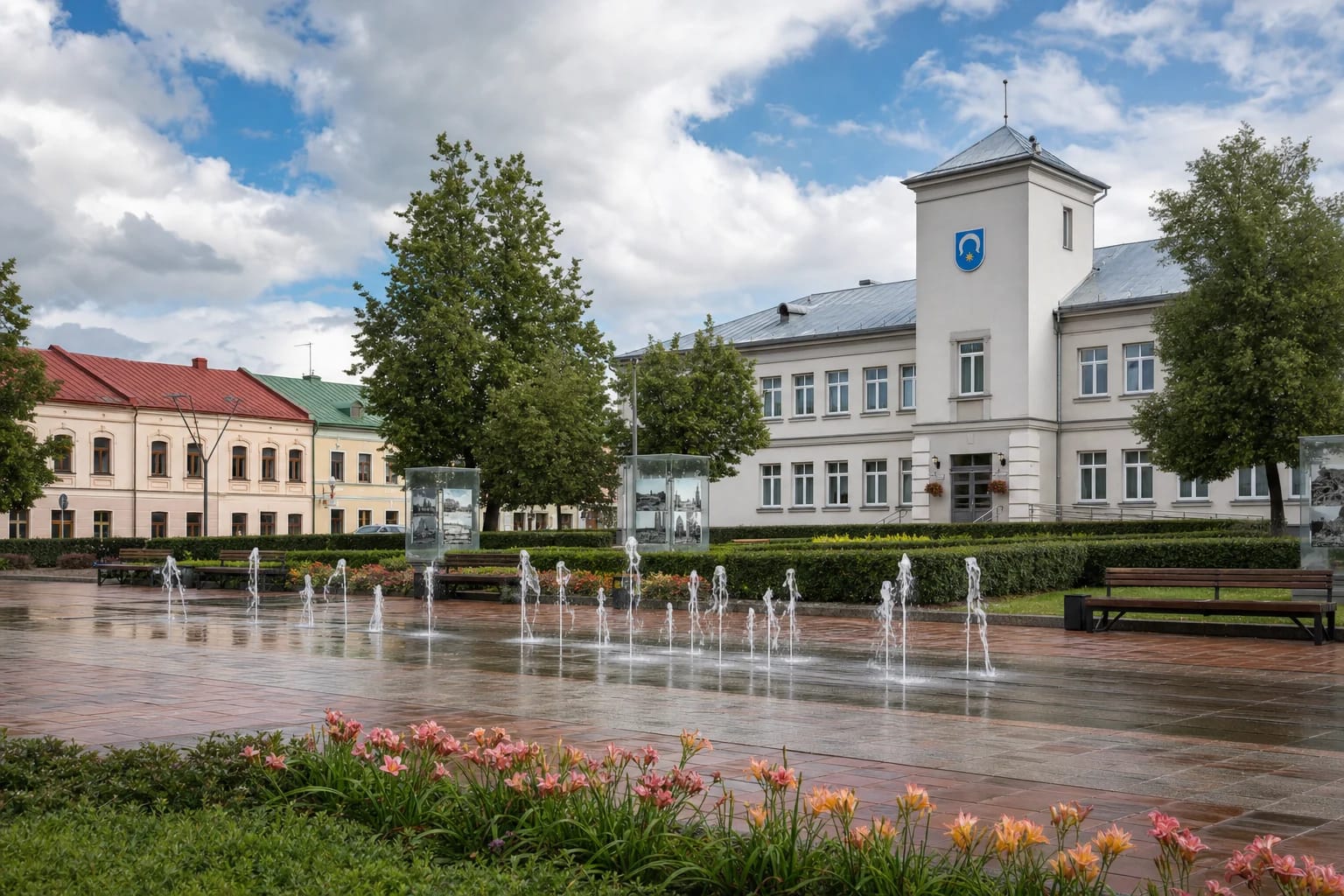
The present plan has two legible parts. A hard-paved ceremonial area beside the municipal building occupies roughly one third and supports events, commemorations, and fairs. The remaining two thirds form a planted garden with paths, benches, clipped hedges, flower beds, fountains, and transparent outdoor exhibition cases.
Utenio Square and nearby Market Square are separate spaces, although together they help visitors understand the old urban core. In 2026 the Cultural Heritage Department reviewed updated data for the Utena Old Town archaeological area, register code 27626. That status signals historically sensitive ground, but it does not make every visible paving stone or surrounding building a surviving market-era feature.
The market's changing names tell more than the legend of Duke Utenis
A trading privilege granted to Utena in 1599 encouraged the town's growth, and a four-sided market square was formed at its centre around the turn of the seventeenth century. Present-day Utenio Square belongs to this old commercial core, but its boundaries, buildings, and uses changed repeatedly. Large markets, particularly on Thursdays, remained an important part of local life for generations.
The municipality's historical account records an unusually long sequence of names. The space was called Market Square, became Paul von Hindenburg Square during the First World War, and was popularly known as Pump Square because of a hydrant. A 1926 town plan labelled it Public Square, the Utenio name followed in 1932, Soviet authorities called it Council Square, and restored independence returned the Utenio name.
Utenis in this story is a legendary founder, not the documented designer of the square. Tradition says that the duke built a castle beside the Utenėlė stream, while archaeology connects the earliest settlement with the Narkūnai hillforts several kilometres from today's centre. The name therefore preserves an origin story rather than proving that Utenis laid out a market on this exact site.
Fire, war, and the Holocaust transformed the square beyond recognition
The fire of 1879 almost destroyed Utena, and the Second World War again dismantled much of the old centre. During the interwar period, several connected brick buildings owned by R. Kabas stood in the middle of today's square and accommodated police administration, a bank branch, shops, and a dining room. They were destroyed during the war, and the present fountains occupy their former site.
Between the wars, most of Utena's Jewish residents lived around Utenio and Market squares and the streets leading to them. Shops, a pharmacy, warehouses, workshops, and other businesses shaped the neighbourhood. The Vilna Gaon Museum of Jewish History records the destruction of the Jewish communities of Utena and the surrounding area in mass killings in 1941. The openness of today's square consequently speaks not only of urban redevelopment but also of a lost community.
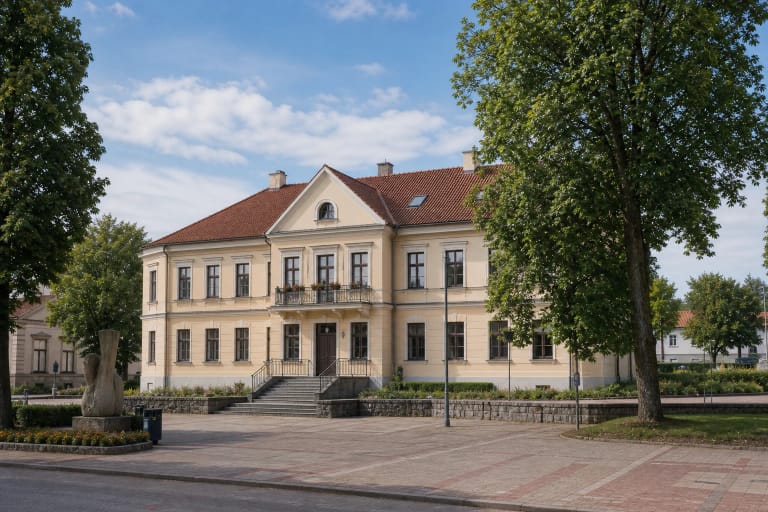
A few older perimeter buildings survived with new functions. The former E. Goldfain house at Utenio Square 3 accommodated the first Utena County municipality in late 1918, established on the initiative of Steponas Kairys; Utena Regional Museum later moved in. Plaques on the facade commemorate Kairys and the re-establishment of municipal government in 1919, while the museum's displays help recover what has disappeared outdoors.
The 2005-2006 redesign balanced ceremony with everyday rest
Landscape architects Albertas Lamauskas and Regimantas Pilkauskas redesigned the square in 2005-2006. VLE includes it among the notable Lithuanian public-space projects of the period after restored independence. The central challenge was to integrate the municipal building into the composition while respecting the scale and changing levels of the long site.
The raised ground beside the municipal offices was lowered to street level so the lower facade and square could form one civic space. Most of the remaining terrain was retained, while clinker paving and planting made the different uses readable. The open plaza supports concerts, commemorations, and fairs; the greener section is better suited to sitting and a short pause.
The Glass Gallery was installed in 2006. That year's international sculpture symposium Senajam traktui - nauji ženklai used it to display maquettes and sketches. Public interest led to the transparent cases remaining permanently in the square. The gallery structure is constant, but its contents change, so an exhibition advertised in an old event notice should not be expected on a later visit.
The memorial signs are easier to understand when kept distinct
The Aukuras memorial honours the partisans of the Vytautas District, their supporters, and couriers. Created by sculptor Vidmantas Gylikis and architect Marius Markūnas, it was unveiled on 16 May 2009. A separate stone in the square commemorates 11 March 1990; state holidays and remembrance ceremonies take place beside these markers.
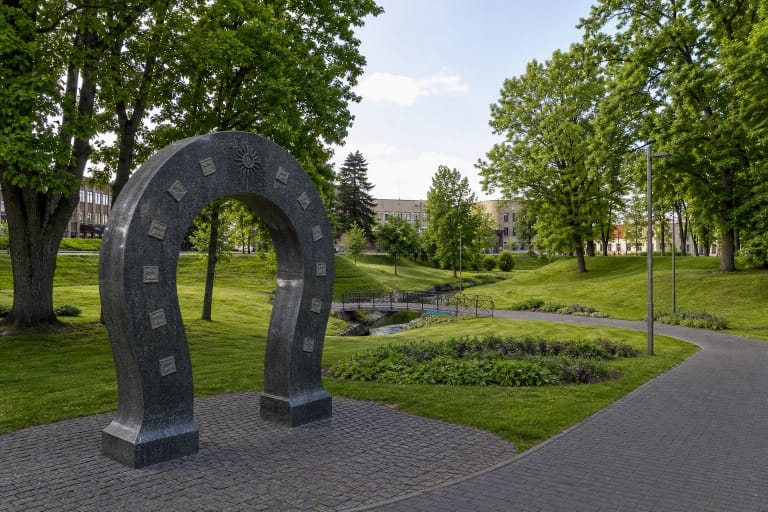
In 2020, Vytautas Šemelis's pavement-level Happiness Tile added a blacksmith-made horseshoe and a reversible Lithuanian phrase meaning happiness capital and capital of happiness. This is a small feature underfoot. It should not be confused with Kęstutis Musteikis's much larger dark-stone horseshoe-shaped sculpture Find Your Happiness in Utena City Garden.
Lauryna Kiškytė's bronze heart for Utena-born cardiologist Bernard Lown was added in 2021. Lown contributed to the development of the modern direct-current defibrillator and co-founded International Physicians for the Prevention of Nuclear War, the organisation awarded the 1985 Nobel Peace Prize. The heart connects his medical work, peace activism, and hometown memory.
The square is free, while fountains and events follow changing schedules
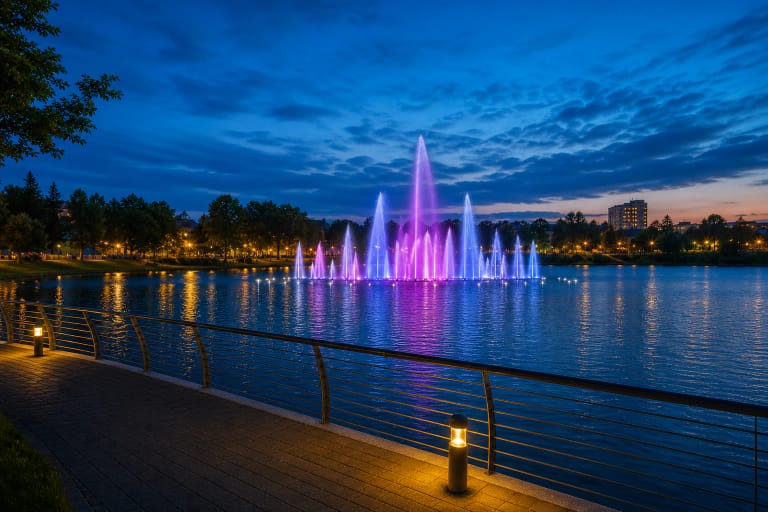
Utenio Square is an ungated public outdoor space with no general admission charge. On the review date, visitor information published fountain hours of 11:00-23:00 from June through August and 11:00-22:00 in September. This is seasonal information that may change with weather, maintenance, or events, so check the latest schedule before a trip built around the water jets and evening lighting.
The principal surfaces are firm, and the area beside the municipal offices was levelled with the street during redesign. The planted section still has gradients, wet paving beside the fountains can be slippery, and temporary stages, market tents, or barriers alter routes. No recent audit of one complete step-free circuit was found, so wheelchair users should assess the most practical approach on arrival.
Municipal plans for 2026 allocated work on technical documentation for modernising the building at Utenio Square 4 and installing a lift, together with interior repairs, but no full reconstruction or closure of the square was found. The square hosted the start of an international cycling race in May 2026, confirming its active event role. Ceremonies, races, and building work can still restrict vehicle access, so follow the signs in force that day.