- Place
- Utena, Utena District Municipality
- Region
- Utena District
- Type
- historic city garden at the meeting of two streams, with terraced slopes, mature trees, footbridges, and the Find Your Happiness sculpture
- Address
- Between J. Basanavičiaus, A. Baranausko and Maironio streets, Utena
- Coordinates
- 55.49870, 25.59839
- Visit duration
- 30-60 minutes; about 1.5 hours with the Riflemen's House and Utena Regional Museum
- Best time
- spring and autumn for the stream valley, or summer for shaded paths; the lowest banks may be wet after heavy rain
Miesto sodas Utenoje, Utena garden at the stream confluence
The garden occupies a two-stream valley, not a single street address
The municipal green-space list rounds the City Garden to about 2.7 ha, while detailed planning documents give an area of 2.65 ha. It extends between J. Basanavičiaus, A. Baranausko, and Maironio streets. Different city records consequently attach numbers such as J. Basanavičiaus Street 52 or 56 to facilities on its edge, but these are not the only park entrances. The coordinate on this page is a representative point converted from official tree-monitoring data, not a car park or a guaranteed step-free entrance.
The defining landmark is the meeting of the Krašuona and Vyžuona streams. Their channels are cut as much as approximately 11 m into the surrounding moraine plain, so the garden drops markedly below busy J. Basanavičiaus Street. The Krašuona banks can flood during snowmelt or intense rain, and low path edges and grass may remain damp after wet weather.
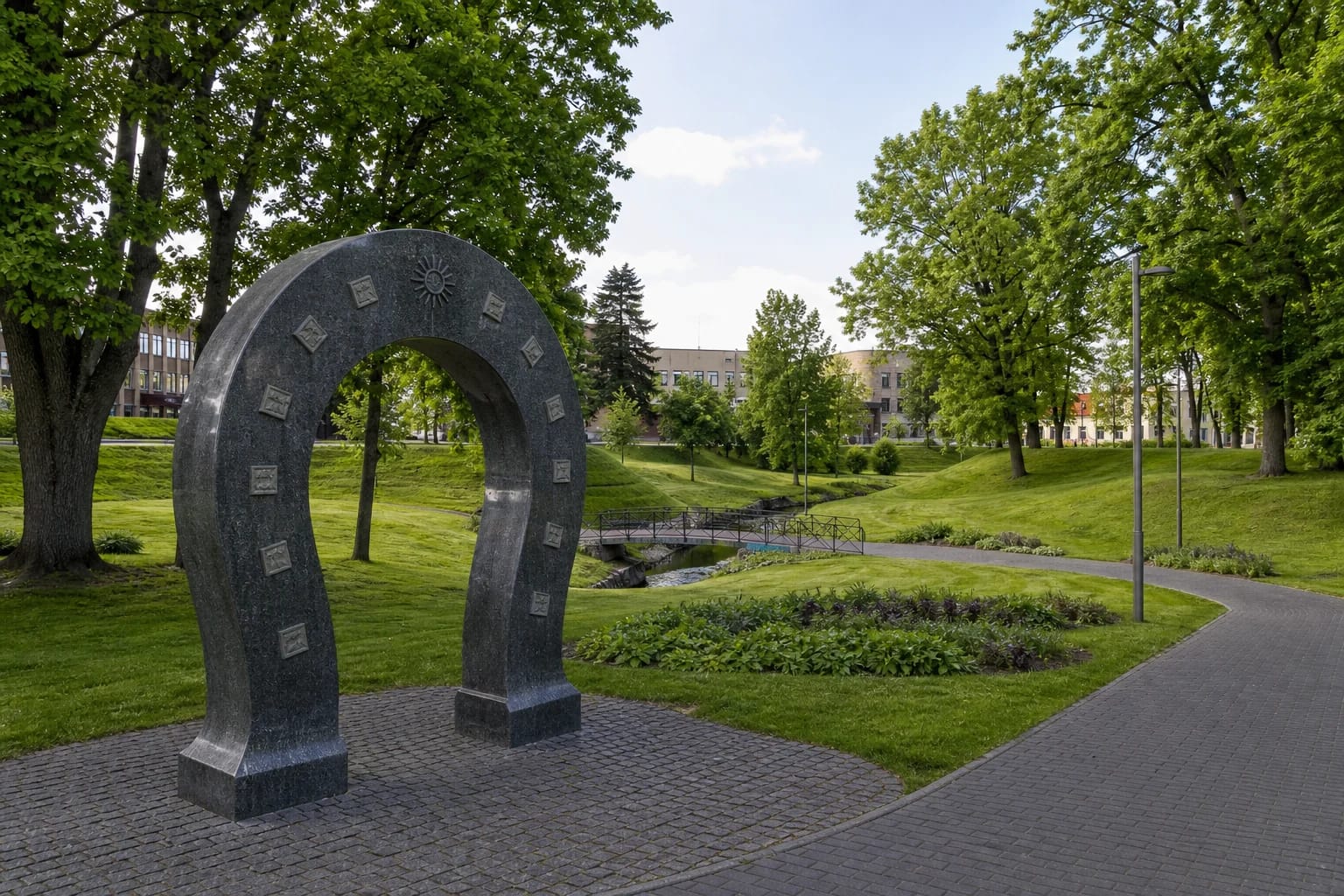
City Garden is neither Dauniškis Park nor Vyžuona Park. The official strategy treats these green spaces as connected parts of Utena's wider urban system, but each has distinct boundaries and a different character. Look for the narrow stream valley, terraces, several bridges, the visual axis towards the Riflemen's House, and a dark stone horseshoe sculpture.
Terraces formed around 1930 still govern the garden's terrain
The landscape-architecture project records that the valley slopes were terraced around 1930 and the terrace edges planted with small-leaved limes. This is the garden's real historic structure: not a single monument or building, but a reshaped natural valley whose steps and lines of old trees remain legible on a walk today.
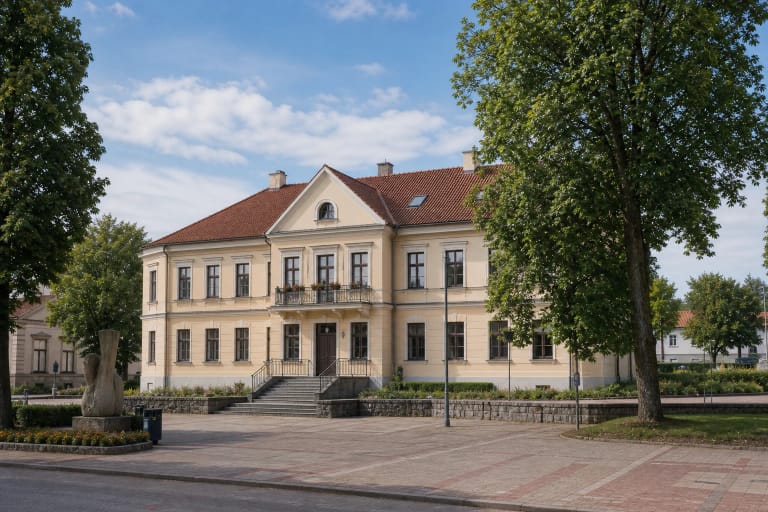
The official tourism strategy likewise associates the garden's beginnings with about 1930. The Utena Riflemen's House rose beside it in 1933. AUTC describes this restrained modernist building as one of Lithuania's most impressive examples of its type. The white building at Maironio Street 8 now serves cultural activities.
Utena Regional Museum records the formal opening of the Riflemen's House on 15 June 1933. Guests included Prime Minister Juozas Tūbelis, Lithuanian Riflemen's Union chairman Antanas Žmuidzinavičius, and Pranas Saladžius. This documented neighbouring history explains why the later landscape design directed the principal path towards the house.
The 2004-2009 redesign revealed the valley's axes instead of flattening it
Landscape architects Albertas Lamauskas and Regimantas Pilkauskas designed and implemented the City Garden renewal in 2004-2009. They retained valuable old trees, introduced new planting, organised paths and resting places, and added bridges. Crucially, the project worked with the valley rather than turning it into a level ceremonial square.
Broad stairs with a landing descend from J. Basanavičiaus Street, which sits about 2.5 m above the garden. The principal path and bridge then establish a clear sightline towards the Riflemen's House. Elsewhere, a footbridge raised about 1.5 m over the Vyžuona was designed to reveal the confluence and its more natural streamside vegetation from above.
The large event lawn is positioned so that old oaks and new planting partly shield it from road noise. The terraces include stairs, benches, and short vantage points. The most rewarding route is therefore not the quickest crossing: descend to the confluence, use more than one bridge, and return along at least one higher terrace.
An inventory of 733 plants shows an actively managed living landscape
The official 2023 inventory counted 733 trees and shrubs in the City Garden across 27 taxa. Only 7 were conifers, while 726 were deciduous. Inspectors rated 588 plants in good condition, 110 satisfactory, 25 unsatisfactory, and 10 poor. These figures describe the garden at one inspection date, not an unchanging state.
Small-leaved limes, Norway maples, and oaks form the garden's main structure, while black alders grow more naturally beside the Vyžuona. Red dogwood, mountain currant, and perennial planting help shape the lower layers. As a result, the upper terraces feel more like a designed municipal garden and the confluence floor more like a moist streamside habitat.
The 2025 monitoring report reassessed a selected 294 plants rather than all 733, so its results cannot simply be compared with whole-park percentages from 2023 or 2024. It identified weaker groups among grey alders, crack willows, and some limes, and recommended removing two higher-risk trees. For visitors, arboricultural work and temporary barriers are normal signs of caring for a park with mature trees.
A horseshoe, an oak associated with Smetona, and the Riflemen's House anchor the route
The easiest contemporary landmark to recognise is sculptor Kęstutis Musteikis's dark stone work Find Your Happiness. Shaped like an oversized horseshoe, it functions as symbolic gateway and photograph point. It is an artistic interpretation of a luck symbol, not a reconstruction of an archaeological find or former city gate.
The official tourism strategy lists an oak named for President Antanas Smetona among the garden's notable features. The checked documents provide neither a secure planting date nor proof that the president planted it himself. It is therefore accurate to call it an oak associated with Smetona's name or memory, without inventing a planting ceremony.
The white 1933 Riflemen's House closes the view along the main path and gives the park a clear architectural focus. From the upper level, turn back towards the valley; from below, watch the building appear between trees and bridge railings. A short walk then connects interwar Utena, later landscape design, and the natural confluence.
The public park is freely accessible, but the terrain makes entrance choice important
The checked official sources publish no ticket office, admission fee, or gated opening hours for City Garden. It functions as a public urban space, although events, tree care, youth-space works, or other temporary projects may close one path or lawn. Check the latest Utena District Municipality notices before a visit built around a specific facility or event.
J. Basanavičiaus Street lies around 2.5 m above garden level and the most direct descent uses broad stairs. Other approaches and hard-surfaced paths exist, but no officially tested map of a complete step-free route was found. Wheelchair and pushchair users should look for lower approaches from the A. Baranausko or Maironio Street side and assess gradients and current works on arrival.
Allow 30-60 minutes for a short circuit, and do not wade in the streams because the confluence is not a designated bathing place. For a longer town route, add the exterior of the Riflemen's House, Utena Regional Museum, and Dauniškis Park. A youth zone and temporary or planned structures appear in public documents, but should not be treated as a permanently staffed visitor centre unless the municipality publishes a current schedule.