- Place
- Jonava town eldership, Jonava District Municipality
- Region
- Aukštaitija
- Type
- Lithuanian partisan burial site and a memorial ensemble created in several periods
- Address
- 16 Panerių Street, Jonava
- Coordinates
- 55.07088, 24.28443
- Visit duration
- 20-40 minutes; longer to read the memorial plaques and walk along the Neris
- Best time
- in daylight, when the inscriptions and the whole ensemble can be viewed calmly
Stela. Partizanų memorialas, Jonava Independence Stele, Stele to Jonava's Independence Fighters, Lithuanian Partisan Burial Site and Graves in Jonava
This is a layered memorial ensemble, not just one stele
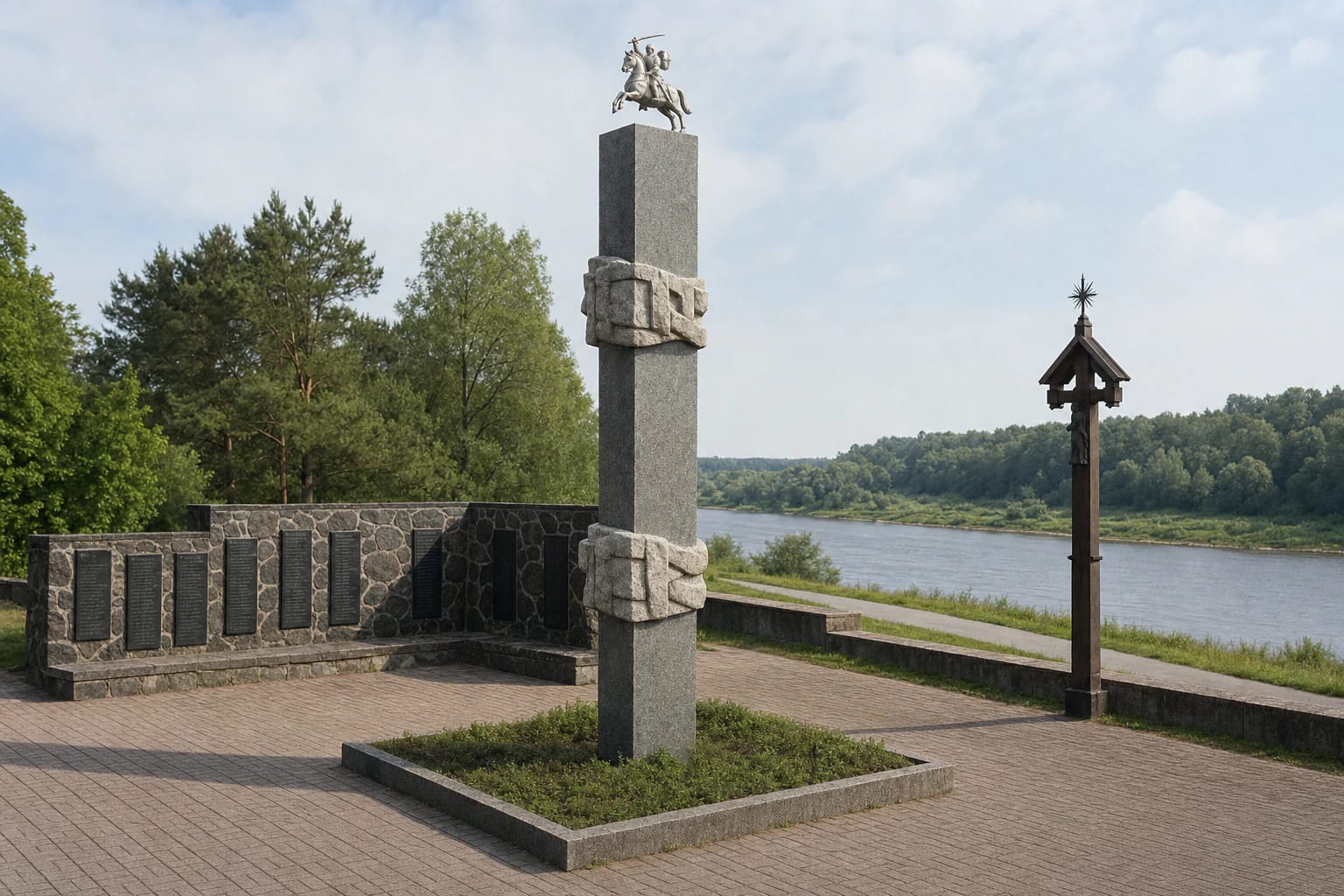
The grey-granite stele crowned by a silver-coloured Vytis is the first feature many visitors notice, but it is only the newest layer of the site. The square also contains an older stone memorial with plaques, a wooden cross, and a chapel-post. The Google Maps name “Stela. Partizanų memorialas” therefore refers to several markers created at different times.
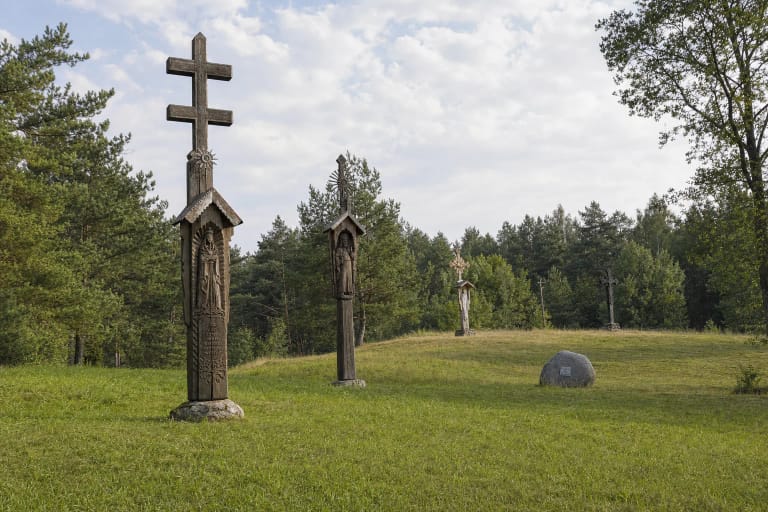
The Genocide and Resistance Research Centre's inventory records that the chapel-post by folk artists Alvydas Kučinskas and Aldona Mačiulytė was unveiled on 14 June 1990. Zigmas Koncevičius's cross followed on 13 November 1994, and the monument by architect Vytautas Juraška and Antanas Akelis was unveiled the next day.
These dates make clear that the ensemble was not created as a single project in 2018. Walk around the site rather than viewing it only from the street: read the older plaques first, then consider the relationship between the traditional wooden markers and the contemporary granite stele.
The memorial marks a partisan burial site and graves
The official inventory connects the site with partisans of the Didžioji Kova and Vytis districts who were killed around Jonava in 1944-1955 or murdered in the town's NKVD-MVD-MGB building. It states that their bodies were buried on the bank of the Neris. This is the documented basis of the memorial, not merely a symbolic dedication added later.
The place received legal protection in 2021. The Cultural Heritage Register names it the Lithuanian Partisan Burial Site and Graves, gives it the unique code 44842, and assigns national significance. The registered boundary defines the protected ground, so the burial site should not be reduced to the stele's foundation, nor should every visible plaque be assumed to mark a separate identified grave.
The public sources checked do not provide a definitive list of every person buried here. Visitors should treat the whole place as burial ground: use the prepared paths, do not step onto monuments or planted areas, and avoid disrupting commemorations.
The 2018 stele tells a story of statehood through symbols
The grey-granite stele was erected in 2018 for the centenary of the restored Lithuanian state and dedicated to independence fighters from the Jonava area. Its tall rectangular column can be seen from the memorial square and the riverside path.
Two groups of massive pale stone bands constrict the column. The municipality interprets them as allegorical shackles representing Lithuania's painful losses of independence. The straight shaft that rises above them evokes the country's road to freedom, while the Vytis at the top represents Lithuanian statehood.
The stele was created by sculptor Gintaris Česiūnas. The dates 1918 and 2018 link the restored state with its centenary, but the stele did not replace the older partisan memorial: it stands beside it and broadens the site's narrative.
The monument has become a living civic symbol for Jonava
Since 2023, the municipality has presented an Independence Stele award around 16 February for work that strengthens national identity, citizenship, and community life. The recipient receives a small copy of the Panerių Street monument, also made by sculptor Gintaris Česiūnas.
In 2026, the award went to Jonava-born partisan liaison Veronika Gabužienė. Deported with her parents, she returned to the Jonava region after 18 years, collected deportees' memories, investigated where partisans died, and worked to commemorate them. The tradition shows that the stele's symbolism is used not only to recall the past but also to recognise civic work today.
Official ceremonies may temporarily change access to the square, and wreaths or candles may be placed at the monuments. Follow organisers' directions during events; at other times, leave flowers or a candle only where they will not damage the stone or obstruct a path.
The open riverside site is free and has no ticket desk
The memorial occupies an open space on Panerių Street beside the Neris walking and cycling path. It is not an indoor museum, so there is no dedicated ticket office or regular tour departure point. The official sources checked publish no fixed opening hours; daylight is the most practical time to visit.
The main square is paved and has prepared approaches, but no detailed public accessibility audit for the entire memorial was found. Visitors with limited mobility should allow for joints between paving blocks, the approach from the street, and temporary barriers during events. Park only in permitted spaces, never on the memorial square or riverside path.
Allow about 20 minutes for a brief look or up to 40 minutes to read the plaques and take in the setting. The exact Google Maps listing showed 4.6 out of 5 from 85 reviews on 27 July 2026; ratings and review counts change over time.