- Place
- Jonava, Jonava District Municipality
- Region
- Aukštaitija
- Type
- Renaissance and Gothic masonry church
- Address
- Skarulių g. 53, Jonava
- Coordinates
- 55.07880, 24.31200
Skaruliai Church of St. Anne building complex
A solitary church beside the factory
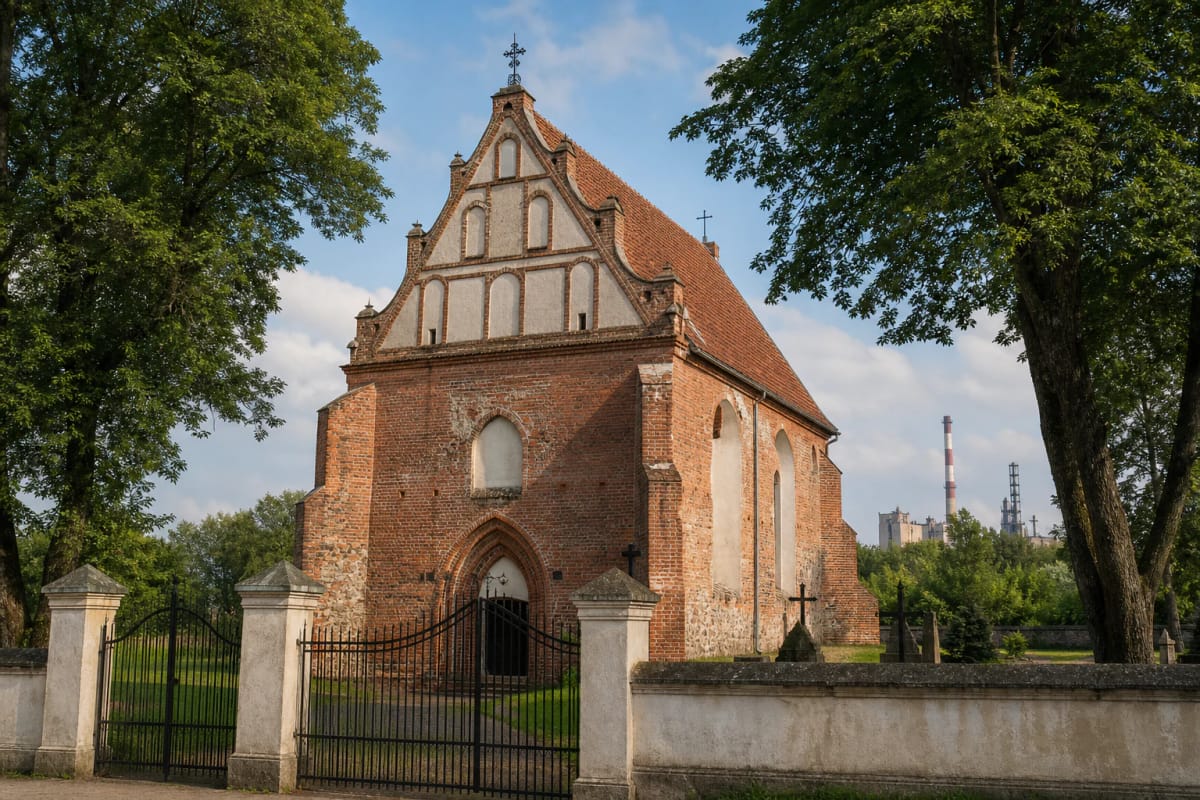
Skaruliai Church of St. Anne stands on the eastern edge of Jonava, on the left bank of the Neris, beside the huge Achema industrial complex, formerly Azotas. It is one of the oldest and most valuable Renaissance Gothic churches in the region and is entered in the Cultural Heritage Register as a nationally significant object.
Its fate is unusual: the surrounding Skaruliai village was moved during the construction and expansion of the chemical factory, so the old church remained like an island beside a vast industrial giant. That contrast is one more reason to stop here.
Built in 1622
The church was built in 1620-1622 by Andriejus Skorulskis, owner of Skaruliai Manor. Its 400th anniversary was marked in 2022, so 1622 is treated as the key date even though masonry work began slightly earlier.
A memorable tradition links the founder with the Holy Land: Skorulskis is said to have been one of the first pilgrims from the Grand Duchy of Lithuania to Jerusalem, and the church is associated with impressions from that journey. This should be treated as tradition; the Jerusalem-cross relief on the facade recalls it.
Renaissance and Gothic architecture
The church is Renaissance with strong Gothic features: red brick, rectangular plan, towerless, three-naved, with a three-sided apse and a small crypt under the presbytery. Six octagonal masonry columns divide the naves, and Gothic cross vaults cover the space.
A separate Neo-Gothic bell tower, built in 1898, stands in the churchyard. This combination of Renaissance, Gothic, and later elements makes the church one of the area's most distinctive monuments.
Valuable interior
The interior is one of the church's main values. The high altar with tabernacle and sculptures dates to the first half of the seventeenth century and is considered one of Lithuania's oldest surviving carved altars of its type. The altars of Jesus Christ and the Mother of God stand nearby.
Especially valuable are the early seventeenth-century polychrome wooden apostle sculptures, effectively a group of the Twelve Apostles and the Crucified. The Cultural Heritage Register describes these artworks as exceptionally significant, making the church an important treasury of sacred art.
Skaruliai, Azotas, and visiting
Skaruliai was once a living settlement, but in the second half of the twentieth century, during construction of the Jonava nitrogen-fertiliser factory from 1962, production from 1965, later Azotas and now Achema, the surrounding village was moved. The church and churchyard survived as a clear sign of the past beside industry.
Today the church is a filial church of Jonava parish, so the interior is easiest to see during services or the St. Anne indulgence feast. A visit usually takes 30-45 minutes; check parish or Jonava tourism information before travelling.