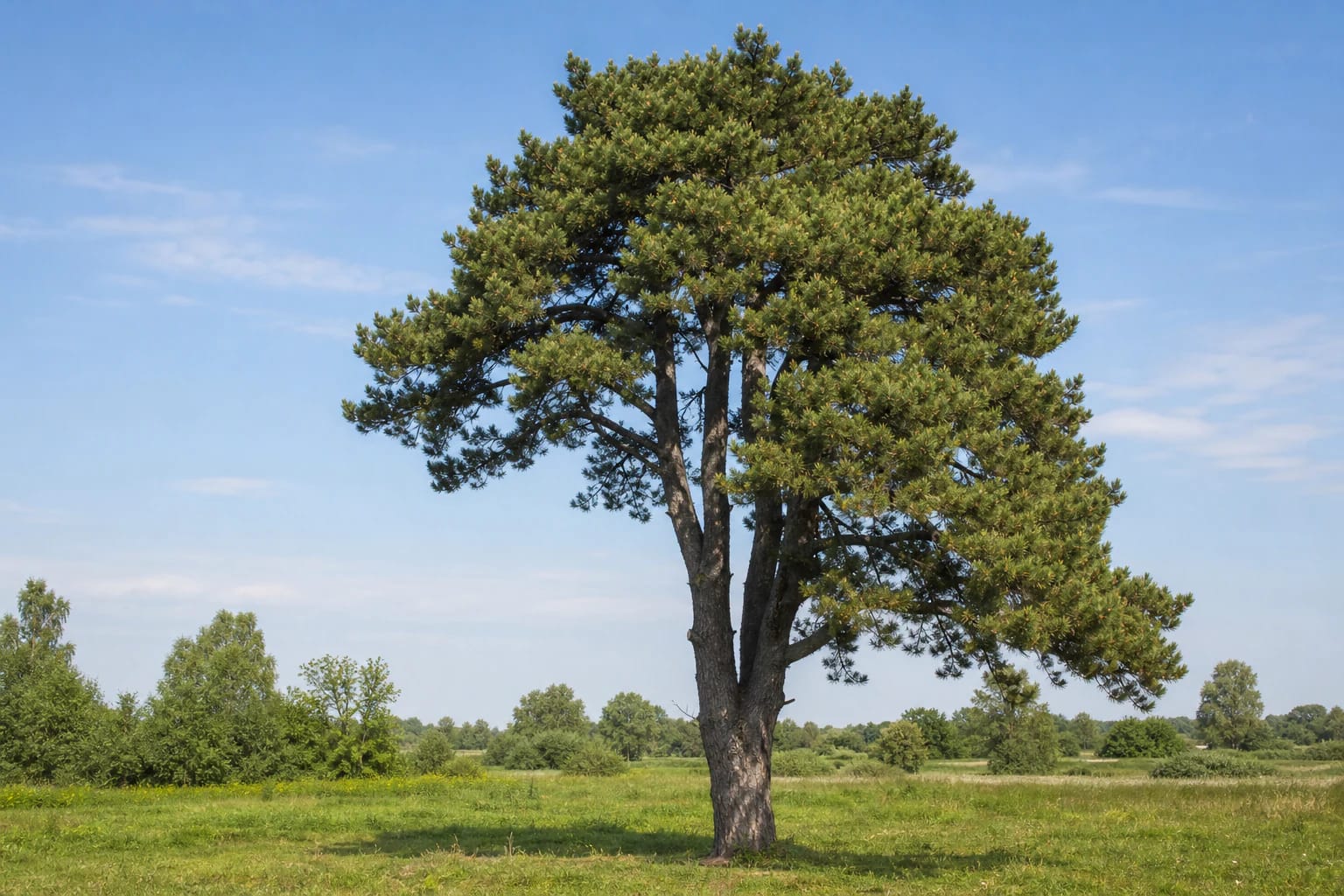
- Place
- Švenčiuliškiai, Krekenava Eldership, Panevėžys District Municipality
- Region
- Krekenava Regional Park
- Type
- botanical nature-heritage object - Scots pine
- Address
- Švenčiuliškiai area, Nevėžis Mid-Reaches Landscape Reserve, Panevėžys District
- Coordinates
- 55.54100, 24.10200
- Visit duration
- a short stop by the tree; allow longer when combining it with a Nevėžis valley route
- Best time
- a dry, bright part of the year, when the crown is clear in the open site and the approach is firmer
Švenčiuliškių pušis, Švenčiuliškiai Scots pine
A protected pine in the open Nevėžis valley landscape
Švenčiuliškiai Pine is a state-protected botanical nature-heritage object in Krekenava Regional Park. It grows not in a dense pinewood but in the open setting of the Nevėžis Mid-Reaches Landscape Reserve, so the tree reads as a distinct landmark in the wider terrain.
The open site also matters to the tree's shape. Saugoma.lt describes an irregular crown typical of a tree growing in an exposed place. From different angles the pine changes: one branch frames the sky while another part of the crown hangs lower over the meadow.
This is not a designed park with a collection of ornamental trees or an event stage. The experience is a quiet stop beside one old tree whose silhouette stands out in open ground.
A 20.9-metre Scots pine
The official object record identifies Švenčiuliškiai Pine as a Scots pine. Its trunk is 1.2 m in diameter, its circumference is 3.52 m, and its height is 20.9 m. These measurements describe the whole tree, not only the section of trunk visible from the approach.
The thick trunk opens into a broad, irregular crown, making the pine look like a long-established landscape tree rather than a uniform woodland silhouette. Wind, light, and the space around its branches are part of its living botany.
Keep away from the trunk and root zone while looking at the tree. Do not climb roots, hang objects from branches, scratch the bark, or turn the crown's dimensions into a physical challenge.
A tree within the Nevėžis reserve network
Nature-heritage register entries associate Švenčiuliškiai Pine with Krekenava Regional Park and the Nevėžis Mid-Reaches Landscape Reserve. This setting includes more than one tree: valley landforms, old river channels, meadows, and settlements form a connected landscape.
The pine is therefore not an isolated object that only needs a quick photograph. Its open surroundings explain why the tree is protected: its form and scale are read together with the spacious Nevėžis valley.
Other Krekenava Regional Park sites can make up a wider route. Separate the pine's location from village streets, old cemeteries, and other attractions when planning, because their access and maintenance may not be the same.
Finding Švenčiuliškiai Pine
Saugoma.lt gives the object point as about 55.541, 24.102 and provides an arrival link to a very nearby location. The coordinate here marks the pine itself, not a guaranteed car park or a step-free path to the trunk.
Use Švenčiuliškiai and Krekenava Regional Park landmarks when arriving, and leave the car without blocking the road or damaging the meadow. Do not drive across grass simply to get closer to the tree.
In an open site, a GPS point can look more precise than the practical access really is: roads, private plots, and pedestrian approaches do not always coincide with a map marker. Follow signs, park notices, and respect for neighbouring land on site.
Accessibility and proposed site changes
Saugoma.lt clearly says that the object is not adapted for visitors with mobility disabilities. An open meadow is not automatically step-free: ground, slopes, gates, road surface, or the distance from safe parking can all matter.
Panevėžys District's 2026-2028 strategic plan mentions a direction to adapt the Švenčiuliškiai and Gringaliai natural and cultural sites for visitors, including paths, parking, a toilet, lighting, and other measures. This is a planning document, not confirmation that all those facilities have already been installed by the pine.
Check the latest municipality or park information before travelling. If access is essential, ask not only about the tree but also about the open approach, parking, and any temporary works on the day of your visit.
A living heritage object needs protection
A botanical heritage object is not simply a photographic prop. Do not disturb soil near the trunk, drive over the root zone, light fires, or leave rubbish. Protect the grass and other plants that make the open growing site legible.
Bright, dry weather makes the crown easier to see, but heat, wind, or wet grass can change the experience. Do not approach during a storm, stand beneath major branches in high winds, or ignore current signs.
The checked official object descriptions publish no separate ticket or box-office hours. Access conditions can still vary: at a nature-heritage site, preserving the tree and its setting matters more than reaching it at any cost.