- Place
- Sumskas, Kalveliai eldership, Vilnius District Municipality
- Region
- Vilnius District
- Type
- an active eighteenth-century masonry church and former Dominican monastery ensemble
- Address
- 8 Vilniaus Street, Sumskas, 13168 Vilnius District
- Coordinates
- 54.60884, 25.72396
- Visit duration
- 30-60 minutes; longer if you explore Sumskas and the former monastery grounds
- Best time
- during officially announced visiting hours; daylight for the ensemble gates and stone wall
Sumskas Church, Sumskas Church of St Michael
Sumskas and the Dominican foundation
The settlement's beginnings are associated with the seventeenth century and the Laukininkai estate, mentioned in the sixteenth century. In 1618, Kazimieras Šumskis bought Sumskas; in 1696, his son Mykolas Rapolas Šumskis and his wife Halina founded a church and invited the Dominicans. The monks received the Kuosinė estate, and a monastic setting grew around the parish sanctuary.
The founders' first church was wooden. The present masonry sanctuary rose in 1767-1789 and was consecrated in 1789. The sequence separates two histories: the church and monastery centre began in 1696, while the masonry building now visible on the hill belongs to the late eighteenth century.
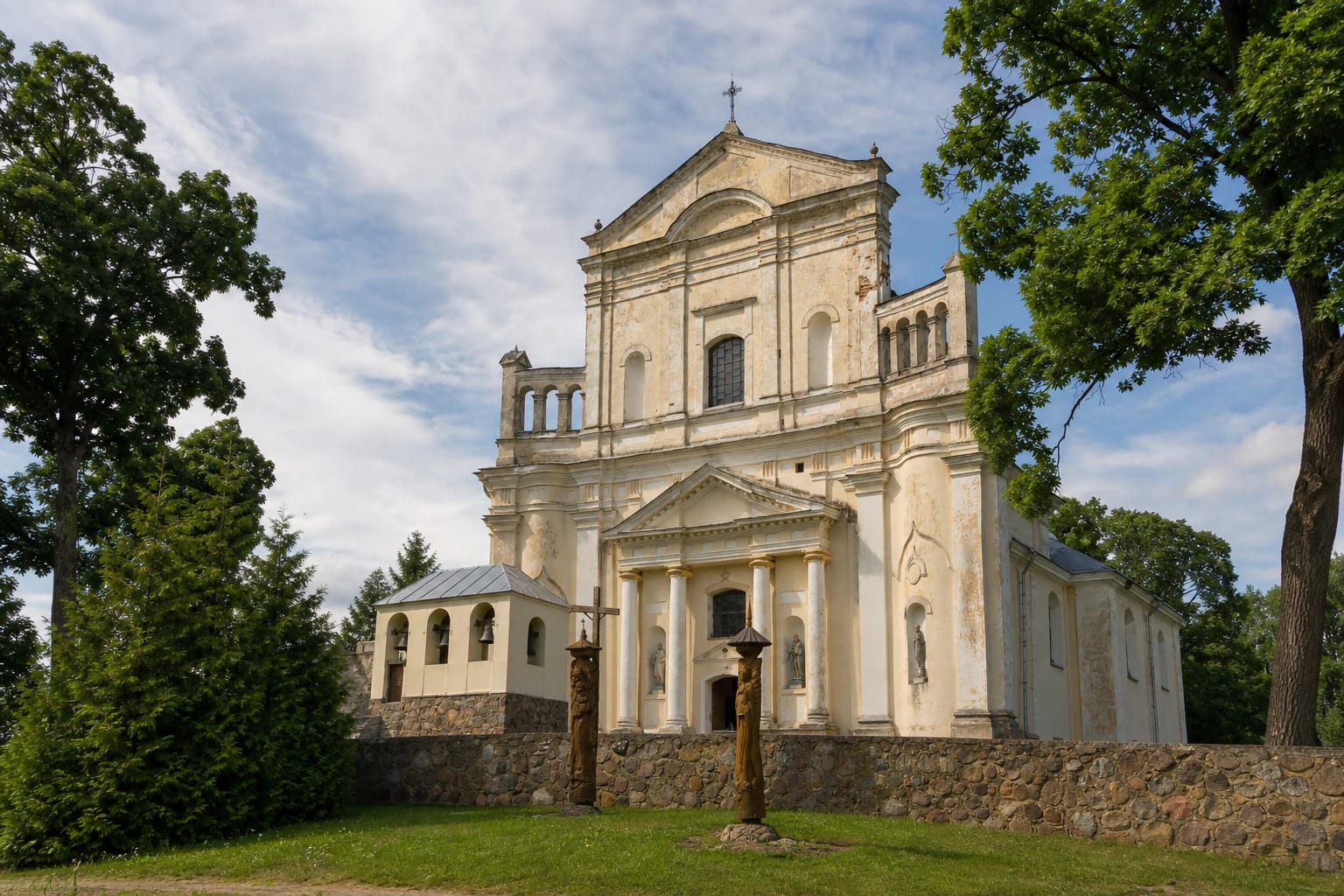
The church and monastery were placed on a green hill. On arrival, pass first through the gate beneath the belfry and then look back at the principal facade. This route reveals the historic monastic complex rather than an isolated church wall.
A late-Baroque and early-Classical facade
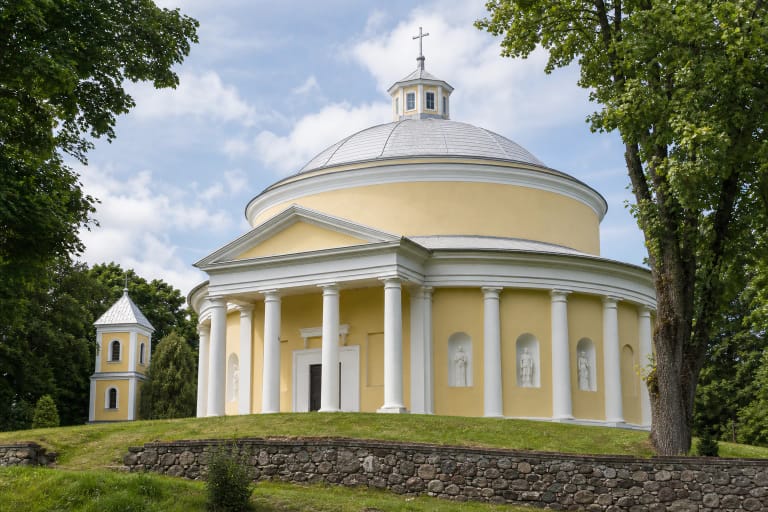
Sumskas Church has a light, massive, symmetrical volume without tall towers on its main facade. Its late-Baroque and early-Classical traits appear through rhythm, proportion, and deep arched niches and window recesses rather than through one dominant ornament.
The churchyard is entered through a gate built under the belfry. A stone wall joins the gate and bell-tower volume to the sanctuary, so the road view includes the ensemble's threshold rather than only a white facade. Step back towards the greenery to see the horizontal scale and central axis more clearly.
Look for the deep arched niches, tall windows, and restrained planes of the principal facade. This is a different experience from the twin-tower Neo-Gothic church at Karvys: Sumskas works as a calm hilltop composition, strengthened by the stone wall and trees.
Dominican traces inside
The interior retains Dominican traits, crucifix sculptures on the altars, and abundant frescoes and illusionistic painting. This is not an empty white volume: look for painted layers that create an impression of deeper space.
The main altar holds an eighteenth-century easel painting of St Michael the Archangel. In its dynamic Baroque scene, the archangel is shown defeating the devil. The work is directly tied to the dedication and explains why the sanctuary matters as more than an exterior building.
The churchyard contains a nineteenth-century chapel post with memorial plaques to the Kamienski family and Felicja Sventickienė. The former monastery garden is also described as having a chapel with Mallorca majolica images of Our Lady of Fatima and St Anthony. See these features only when the grounds are open and without disrupting prayer.
The monastery ensemble and its present condition
Sumskas Church and the former Dominican monastery belong to one historic environment. The church and monastery have been renovated, but renovation does not erase the ensemble's history: the gate beneath the belfry, stone wall, churchyard, and former garden remain distinct layers of the place.
Sumskas lies about 32 km east of Vilnius, near the Belarusian border. Plan time for the settlement itself rather than treating the church hill as a passing roadside stop. The surrounding greenery gives the architecture room, although summer leaves may hide parts of the wall and secondary buildings.
The place is still defined by worship. The sanctuary belongs to the Naujoji Vilnia deanery, and Mass is celebrated only in Polish. Plan your visit as an encounter with a living parish, not as a permanently open museum.
When to visit Sumskas
The Vilnius Archdiocese lists Mass at 17:00 on Monday, Wednesday, and Friday; at 9:00 on Tuesday, Thursday, and Saturday; and at 8:00 and 12:00 on Sunday. All listed services are in Polish. Schedules can change, so check the archdiocese website before travelling.
The Vilnius District tourism information-centre entry lists visiting hours of 11:00-16:00 on Wednesday to Friday and 11:00-15:00 on Saturday and Sunday; Monday and Tuesday are listed as closed. Because hours can be updated, confirm them during the week of your trip before planning interior access.
The address is 8 Vilniaus Street in Sumskas. Allow 30-60 minutes for the ensemble, photograph only where permitted, and do not enter closed monastery or garden areas.