- Place
- Vilnius District Municipality
- Region
- Vilnius Region
- Type
- Grand Duchy of Lithuania masonry enclosure castle with donjon and museum exhibition
- Address
- Šv. Kazimiero g. 2, Medininkai, Vilnius district
- Coordinates
- 54.53944, 25.64999
Medininkai Castle, Medininkai enclosure castle
What You See First
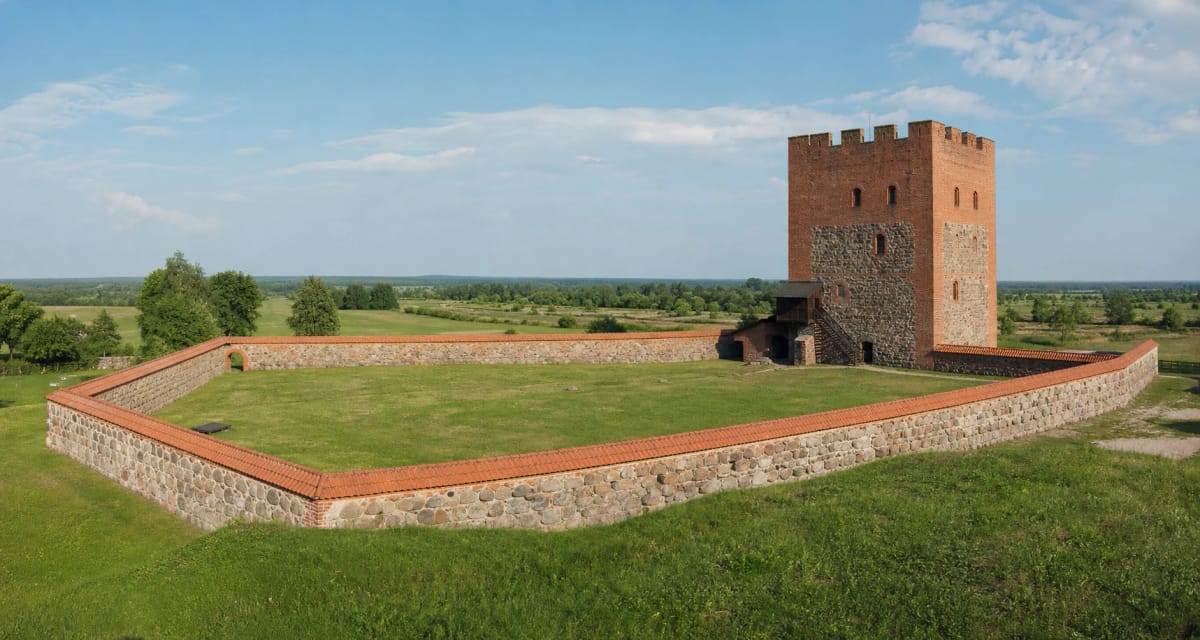
Medininkai Castle is not a decorative palace ensemble. It is an open, low, clearly defensive place: a large quadrangular courtyard, fieldstone walls, red-brick inserts, tile caps on the walls, and the donjon rising in the northeast corner.
VLE gives the wall perimeter as 568 m, original wall height as 14-15 m, surviving height at about 70 percent, wall thickness as 1.8-1.9 m, and courtyard area as about 2 ha. Three ruined towers protrude from the walls. Even today, the castle works through scale rather than ornament.
The Largest GDL Enclosure Castle
Medininkai is considered the largest masonry enclosure, or gardinė, castle by area in the Grand Duchy of Lithuania. It is among the least altered, so the early masonry defensive principle is easy to read: long walls protect a large courtyard, while towers and gates control access.
The masonry uses fieldstones and brick in a shell construction with Baltic brick bonding. VLE connects its structure with Lida, Kreva, and the first Kaunas Castle, making it useful for understanding a family of early GDL masonry castles.
Ditches, Marsh, and Frontal Defence
The castle was built not on a high hill but on sloping ground near marshland. On the higher eastern side, a double defensive ditch system survives; VLE gives about 20 m width and 3-8 m depth. On the western marsh side, traces of a rampart remain.
This explains the castle's character: not a romantic hilltop panorama, but a large refuge and frontal-defence space where local people could shelter during Tatar or Teutonic attacks.
Date and Importance
The safest date is the late thirteenth century or first half of the fourteenth century. Trakai History Museum links it with Gediminas' time and the early fourteenth century, while VLE presents arguments for earlier, thirteenth-century masonry: the brick masonry of the north and east walls is considered the oldest above-ground masonry surviving in Lithuania, close to the thirteenth-century masonry of Riga's buildings and to the masonry found in the archaeological layers of the Vilnius Lower Castle and Old Trakai.
Written sources mention Medininkai Castle from 1311-1313. The Teutonic Order attacked in 1320, 1385, 1392, and 1402, and in 1402 the castle was burned. From the late fifteenth century it was no longer used for defence, and after an early sixteenth-century fire it was abandoned.
Donjon and Museum Exhibitions
The main visiting point is the restored northeast tower, the donjon. VLE notes that historically it was about 30 m high, five storeys tall, with living spaces; before restoration, a five-storey fragment of about 23 m remained.
Trakai History Museum states that four exhibition halls are installed in the donjon, with cannon, stone shot, archaeological finds, fourteenth- to eighteenth-century GDL arms, tenth- to twentieth-century silver items, and a representative hall with access to the viewing platform.
Restoration and Present View
The castle was researched and conserved through the twentieth century, including studies by S. B. Lasavickas and K. Mekas in 1955-1956 and 1960-1962, conservation in 1961-1963, restoration in 1970-1973, and a history exhibition in 1974. In 1994-2000, under a project led by J. R. Glemža, about half of the donjon was rebuilt and the defensive walls were conserved and roofed with protective tiles; the donjon rebuilding was supported by the Medininkai Castle Fund of the American Lithuanian Engineers and Architects Association.
Since 2004 the castle has again belonged to Trakai History Museum; a reconstruction programme was prepared in 2006, and reconstruction in 2010-2012 helped create the clear museum-adapted castle body visitors see today.
How to Visit Meaningfully
Do not rush only to photograph the tower. Walk the courtyard and walls slowly to understand the scale, gate openings, empty yard, and how many people could fit inside the enclosure during danger.
On a clear day, climb to the donjon viewing platform. From there, the quadrangular plan, wall lines, Medininkai settlement, green surroundings, and nearby highest-points area make sense together.