- Place
- Kaišiadorys District Municipality
- Region
- Kaišiadorys District
- Type
- active Neoclassical rotunda church beside Lake Kalviai
- Address
- Lapainios g. 39, Kalviai, LT-56283 Kaišiadorys District
- Coordinates
- 54.70895, 24.28359
- Visit duration
- 20-40 minutes for the exterior, churchyard, and lake view; longer if the church is open or you attend Mass
- Best time
- a bright day for the architecture and lake setting; before the officially listed 12 noon Sunday Mass if you hope to see the interior
Kalviai Church, Kalviai Rotunda, Church of St Anthony of Padua in Kalviai
From the Pac chapel to the Wawrzecki rotunda
The first church in Kalviai was built in 1753 through the efforts of Antanas Mykolas Pac. That timber building burned in 1792, so none of it forms part of the present sanctuary, which was conceived afresh at the beginning of the nineteenth century.
The owners of Kalviai Manor, Tomas and Józefa Wawrzecki, began the new masonry church in 1800. It was completed and consecrated to St Anthony of Padua in 1806. Tomas Wawrzecki had served in the Four-Year Sejm of the Polish-Lithuanian Commonwealth and was the last Grand Standard-Bearer of Lithuania.
The church and its setting continued to change. Fire and storms affected it during the nineteenth century, while the interior was altered and the present churchyard belfry built in 1936. The registered heritage complex now brings together the church, belfry, and their landscape relationship.
Why Kalviai Church is an architectural exception
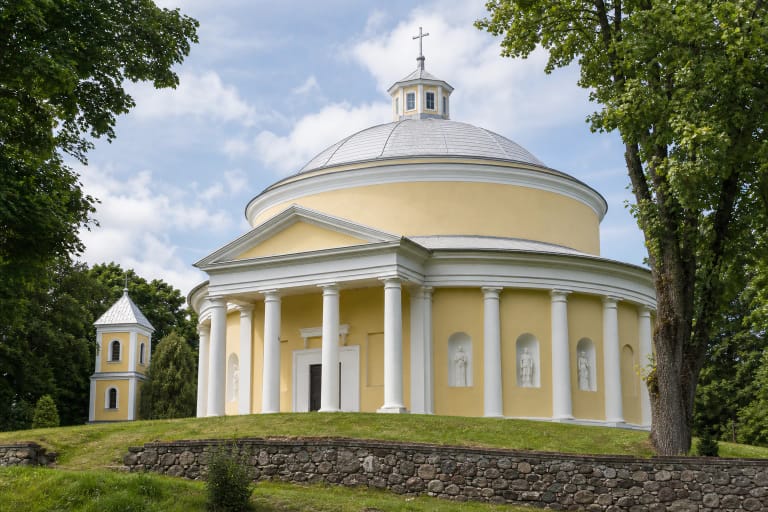
The main body is a true rotunda, a sanctuary planned around a circle. This is exceptionally rare among Lithuanian Catholic churches. VLE calls Kalviai the country's first masonry church of its kind, and the most useful comparison is the somewhat later Holy Trinity Church in Sudervė.
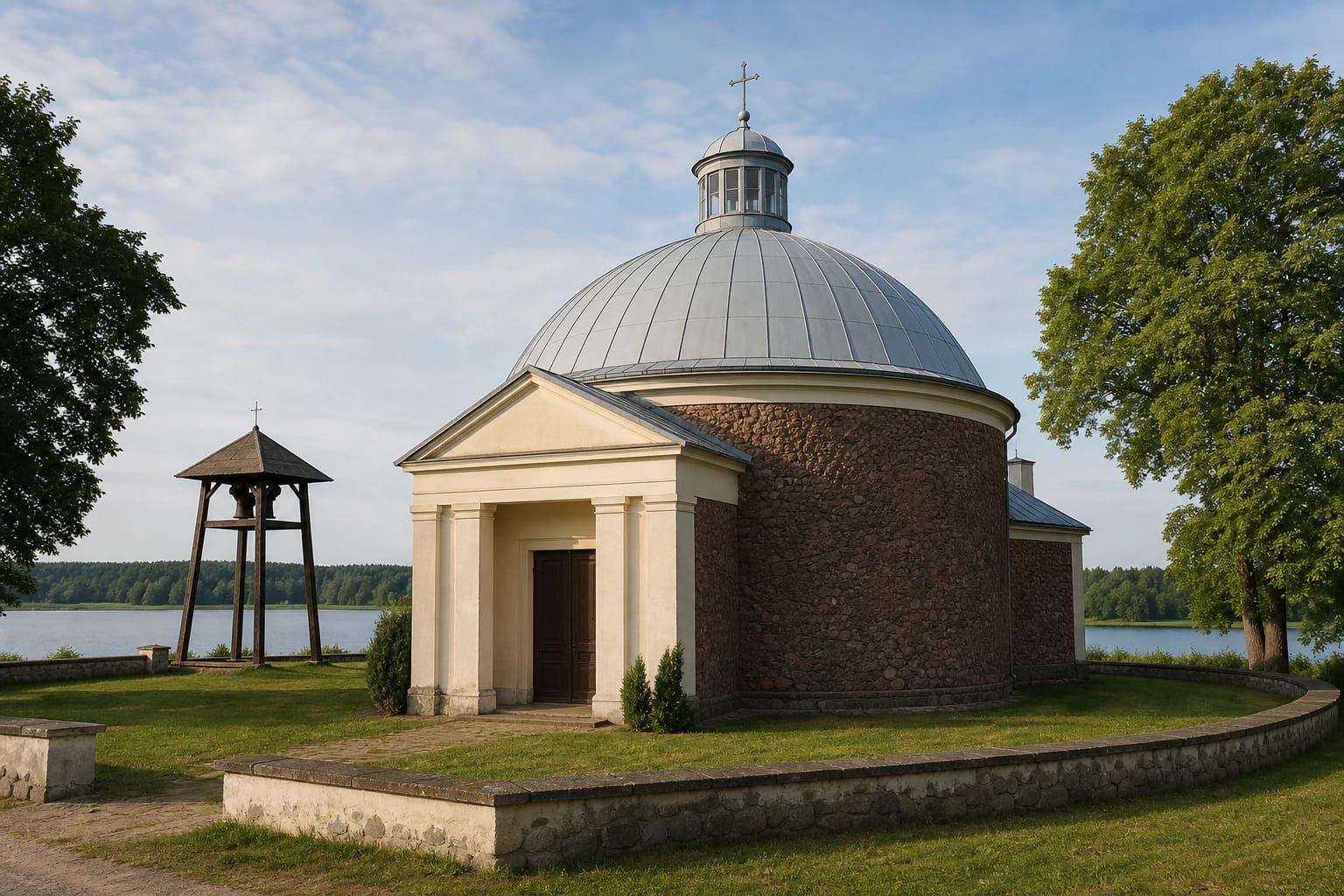
Rectangular porch and sacristy volumes attach to the round body. A classical Doric portico and triangular pediment emphasise the entrance, while the roof rises into a dome, glazed cylindrical lantern, and cross. Clear geometry, rather than a high steeple, gives the small building its monumental character.
The exterior is not exposed red brick. Instead, red field-granite chippings coat the rendered masonry, an unusual finish whose granular russet surface contrasts with the pale portico, cornice, and dome. Walk close enough to distinguish this stone texture from ordinary brickwork.
A windowless hall lit from the dome
The curved walls of the main hall contain no conventional windows. Daylight falls from above through the lantern over the dome, so the interior changes subtly with the weather and time of day. This central light reinforces the geometry and draws the eye upwards.
Research published by Kaišiadorys Museum records an earlier colonnade and gallery that once encircled the interior. Only a section beside the organ survived the 1936 reconstruction. The present hall therefore does not reproduce every aspect of the original Wawrzecki-period arrangement.
The church has three altars. The timber high altar acquired Gothic Revival forms, while the two side altars are associated with Baroque Revival design. A stone holy-water vessel shaped like a traditional mortar is recorded in the porch. These details are visible only when the doors are open.
Churchyard, belfry, and the Lake Kalviai landscape
The church occupies higher ground at the edge of Lake Kalviai, so its silhouette is inseparable from water, grass, and mature trees. A good short route is to walk around the rotunda from the portico, following the curved wall past the sacristy and viewing the dome from the lake side.
A simple open belfry built in 1936 stands in the churchyard, its hipped roof carried on timber posts. It deliberately does not compete with the rotunda. The low horizontal structure makes clear that the complex's focus is the central domed composition rather than a conventional bell tower.
The lakeshore may be busier than the churchyard on warm weekends. This remains an active place of worship, so keep a respectful distance when photographing from the grounds and avoid interrupting services or private rites.
Mass, access, and planning a visit
On 27 July 2026, the official diocesan parish page listed Sunday Mass at 12 noon. This is not a museum timetable: the doors may remain locked at other times, and services can change for feasts or pastoral reasons. Recheck the diocesan page or contact the parish before travelling.
There is no admission charge to view the exterior or attend worship, but entry to an active church depends on it being open and on any rites in progress. If you want time to study the interior rather than simply attend Mass, arrange access in advance.
The approach may include uneven ground and the historic building may have thresholds. The official parish page does not give a complete step-free access description, so ask about individual requirements in advance. Google Maps showed 4.8 out of 5 from 269 reviews on 27 July 2026; both figures change.