

- Genre
- Stone legend
- Source status
- widely known folklore legend
- Motifs
- devil, rooster, stone, church, Anykščiai, Darius and Girėnas
Puntukas, Puntukas Stone, Anykščiai Puntukas
The Legend of Puntukas Stone
It is said that in old times the devil wanted to crush the Anykščiai church with a stone. At night he chose an enormous boulder, threw it onto his shoulders, and waded through the dark toward the town so that no one could stop him before dawn.
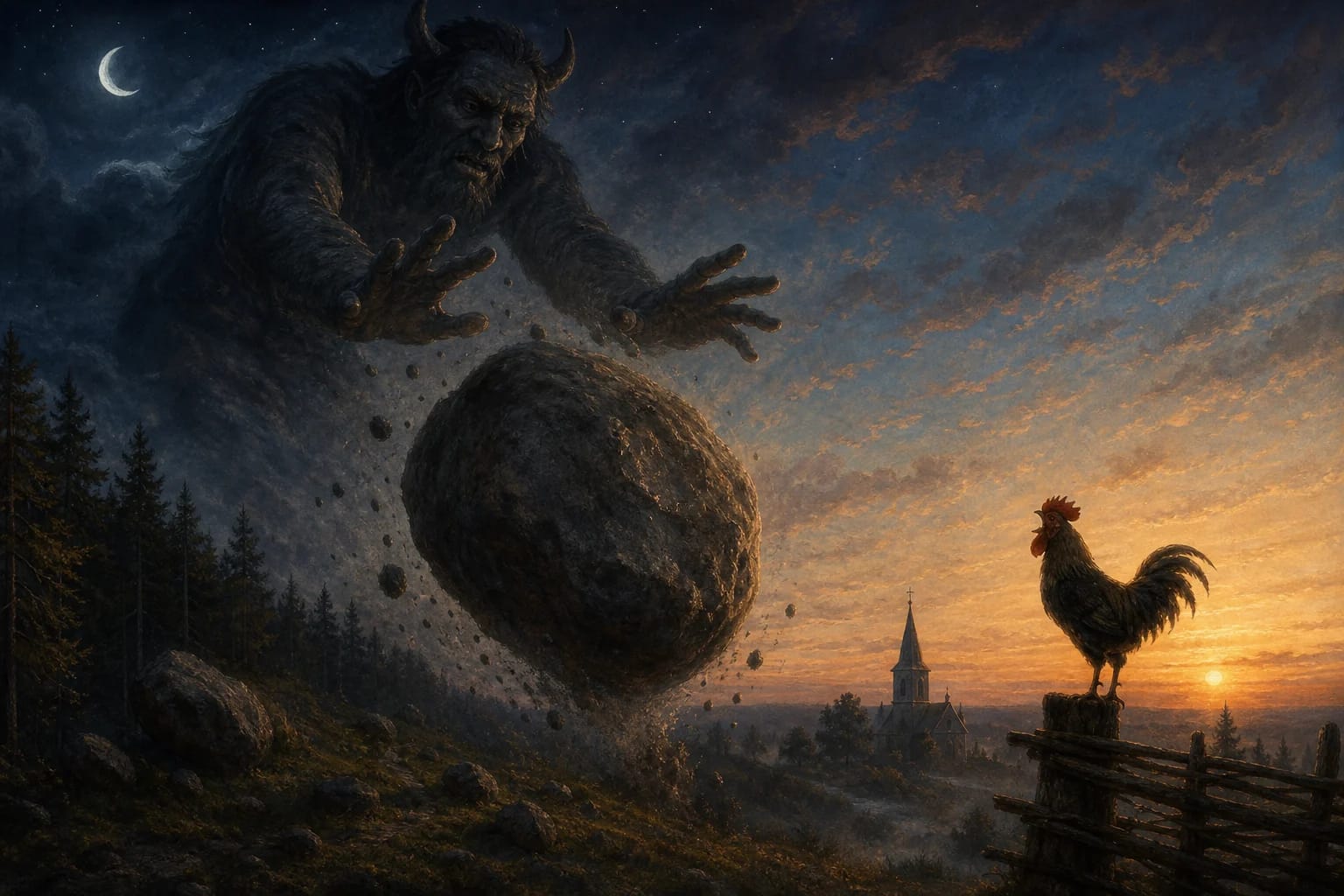
Carrying the stone was hard even for the evil one. When he was already nearing Anykščiai, a rooster crowed. The power of night broke at once: frightened by the sign of light, the devil threw his burden aside and vanished into the forests.
That is how Puntukas remained lying near the Šventoji. Other stories explain that the name is connected with a man named Puntukas, perhaps a sacrificer, warrior, or nobleman. In the legends the stone is therefore both the devil's abandoned weapon and a sign of old memory.
Interpretation of the Puntukas Stone Legend
The Puntukas plot brings the old and Christian worlds into collision. The devil tries to destroy a church, but he is stopped by the rooster, a sign of dawn, order, and the new day. The stone becomes frozen proof of his defeat.
The legend also explains the unusual size of the boulder. A huge natural object asks people for a story, so a stone carried by a glacier becomes, in folklore, an object deliberately carried but not used in time.
The later bas-relief of Darius and Girėnas added another layer of memory: Puntukas became not only a mythological object but also a sign of modern Lithuanian heroism.
History of the Puntukas Stone Legend
VLE gives several versions of the name and legend of Puntukas: the devil carried the stone toward the Anykščiai church but dropped it when the roosters crowed; other versions mention Puntukas as a sacrificer or warrior.
Puntukas was long considered Lithuania's largest boulder until larger stones were later identified. Even so, its visibility, its place in Anykščiai Forest, and the memorial layer of Darius and Girėnas have made it perhaps Lithuania's best-known stone.
Today the legend matters not as a geological explanation but as the language of place memory: it helps explain why one boulder became a national object of storytelling.
Puntukas is the second-largest boulder in Lithuania. The bas-relief of the aviators Darius and Girėnas and an excerpt from their testament were carved into it in 1943 by sculptor Bronius Pundzius. The plot of a devil-borne stone dropped when a rooster crows is a classic type of Lithuanian stone legend. Lithuanian place legends are collected in Žemės atmintis: Lietuvių liaudies padavimai (1999) and classified in Bronislava Kerbelytė's catalogue, vol. 3 (2002).