- Place
- Vilkaviškis District Municipality
- Region
- Vilkaviškis District
- Type
- large boulder and geological, mythological heritage object
- Address
- Vištytis Eldership, Vištytis Regional Park, Vilkaviškis District Municipality
- Coordinates
- 54.47000, 22.70500
Great Stone, Footmarked Stone, Miraculous Stone
The great Vištytis boulder
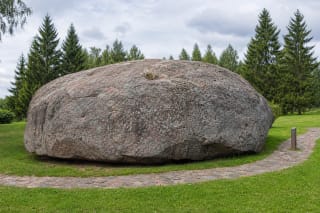
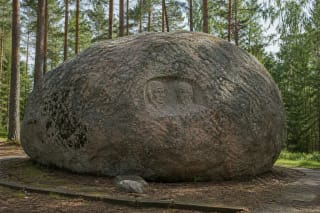
Vištytis Stone is in Vištytis Eldership, Vištytis Regional Park, Vilkaviškis District. Saugoma.lt calls it the largest and most impressive boulder in Vištytis Regional Park, while VLE states that it is the sixth-largest stone in Lithuania.
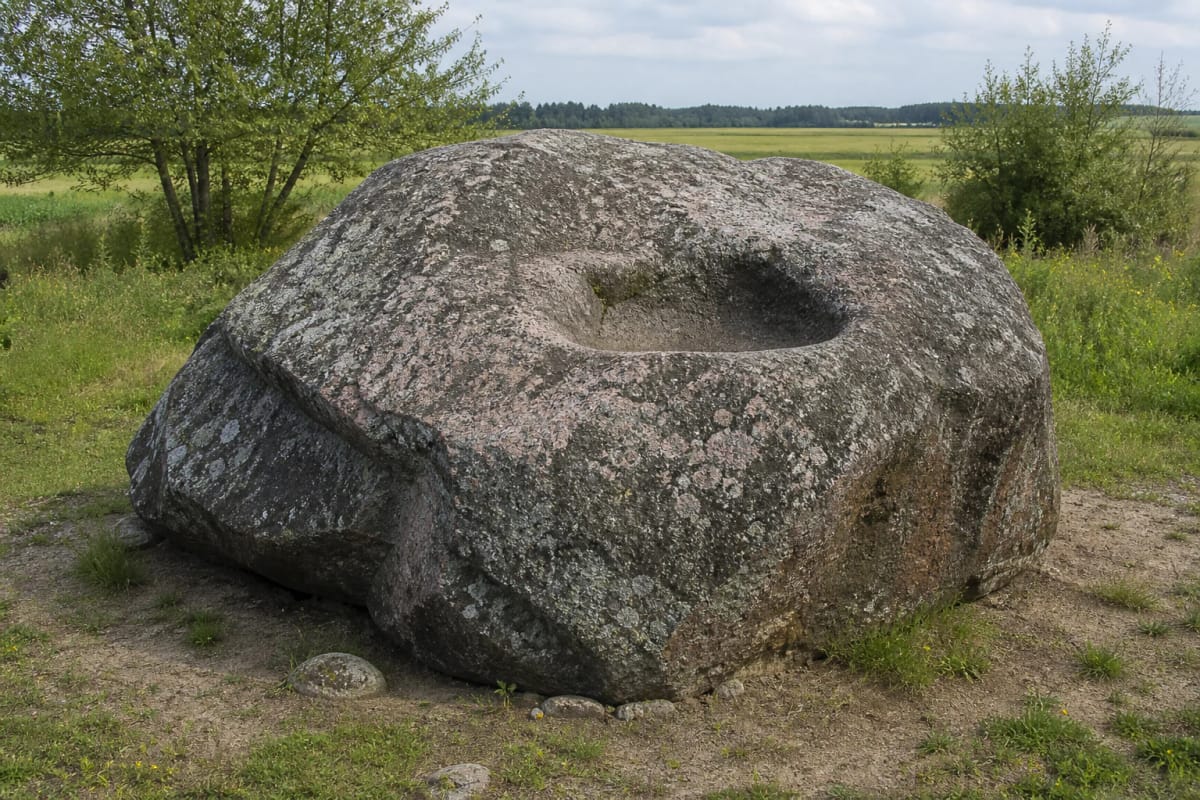
The place is interesting because it has two layers. The first is geological: a large Ice Age erratic boulder of microcline granite. The second is mythological and religious: the bowl on top of the stone, called the Devil's Foot, and the stories connected with it.
Dimensions and rock
VLE gives precise measurements: Vištytis Stone is 7.1 m long, 4.74 m wide, 4.01 m high, and its greatest horizontal circumference is 16.86 m. Petrologically it is microcline granite with biotite.
Like other large Lithuanian boulders, Vištytis Stone is a glacial legacy. It helps explain that Suvalkija's landscape is not only flat country: many Ice Age traces remain both underground and on the surface.
Devil's Foot and the bowl
On top of the stone is a bowl-shaped hollow about 90 cm long, 75 cm wide, and 40 cm deep. Saugoma.lt calls this hollow the Devil's Foot, while VLE notes that the footprints were regarded as the devil's or the Blessed Virgin Mary's footprints.
Rainwater collects in the hollows. Saugoma.lt and VLE note a belief that this water had healing powers. Present that motif as belief and tradition, not as medical advice.
Mythological and religious layer
Saugoma.lt states that Vištytis Stone is included in the List of Mythological Places of the Lithuanian Register of Immovable Cultural Values. It also notes that in ancient times the stone may have been an altar of the old Lithuanian religion.
VLE adds a Christian layer of tradition: in the eighteenth century the stone was called the Stone of the Most Holy Trinity, and according to testimony by former Vištytis parish priest Kazys Montvila, around 1800 and later believers came to it in procession during the Cross Days.
Attempts to destroy the stone
VLE notes that the sides of the stone are chipped, with carved holes and metal wedges still visible. This is connected with the 1930s and 1940s, when people tried to destroy the stone.
That detail matters because it shows that the natural monument did not simply survive by default. Large boulders were often treated as building material, obstacles, or raw stone, so the surface seen today is also part of a survival story.
Protection status
VLE states that Vištytis Stone has been protected since 1964 and has been a geological natural-heritage object and natural monument since 2000. Saugoma.lt also emphasizes its mythological status.
When visiting, look at the stone not only as a large photo object. Its bowl, chipped sides, mythological stories, and protection history matter as much as its dimensions.
How to visit Vištytis Stone
Vištytis Stone works well as a short stop while travelling through Vištytis Regional Park. View it from several sides, notice the hollow on top and the chipped sides, but do not climb on the boulder or collect water from the hollows.
The best photograph usually comes from stepping back far enough to show the whole stone and the scale of its surroundings. A close-up is useful for the hollow, but it does not show why Vištytis Stone ranks among Lithuania's largest boulders.