- Place
- Panevėžys City Municipality
- Region
- Panevėžys
- Type
- working historic bookshop in a listed building dating from 1890-1900
- Address
- 21 Respublikos Street, Panevėžys
- Coordinates
- 55.73015, 24.35955
- Visit duration
- 20-45 minutes for the shop and facade; 1-2 hours with the courtyard and nearest central cultural sights
- Best time
- in daylight during shop hours; recheck the day's schedule and courtyard access before travelling
J. Masiulio knygynas, Juozas Masiulis Bookshop, J. Masiulis Bookstore, Masiulis Bookshop, Panevėžys's first Lithuanian bookshop
Visit it as a reader, not as a museum: the history survives in the fabric of a working shop
The door at 21 Respublikos Street opens into a privately operated bookshop that continues to trade in a historic building. Its official pages do not advertise a visitor ticket, permanent museum exhibition, or daily drop-in tour. On 18 July 2026 the published hours were Monday-Friday 09:00-18:00 and Saturday 09:00-14:00, with Sunday closed. Check them again before travelling because this is a business timetable rather than fixed monument access.
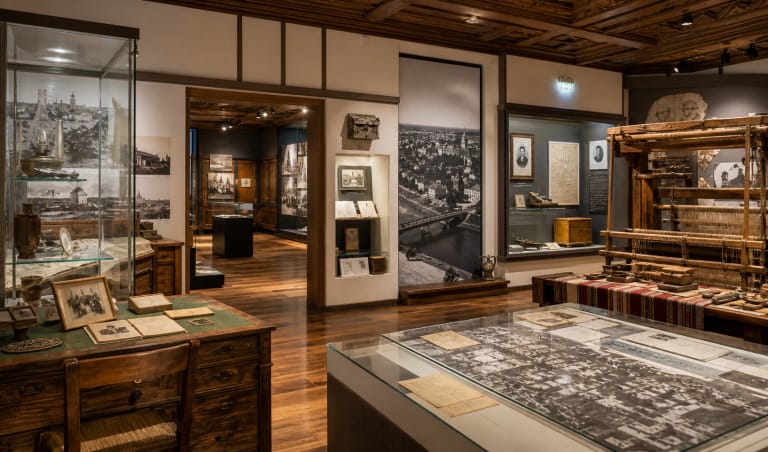
Bookshelves and shop windows remain the main purpose of the interior, but several layers of memory survive in the sales room. The municipality's account of the 120th anniversary identifies a portrait of Vytautas the Great that decorated the shop during the interwar period and a portrait of Juozas Masiulis painted before the Second World War. A 1982 refurbishment added ceramic artist Rimantas Skuodis's eight-panel Laiko mozaika, or Mosaic of Time. These works belong to a working retail environment, so ask a member of staff if you wish to inspect or photograph a particular piece.
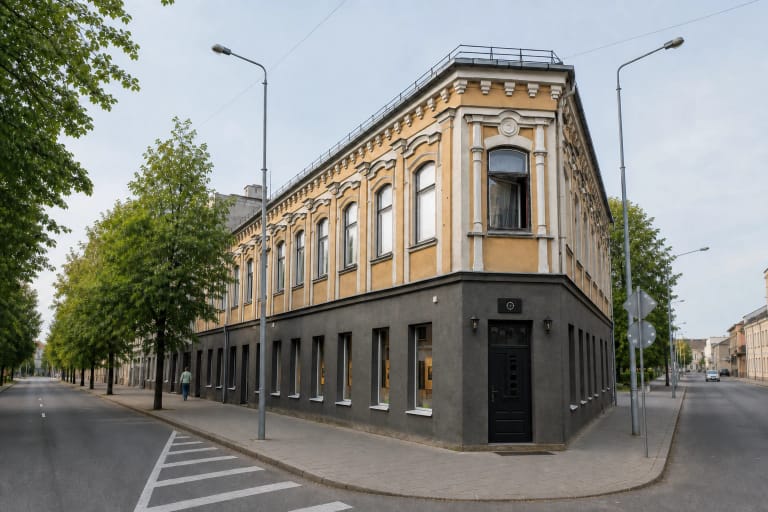
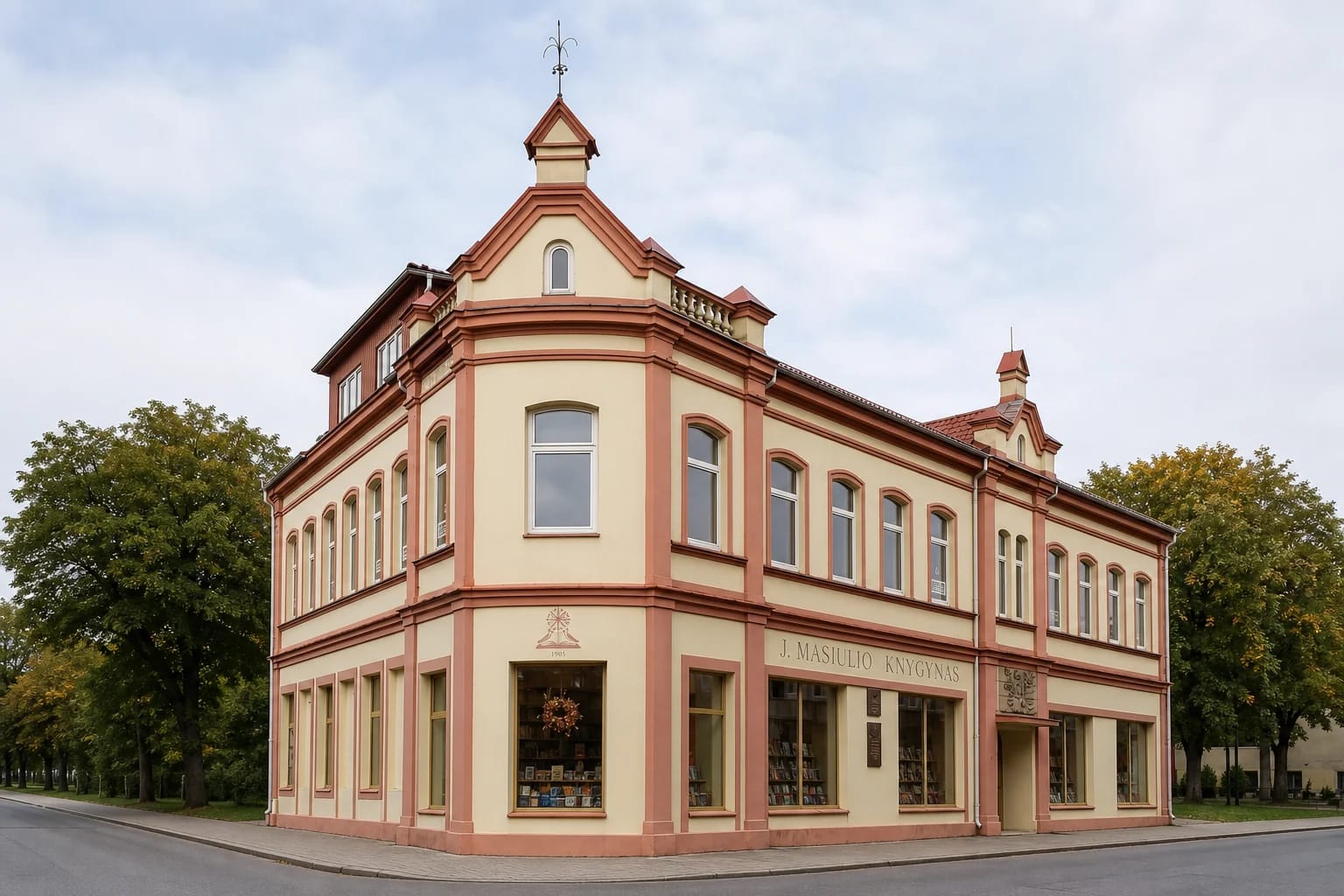
Outside, look first for the prominent corner pediment and short balustrades, the open-book emblem dated 1905, the shop name, and two memorial plaques to Juozas Masiulis. Skuodis's facade relief Metraštininkas, The Chronicler, is another deliberate detail on the east front. The exceptional feature is not a single exhibit but the overlap of place and use: the corner building still serves the public-commercial and bookshop purpose that developed here historically.
The dates 1890, 1904, and 1905 mark three different steps from clandestine trade to a legal bookshop
The Cultural Heritage Register traces Juozas Masiulis's trade in everyday goods and distribution of prohibited Lithuanian publications in this building to 1890. That is not the founding date of a legal Lithuanian bookshop. It refers to the earlier shop and underground activity at a time when the Russian Empire prohibited Lithuanian printing in the Latin alphabet.
The bookshop's official history records that Masiulis belonged to the Garšviai book smugglers' society and maintained close ties with the priest Jonas Karbauskas. The press ban was lifted on 7 May 1904, but legal bookselling still required permission from the Tsarist authorities. By 1905 the Lithuanian press was reporting J. Masiulis's bookshop on Bajorai Street, later Respublikos Street, which is why 1905 is treated as the founding year.
Its early full name can be rendered as Juozas Masiulis Bookshop, Haberdashery and Writing-Supplies Store. The stock included Lithuanian and foreign-language literature, prayer books, devotional objects, stationery, candles, and other practical goods. By 1912 it carried more than 1,000 publication titles. This mixed inventory explains how the premises could function simultaneously as a commercial enterprise and a centre for Lithuanian-language print.
Juozas and Juozapota Masiulis built a family business and helped shape civic life in interwar Panevėžys
Juozas Masiulis was born in Prastavoniai on 6 March 1864 and baptised the following day. The official history explicitly corrects the often repeated date of 7 March: it was his baptism, not his birth. After leaving the family farm for Panevėžys, he learnt the trade in the Jokubaitis sisters' commercial house, worked with his uncle Vincas Kuzma, and gradually moved from foodstuffs towards the books that interested him most.
He married Juozapota Kuzmaitė in 1908. Both worked in the bookshop and, after returning from Smolensk following the First World War, developed links with booksellers in Latvia, Germany, and France. During the interwar period eight employees worked here, lived upstairs, and received meals from the owner. Juozapota served on the first Panevėžys City Council from 1919 to 1921, while their daughter Ona joined the family shop in 1932.
Masiulis supported the St Vincent de Paul Society, scouts, volunteer firefighters, and construction of the future Panevėžys Cathedral of Christ the King. He was elected to the city council in 1931 and 1934. His life was not untouched by violence: the Red Army took him hostage in 1919, he was held in Panevėžys prison, and was released on bail. He died on 26 March 1940, just before Soviet rule forcibly broke the family's connection with its business.
Nationalisation broke the continuity of ownership, but the bookshop function survived and the historic name returned
The shop was nationalised during the first Soviet occupation. After the Second World War a Panevėžys Central Bookshop operated in the same premises, preserving the sale of books but not the Masiulis family's ownership, historic company name, or unchanged business identity. That distinction matters whenever the site is described as having an entirely uninterrupted history.
The 1982 interior reconstruction left the Mosaic of Time and The Chronicler. The Juozas Masiulis name returned in 1992 and the building was restored to the founder's son Jonas. After his death in 1995, it passed to his daughter Karolina Masiulytė-Paliulienė. The property was renovated in 1996 and a founder's plaque unveiled in 2004. Alma Littera acquired the business in 2005, and the Paliulis family took it back in 2015.
In 2025 Panevėžys City Municipality called it one of Lithuania's oldest independent bookshops still operating and marked its 120th anniversary. That is more precise than claiming it as the country's oldest wholly unchanged shop: the place, bookselling use, and revived family tradition survived, but occupation changed the owner and name. On 18 July 2026 the official online shop and opening hours for the physical premises were still active.
Heritage code 36143 protects a Historicist building shaped by both its prewar design and Soviet-period alterations
J. Masiulis Bookshop entered the Cultural Heritage Register in 2011 as an individual immovable property of local significance, valued for its architecture and history. The register dates construction to 1890-1900 and describes two storeys with a mansard level, a basement below the south-west portion, a compact trapezoidal plan, and a multi-pitched roof. Its volume defines the corner of Respublikos and Vasario 16-osios streets.
The facades are Historicist. Protected or characteristic elements include the corner and east-front pediments, cornices between the floors and below the roof, openings of several shapes, and a balustrade on either side of the corner pediment. Before the Second World War, vases stood on its end posts and the building had an exposed brick style with richer masonry decoration. Soviet-period plaster and altered ground-floor openings mean today's cream and muted-pink exterior should not be mistaken for an exact reconstruction of its 1905 appearance.
The register also records load-bearing brick walls, Akerman vaulting, and arched basement niches. It does not follow that visitors can enter the basement: no everyday public route through those rooms is published. The reliable way to read the building is to begin with the public exterior, enter the sales room during shop hours, and avoid assuming museum-style access to back-of-house spaces.
The courtyard Secret School links the shop to the press ban and anchors a compact book-and-culture walk
As part of the 120th-anniversary programme, sculptor Romualdas Kaminskas's installation Slaptoji mokykla, or Secret School, opened in the bookshop courtyard in June 2025. The bookshop's current website has dedicated Lithuanian and English pages explaining the scene, but it does not publish separate courtyard opening hours. If the installation is the main reason for your visit, ask whether the yard will be accessible that day.
The scene represents a clandestine daraktorius school, sometimes called a school of hardship, of the kind that taught children during the 1864-1904 press ban. The official explanation connects book smugglers including Masiulis with Lithuanian publications brought from Königsberg and villagers with privately hired teachers who taught in their native language. The priest teaching the children symbolises Jonas Katelė, an organiser of secret schools, while the text also recalls Gabrielė Petkevičaitė-Bitė's work as a clandestine teacher.
A compact central route begins at the bookshop, crosses the junction to Panevėžys Photography Gallery, and continues to Panevėžys Regional Museum and Gabrielė Petkevičaitė-Bitė Public Library. The Cathedral of Christ the King adds the specific thread of Masiulis's patronage. The official bookshop pages do not provide a general photography policy, dedicated parking plan, or full description of step-free access. Discuss a particular need by phone; the map pin identifies the building at 21 Respublikos Street, not a separate courtyard gate.