- Place
- Panevėžys City Municipality
- Region
- Panevėžys
- Type
- state drama theatre founded in 1940 and housed in an early-modernist building completed in 1967
- Address
- 5 Laisvės Square, Panevėžys
- Coordinates
- 55.72910, 24.36397
Juozo Miltinio dramos teatras, Panevėžys Drama Theatre, Miltinis Theatre, Juozo Miltinio Drama Theater
This is a working repertory theatre, so a performance or tour ticket is the reliable way to see inside
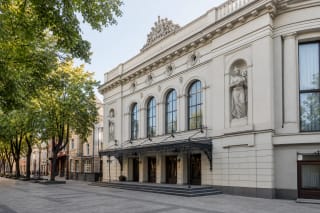
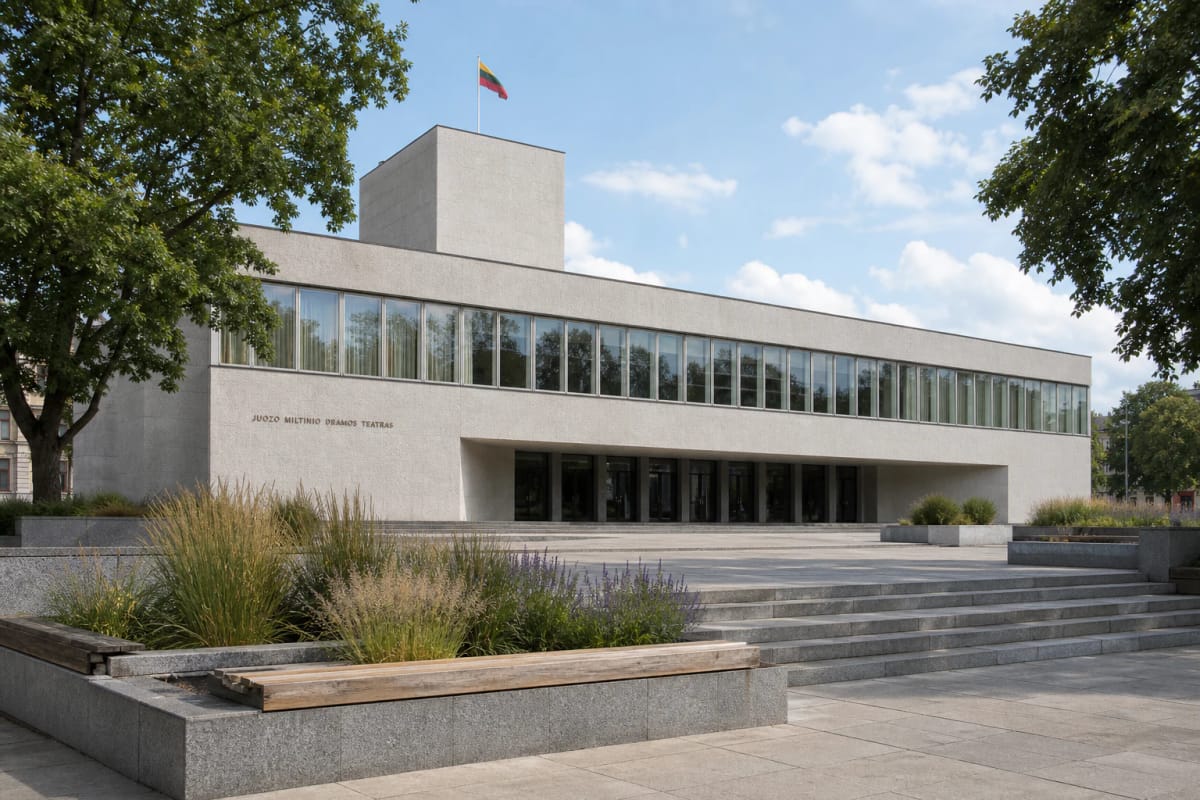
Juozas Miltinis Drama Theatre stands on the eastern side of Panevėžys's Laisvės Square at 5 Laisvės Square and coordinates 55.7290982, 24.3639723. Its long grey front, continuous upper-floor window band, recessed ground floor, and tall stage tower are immediately recognisable from the square. This is a cultural institution rather than an architecture museum open for casual interior visits every day.
The exterior and relief on the north wall can be seen at any time, but the foyers, auditoria, Juozas Miltinis's office, stage, scenery and props stores, dressing rooms, and wardrobe open during performances or booked tours. The repertoire also lists tour dates for individual visitors, so forming a private group is not always necessary.
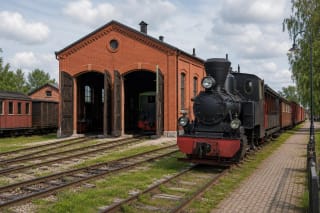
Check the venue as carefully as the time printed on the ticket. The company tours and presents some productions elsewhere in Panevėžys, including the narrow-gauge railway depot, so an event in the JMDT repertoire does not automatically take place at 5 Laisvės Square.
Founded on 18 November 1940, the theatre premiered on 15 March 1941 in converted factory workshops
The theatre's origins lie in Kaunas, where Juozas Miltinis began leading the Labour Chamber acting studio in 1938 after studies in Paris and a period in England. On 18 November 1940, education commissar Antanas Venclova signed the order permitting a drama theatre in Panevėžys. Miltinis arrived with the core of his studio company on 1 December.
The first premiere followed on 15 March 1941: Miltinis's production of Nikolai Pogodin's Silver Valley. This is the date when the stage opened, and should not be confused with the founding order of 1940. The company first worked at 81 Respublikos Street, now number 77, in a former locksmith workshop of the yeast and spirit factory that philanthropist Stanislovas Montvila had converted into the municipal theatre in 1913.
During the German occupation, it operated as Panevėžys City Theatre. Alongside politically unavoidable material, the company staged Kazys Binkis's Atžalynas, Sofija Kymantaitė-Čiurlionienė's Pinigėliai, Ben Jonson's Volpone, and Luigi Pirandello's Henry IV, beginning its lasting dialogue between Lithuanian drama and Western classics under wartime conditions.
Miltinis trained actors as thinking personalities, and the accusation of formalism in 1954 did not end his work
Miltinis built not only a repertoire but a long-term acting studio attached to the theatre. It trained Vaclovas Blėdis, Gediminas Karka, Bronius Babkauskas, Donatas Banionis, Algimantas Masiulis, Eugenija Šulgaitė, Regina Zdanavičiūtė, and others. Ensemble cohesion, improvisational freedom, command of theatrical form, and attention to each actor's individuality became hallmarks of the company.
In 1954, Miltinis was dismissed after accusations of formalist directing and disregard for the Stanislavski system. While working at the Lithuanian Film Studio, he continued to direct secretly in Panevėžys, with some productions credited to Vaclovas Blėdis. His official return in 1959 explains why Hedda Gabler and Death of a Salesman belong to Miltinis's artistic line even though another name appeared in the director credit.
The mature intellectual-theatre period includes Chekhov's Ivanov in 1960, Shakespeare's Macbeth in 1961, Dürrenmatt's The Physicists in 1967, Strindberg's The Dance of Death in 1973, Sophocles's Oedipus Rex in 1977, and Requiem for a Nun after Faulkner and Camus in 1979. Miltinis staged his final production, The Candlestick, in 1980; pupils including Donatas Banionis then carried the company forward.
Built in 1965-1967 under the label of a cultural centre, the theatre was tailored to Miltinis's concept of stagecraft
Because the Soviet authorities would not permit construction of a new theatre, the scheme began officially as a cultural centre and was initially expected to copy the Fishermen's Cultural Palace in Klaipėda. Permission for an individual design eventually produced a purpose-planned theatre in 1965-1967 through the Kaunas branch of the Urban Construction Design Institute. VLE credits Algimantas Mikėnas and Liudvika Mažeikienė, while building studies usually emphasise Mikėnas as the lead architect who worked directly with Miltinis.
The early-modernist exterior is deliberately austere: grey granite render, horizontal bands of glass and metal, asymmetrical masses, and a façade set back from the older building line of the square. Large foyer windows join the interior visually to Laisvės Square. Juozas Kėdainis's metal relief Creative Genius occupies the north wall, while the theatre-name relief survives above the principal front.
Miltinis continued adjusting the layout during construction. The original 550-seat auditorium combined timber lining with specialist acoustics; the stage had a vertically moving revolve, a configurable apron and orchestra pit, while the lighting control position was placed at the rear of the auditorium at his request. Construction finished in 1967, but the official opening took place on 17 February 1968. Both years are accurate because they mark different stages.
After reconstruction, the main auditorium seats 397, while the theatre tower became a sign of freedom in 1988
Rooms were renewed in 2007, technical equipment in 2016-2020, and the main stage and auditorium reconstructed in 2018-2020 before reopening in 2021. The main stage now measures 17 by 17 m to the walls and rises 17 m to the grid; its working width between drapes is 13 m, and the auditorium has 397 seats. This is the present capacity, whereas 550 describes the original 1968 hall.
The building contains three performance spaces: the Main and Small auditoria and Miltinis Laboratory, as well as two foyers, a conference room, and creative and technical departments. Each room creates a different relationship between actor and audience, so check the named hall before selecting a seat.
On 21 October 1988, the Lithuanian tricolour was raised on the theatre tower, the first such raising in Panevėžys before the restoration of independence. A plaque entitled Freedom for Lithuania, unveiled on the extension in 2022, remembers the event. In 1995, Panevėžys Drama Theatre received Juozas Miltinis's name, formally fixing its bond with his school.
Performance prices vary, and in summer 2026 the box office is closed through 3 August
There is no single performance price: the amount appears on each repertoire listing, and tickets are sold by the theatre and Kakava. In 2026, the published policy offered EUR 4 off for school pupils, students, pensioners, disabled visitors, and holders of POLA, Family, or ISIC cards, plus 10 percent for groups buying at least fifteen tickets. Those reductions do not apply to children's performances or premieres. Confirm prices and conditions before purchase.
In 2026, a booked 80-minute educational tour cost EUR 10, reduced to EUR 4 for pupils, students, seniors, and disabled visitors, with groups of fifteen to thirty. The two-hour tour sold through the repertoire cost EUR 12 or EUR 8 at the listed concession. Tours enter the backstage areas and Miltinis's office, but do not run daily, so registration or a separate ticket is essential.
Normally the box office opens Tuesday-Saturday 09:00-18:00, closing for lunch 14:00-15:00; on Sunday it opens one hour before a performance and remains closed on Monday. A major summer exception applies in 2026: weekend opening stops from 16 June to 23 August, and the box office closes completely for holiday from 1 July through 3 August. Online sales continue; always recheck the official site.
A wheelchair user and accompanying personal assistant can obtain a limited number of tickets with a 100 percent reduction by calling +370 45 584 614 or emailing kasa@miltinioteatras.lt. Children under seven are not admitted to evening performances, and individual productions may set a higher age recommendation. On 13 July 2026, the Google Maps entry had 1,237 reviews averaging 4.7 out of 5.