- Place
- Vilnius City Municipality
- Region
- Vilnius
- Type
- active historic Orthodox church
- Address
- 12 Didžioji Street, Vilnius
- Coordinates
- 54.67991, 25.28875
- Visit duration
- 25-40 minutes outside services
- Best time
- morning or daytime, when relief on the facade reads clearly from narrow Didžioji Street
Church of the Translation of the Relics of St Nicholas the Wonderworker, St Nicholas Orthodox Church on Didžioji Street
Origins in Algirdas's Vilnius
The first wooden Orthodox church here is believed to have been built in the mid-fourteenth century at the initiative of Juliana, wife of Grand Duke Algirdas. Because this early phase is not fixed by an exact contemporary record, it is best understood as a scholarly interpretation rather than a precise construction date.
In 1514 Grand Hetman Konstanty Ostrogski built a masonry church to commemorate victory at the Battle of Orsha. A privilege from Sigismund the Old was required, and the small Byzantine-Gothic church rose on the earlier sanctuary's foundations.
From the Uniates to a Neo-Byzantine facade
The church passed to the Uniates in 1609. Rebuilding after the fires of 1747 and 1748 gave it a Baroque appearance, while a house still blocked its facade from Didžioji Street until the mid-nineteenth century.
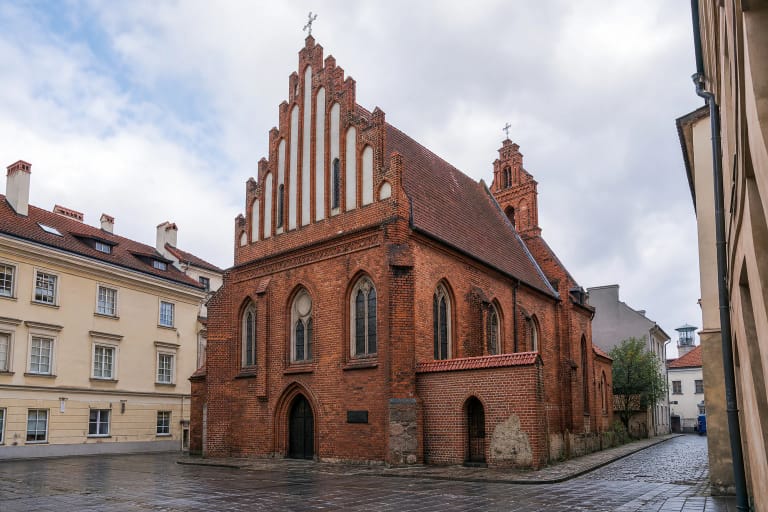
Surrounding structures were cleared in 1865 and Alexander Rezanov redesigned the church under Nikolai Chagin's supervision. The old Gothic walls and almost unchanged volume remained, but the Baroque facades were recast in Neo-Byzantine form.
What survives on Didžioji Street
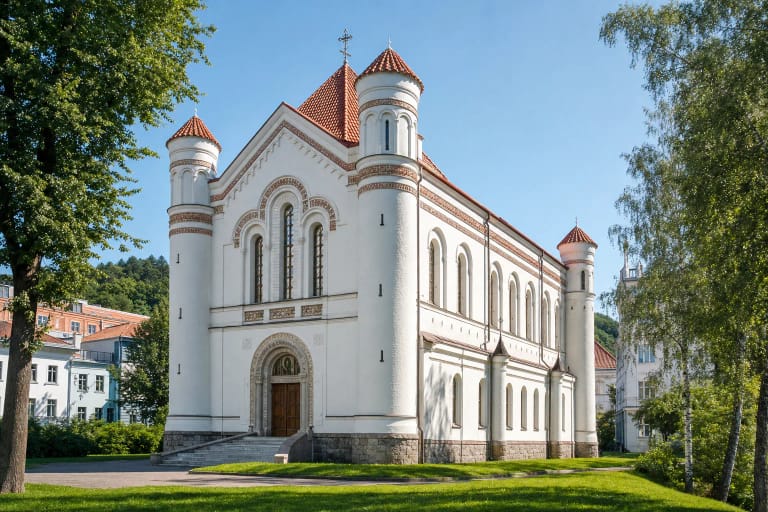
Rounded portals, reddish-brown decorative bands, the bell tower and Orthodox crosses dominate today's street view. Yet the most important feature is not only nineteenth-century decoration: older Gothic construction still stands beneath it.
The church is tightly enclosed by Old Town houses, so the clearest view is from the opposite side of Didžioji Street. The passage beside it towards Bokšto Street was historically called Nicholas Alley.
The former facade in images and today's streetscape
The Lithuanian National Museum of Art's research on Didžioji Street publishes historical images of the church, including an Ivan Trutnev lithograph showing its appearance before the 1865 remodelling. Comparing them with today's facade separates the continuity of the 1514 volume from the Neo-Byzantine exterior created in the nineteenth century.
The same study adds a social layer to the block. Priest Ioann Shverubovich served here in the late nineteenth century, while his son, the future actor Vasily Kachalov, grew up in the neighbouring house. This specific story reminds visitors that the church was part of residents' daily life, not an isolated monument.
An active church, not a museum display
Orthodox liturgy and patronal feasts continue at St Nicholas. Interior access follows the community's worship, and authoritative sources do not publish stable daily tourist opening or ticket hours.
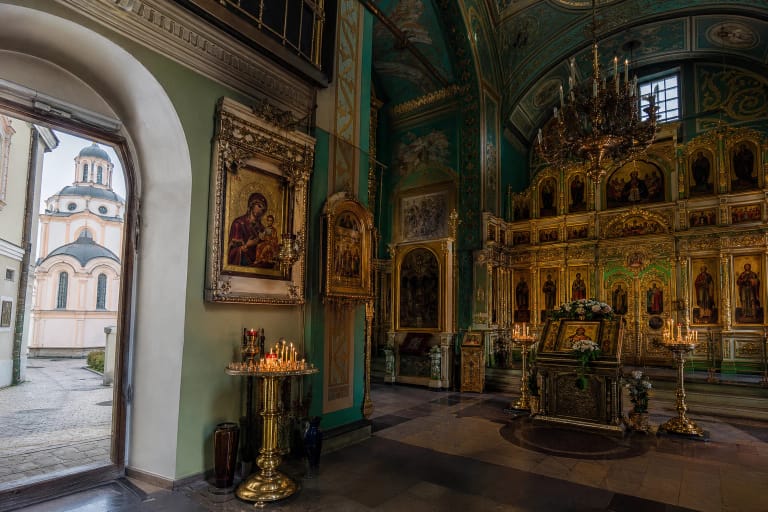
Check the Lithuanian Orthodox Church's news before travelling or contact the community. If doors are open, enter quietly, ask before photographing, and look for the iconostasis and junction of architectural periods.