- Place
- Vilnius City Municipality
- Region
- Vilnius
- Type
- Lithuanian National Museum of Art gallery in historic Chodkevičiai-Pusłowski Palace with a permanent exhibition of sixteenth- to nineteenth-century Lithuanian art
- Address
- 4 Didžioji Street, Vilnius
- Coordinates
- 54.68062, 25.28871
Vilniaus paveikslų galerija, VPG, Chodkevičiai Palace Picture Gallery, Chodkiewicz Palace
On Didžioji Street, the building itself is the first exhibit
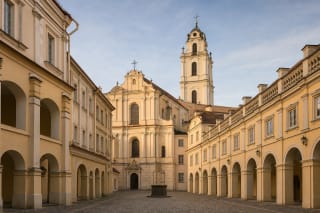
Vilnius Picture Gallery occupies 4 Didžioji Street, at coordinates 54.6806177, 25.2887105, roughly 200 m from Town Hall Square. The entrance passes through the central carriageway of Chodkevičiai Palace, moving visitors from a busy Old Town street onto the axis of its formal courtyard before they enter the galleries.
This is not the National Gallery of Art beside the Neris, whose permanent collection addresses the twentieth and twenty-first centuries, nor the Radvila Palace Museum of Art on Vilniaus Street. The picture gallery's core subjects are sixteenth- to nineteenth-century Lithuanian art, the Vilnius Art School, and nineteenth-century palace culture. LNMA's current description extends into the early twentieth century and foreign art, particularly through temporary exhibitions.
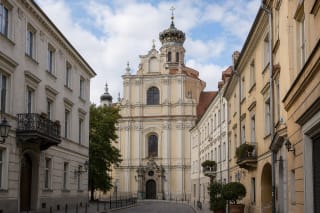
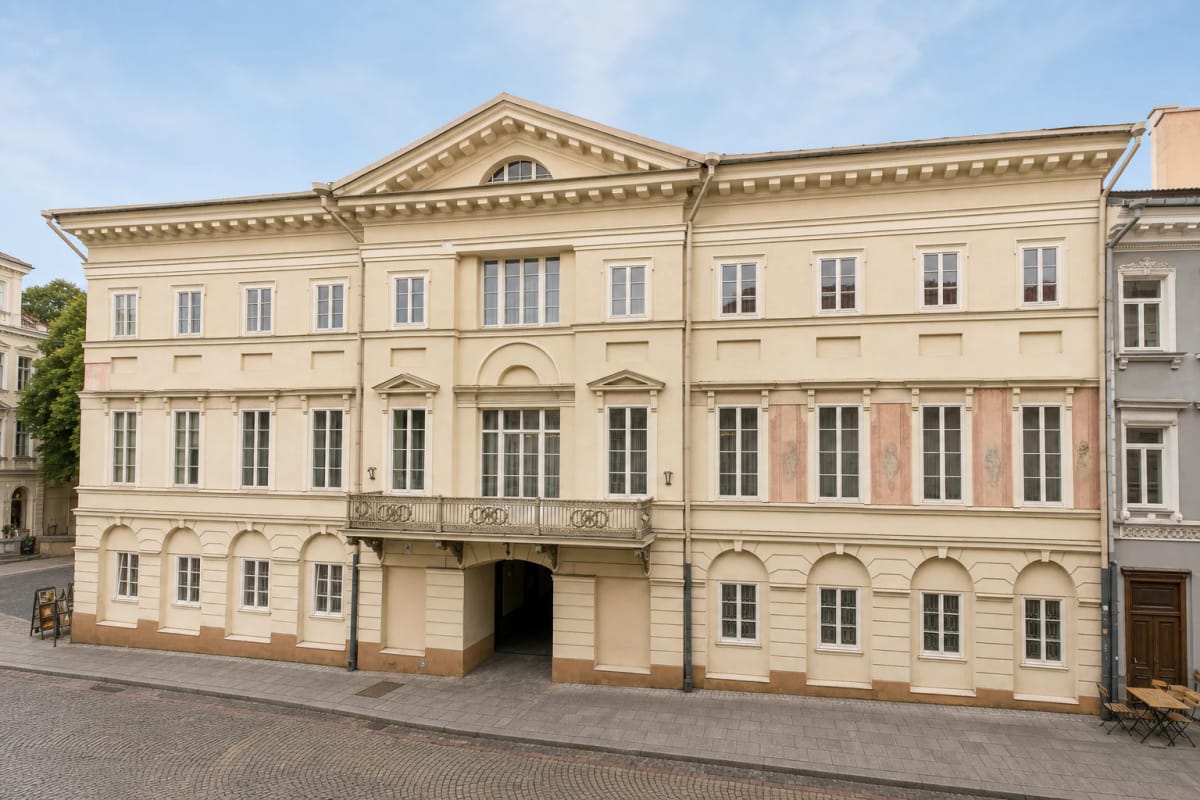
Study the palace front before buying a ticket. On the pale three-storey range facing Didžioji Street, a central projection ends in a triangular pediment with a semicircular window. A balcony with cast-metal railings projects above the carriageway, while a rusticated ground floor supports the more restrained rhythm of windows above.
The Chodkevičiai residence grew from sixteenth-century masonry into an enclosed palace complex
The Cultural Heritage Register identifies layers from the fifteenth to the early twentieth century across the complex, while sections of the present western range were built in the sixteenth century. At the turn of the sixteenth and seventeenth centuries, the Supraśl branch of the Chodkevičiai family joined earlier houses into a fortified urban residence with towers and a courtyard. At least eight generations of the branch lived here over more than three centuries.
In 1600, the palace became a strongpoint during the conflict between the Chodkevičiai and Radziwiłł families over the marriage and dowry of Zofia Olelkowicz. The museum's history relates that both sides assembled armed supporters and may even have fired artillery from their residences. The scale of the clash comes through a historical account, but the conflict clearly shows that an urban palace could also operate as a fortress of political power.
The complex expanded repeatedly after fires and wars. Architects Abraham Würtzner and Franciszek Ignacy Hoffer rebuilt it for Jan Mikołaj Chodkiewicz in 1754-1762. Wojciech Pusłowski acquired the palace in the early nineteenth century, and a further campaign around 1825-1834, attributed to Tomasz Tyszecki, created its present late-Classical character and a formal courtyard enclosed by four ranges.
An academy, professors' flats, and conservation changed the palace without erasing its interiors
The Vilnius Medical-Surgical Academy moved into the palace in 1834, followed by the offices of the Vilnius Educational District in the 1840s. After the First World War, the complex passed to the university and contained apartments for professors and cultural figures. Residents included philosopher Vosylius Sezemanas, economist Vladas Jurgutis, historian Ignas Jonynas, and psychologist Jonas Vabalas-Gudaitis.
Large rooms were divided, flats installed, and some openings and structures altered as uses changed. Late-twentieth-century conservation restored the logic of the ceremonial rooms and adapted the western range as a museum. Vilnius Picture Gallery opened here in 1994; other ranges now house LNMA administration, its library, archive, and collection stores.
The first-floor state rooms retain or reconstruct a nineteenth-century ensemble of tiled stoves, fireplaces, wall and ceiling stucco, polychromy, panelled doors, stairs, and balcony railings. The museum openly supplements surviving fabric with period furniture and applied art from its collection. Not every object belonged to the Chodkevičiai, but together they explain how an urban palace performed status.
The permanent display leads from Grand Ducal portraiture to Lithuanian artists studying across Europe
The gallery was founded in 1956 and operated in Vilnius Cathedral until 1986; it opened in the restored Chodkevičiai Palace in 1994. The present route begins with nineteenth-century palace interiors containing furniture, porcelain, clocks, medals, portrait miniatures, portraits of Vilnius residents from the Philanthropic Society collection, and views of the old city.
The art then unfolds chronologically. Portraits by local and foreign masters from the sixteenth to eighteenth centuries introduce the estates, patrons, and representational culture of the Grand Duchy of Lithuania. From 1793, the Vilnius Art School becomes central: work by its professors and students shows how the university established a professional tradition of art education.
After Vilnius University closed in 1832, Lithuanian artists trained in St Petersburg, Warsaw, Munich, Paris, Rome, and other centres. Local subjects therefore meet Classicism, Romanticism, Academicism, and Realism in the nineteenth-century rooms. The display presents Lithuanian art not as an isolated national line but as a field connected to European institutions.
Smuglewicz, Rustem, Rusiecki, and the palace details reward slow looking
Principal artists include Franciszek Smuglewicz, the first professor of drawing and painting at the Vilnius Art School, his successor Jan Rustem, the Italian-trained Kanuty Rusiecki, and Wincenty Smokowski. Their work allows comparisons among history painting, portraiture, religious art, everyday subjects, and landscape rather than reducing the gallery to one dominant masterpiece.
In the opening rooms, look at the relationship between art and setting. A tiled stove, a commode made by Guillaume Beneman in Paris around 1786, Sèvres porcelain, or a view of old Vilnius can explain the function of a nineteenth-century interior as effectively as a portrait on the wall. Windows facing the courtyard and tall aligned doorways reveal how movement through the ceremonial suite was organised.
Temporary exhibitions continually change the visit. In summer 2026, the official programme listed drawings from the eighteenth to twenty-first centuries, a Wincenty Sleńdziński exhibition, and a project examining a disputed Caravaggio attribution. Check which rooms are open before travelling, as exhibition changeovers can temporarily interrupt part of the route.
The gallery stays open until 20:00 on Tuesdays and is adapted for visitors with reduced mobility
The official schedule on 13 July 2026 listed Tuesday 10:00-20:00, Wednesday-Saturday 10:00-18:00, and Sunday 11:00-17:00. The gallery closes on Mondays and public holidays, shuts one hour earlier on the eve of a public holiday, and admits its final visitors 30 minutes before closing.
On that date, standard admission cost EUR 6 and a concession EUR 3; a guided tour cost EUR 20 in Lithuanian or EUR 25 in another language. Prices, eligibility for free or reduced admission, and gallery access change, so confirm them on the official LNMA page. The museum states that the premises accommodate visitors with reduced mobility and parents with pushchairs, while the permanent display includes provisions for sensory access.
The public Google Maps entry showed 4.6 out of 5 from 693 reviews on 13 July 2026; its score and count will change. Allow at least 90 minutes for the principal route, or two and a half to three hours if you plan to read labels carefully, study the palace interiors, and include a temporary exhibition.