- Place
- Labanoras Forest Nature Trail, Švenčionys District Municipality
- Region
- Labanoras Regional Park
- Type
- mature forest and hollow-tree habitat landscape
- Coordinates
- 55.26400, 25.81400
Labanoras old hollow trees, Old trees of Labanoras Forest
Not the name of one tree
The phrase old hollow trees of Labanoras sounds like the name of one object, but authoritative sources present it more as a mature-forest theme. Saugoma.lt and VLE describe Labanoras Regional Park, the Labanoras Forest Nature Trail, and the value of the forest itself, but not one single tree officially named this way. This page therefore treats the old hollow trees of Labanoras as a landscape and habitat experience.
Individual famous Labanoras trees do exist. In listing park natural heritage objects, VLE mentions botanical monuments such as Argirdiškė Pine, Lithuania's tallest pine, Baltagalis Pine, six Labanoras pines, Lūšnia Pine, Pabaltė Pine, and Peršokšna pyramidal spruce. A hollow tree matters here not because of one label but because it shows forest age, natural processes, and animal habitats.
Lithuania's largest lake-rich forest
Labanoras old trees make sense only at forest scale. VLE states that Labanoras Regional Park, established in 1992, covers 55,317 ha in Molėtai, Švenčionys, and Utena districts, with forests making up about four fifths of its territory. Labanoras Forest is Lithuania's largest forested area with the densest lake network, containing about 285 lakes and dominated by pinewoods.
The forest is biologically rich. VLE gives 1020 plant species, 40 mammal species, and 150 nesting bird species, including black storks, lesser spotted eagles, and Eurasian pygmy owls. Girutiškis Reserve is a Ramsar wetland of international importance, so old hollow trees are part of a nationally valuable ecosystem.
Why hollows matter
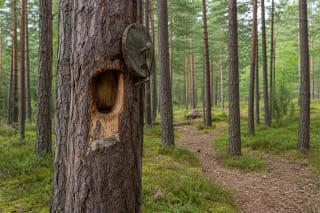
Hollows in old trees are crucial for forest life. Birds can nest there, and bats, insects, and other species can live there. An old hollow tree is often a small apartment block, not just a beautiful trunk; that is why mature forest is protected together with deadwood and cavity trees.
Visitors should not interfere with hollows, scrape bark, or sacrifice the tree for a better photograph. In a forest, value often lies in what looks untidy: dry branches, cavities, deadwood, and moss. That order supports habitat chains from fungi to rare birds.
Labanoras Forest Nature Trail
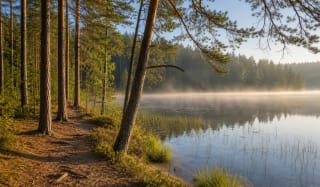
Saugoma.lt presents the Labanoras Forest Nature Trail as a visitor object and gives its length as about 2.6 km, easily reached from Labanoras town toward Ignalina. It is a good introduction to the forest: visitors can see old woodland, enter a bog, admire Lake Labanoras, and find burial mounds beside the trail.
An official trail is the best way to see forest maturity without disturbing sensitive places. It also helps explain park logic: Labanoras Regional Park was created to protect a large landscape of lakes, bogs, forests, and cultural heritage, and old hollow trees are one layer of that complex, not a separate attraction.
What to watch for and how to visit
In Labanoras, walk slowly. Look not only for the biggest trunk but for signs of tree age: hollows, broken branches, fungi, mosses, young growth of different ages, and old pines. Since the park also has named monument pines, plan your route with Saugoma.lt or the park map rather than wandering off-track through sensitive habitats.
There is usually no separate ticket for independent trail walking, but a protected-areas visitor ticket may be recommended as support. Check current rules on Saugoma.lt or park information. Labanoras combines easily with Aukštaitija National Park lakes and the Palūšė visitor centre for a calm forest trip.
How Labanoras differs from Dzūkija hollow pines
It is useful to compare Labanoras hollow trees with the pines of Musteika in Dzūkija, but the difference matters. In Dzūkija, hollow pines are primarily linked with tree beekeeping, where people carved cavities for bees. In Labanoras, hollows are mostly natural habitats formed by trees, wind, fungi, and birds, so the same term has an ecological rather than craft meaning.
This comparison helps you understand what you see. In Musteika, a hollow tells a craft story; in Labanoras, it tells a story of forest age and life. Both are valuable, but they should not be mixed.