- Place
- Anykščiai, Anykščiai District Municipality
- Region
- Anykščiai District
- Type
- first-half-of-the-19th-century neoclassical manor house
- Address
- Paupio g. 10, Anykščiai
- Coordinates
- 55.52697, 25.10397
- Visit duration
- 30-60 minutes
- Best time
- daylight and the warm season, when the house can be combined with a walk beside the Šventoji
Okuličiūtė Manor, Okuličiūtė Palace
A small manor house in central Anykščiai
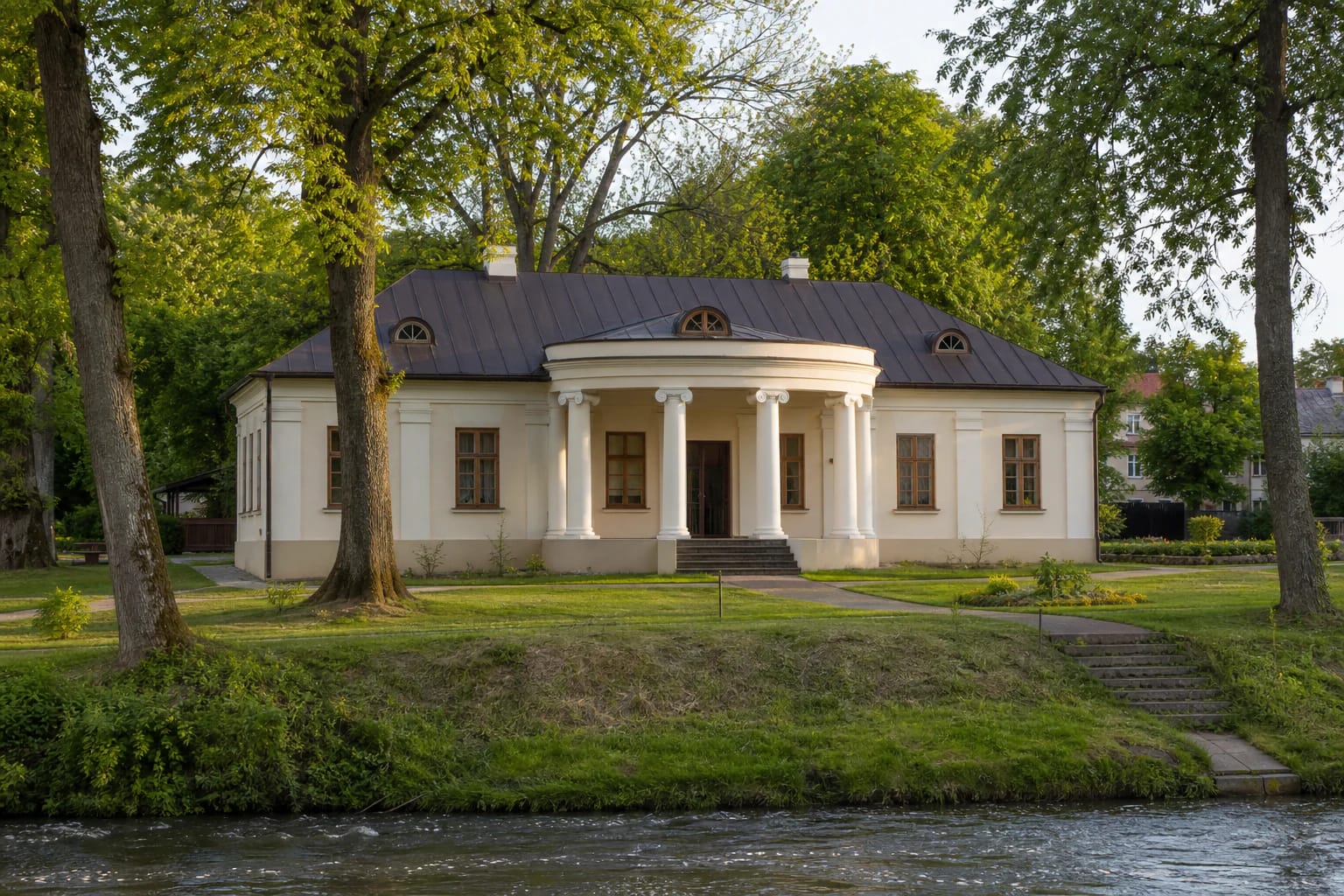
Okuličiūtė Manor House stands on Paupio Street in central Anykščiai, beside the Šventoji River. It is a small one-storey neoclassical building from the first half of the 19th century, with a low mansard roof and a rectangular volume. The useful mapped point for navigation is 55.526973, 25.103968.
The building matters not only for its age but also for its relationship with the riverbank. Its modest scale lets you read it as part of the town fabric rather than as a remote aristocratic estate. From outside, look at the portico proportions, façade openings, and planted setting, even when library activity means the interior is not being shown.
The neoclassical portico and architecture
The most distinctive façade element is an expressive portico with four Ionic-order columns set on a low curved pedestal. Above them is a semicircular porch canopy, giving a small building a formal presence. The building is not attributed to a named professional architect; when viewing it, focus on the surviving portico and façade proportions.
The façade has medium-sized rectangular double windows, while the profiled wooden shutters have not survived. Read the present appearance by separating the architectural elements still visible from features that once existed but can no longer be seen.
The Okuličiūtė name and the 1863 account
The manor house takes its name from the noblewoman Okuličiūtė, regarded as its first builder and owner. The building is not attributed to a named professional architect. The name itself preserves the memory of the earliest owner.
A 1928 publication by Antanas Vienuolis tells that the house served as an insurgent headquarters and secret arms depot during the 1863 uprising. This remains a local memory account recorded as Vienuolis’s historical version.
The Šukevičius family and the altered park
Before the First World War, a man from Saint Petersburg had bought the manor house and lived there. Around 1918-1919, pharmacist Donatas Šukevičius became its owner and bought it for his parents. The Šukevičius family restored the house and tended the 19th-century park.
The park contained rare trees and ornamental shrubs, but part of it was later flooded and washed away by the Šventoji after a mill was built. This change shows that the manor’s history is not just a façade story: the river, industrial activity, and growth of the town reshaped the surrounding landscape.
From wartime uses to a library space
By 1948, the building was already serving a different purpose: the interior had been stripped, and the rooms held wool-carding, spinning, and felting workshops, a warehouse, and grain storage. A red-brick annex stood nearby. These changes show how often the house was adapted to practical needs.
A public library has operated in the manor house since 1955, and it now contains departments of the L. and S. Didžiuliai Public Library of Anykščiai. Its current use makes this a living cultural building, so visitors should fit architectural viewing around the library’s own schedule and educational activities.
Istorijų dvarelis and planning a visit
Today the building houses Istorijų dvarelis, a children’s and young-adult literature and education space created in a renewed library branch. Opening hours can change, and educational visitors are not necessarily accepted throughout the day, so check the day’s information and registration requirements before travelling.
Allow roughly 30-60 minutes for the building and its setting, especially if you combine it with a walk beside the Šventoji. The library’s event schedule and education arrangements can change, so check the information for the day of your visit.