- Place
- Pienionys Forest, Anykščiai District Municipality
- Region
- Anykščiai Regional Park
- Type
- geological and mythological boulder in Anykščių šilelis
- Coordinates
- 55.50800, 25.07100
Pašventupys Stone
The second famous Anykščiai stone by the Šventoji
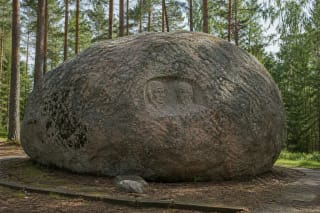
Puntukas' Brother often remains in the shadow of Puntukas, yet it is an interesting boulder in its own right. VLE presents it as Puntukas' Brother or Pašventupys Stone: a boulder in Anykščiai District, south-west of Anykščiai, east of Šeimyniškiai village, in Pienionys Forest, on the right bank of the Šventoji. This is an important orientation detail, because many visitors mistakenly assume the stone lies on the same side of the river as Puntukas.
Its other name, Pašventupys Stone, helps explain the place: the boulder belongs to the Šventoji river landscape in Anykščiai Regional Park's Anykščių šilelis Landscape Reserve, not to a town square or museum. VLE states that Puntukas' Brother is about 3 km from Puntukas itself, so the region's two famous boulders form one field of discovery.
Size and geology
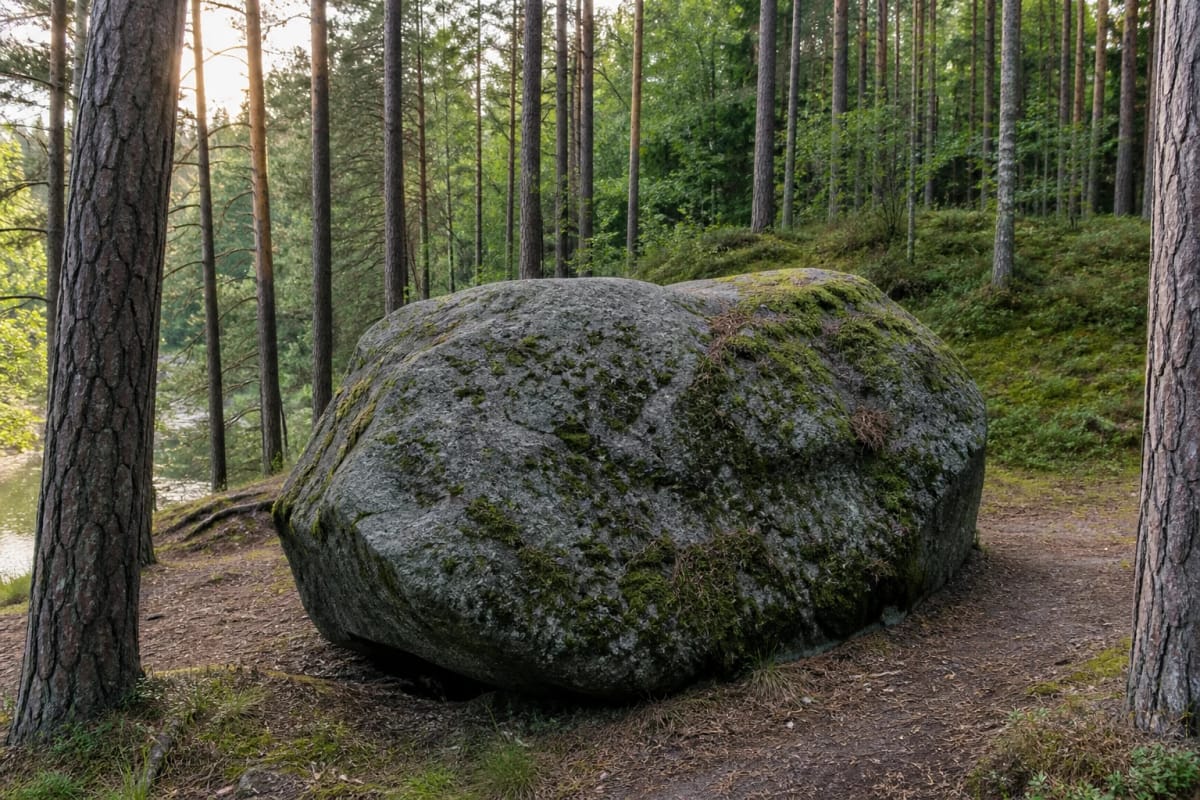
VLE gives exact measurements: the larger part of the boulder is underground, while the visible above-ground part is 1.85 m high, 5.94 m long, 4.70 m wide, and 18.57 m in maximum horizontal circumference. The above-ground part is shaped like an irregular triangular pyramid with a rounded top; its edges and corners were smoothed by ice and water. Saugoma.lt gives approximate dimensions of 6 x 4 x 1.7 m and notes that if unearthed, the stone could rival Puntukas in size.
Petrologically, VLE describes Puntukas' Brother as greyish-pink, medium-grained granite, dominated by plagioclase, quartz, and microcline. The stone is cracked, the largest crack wedge-shaped, and parts of the surface are mossy. One edge is split, which is why Saugoma.lt compares it to a petrified beast with an open mouth.
A glacial erratic
Like Puntukas, Puntukas' Brother is an erratic boulder. VLE states that continental Pleistocene glaciers carried it from Scandinavia, and one side bears strong parallel scratches in several directions, marks of glacial movement. Such stones are landscape memory of processes far older than human history.
Laboratory research helps date the stone's exposure. VLE refers to quartz studies carried out in a French laboratory, according to which the ice covering the boulder melted 14,200 years ago. Puntukas' Brother was scientifically described by A. Linčius in 1989, Vidas Mikulėnas in 1998, and G. Skridlaitė in 2003, making it one of the better-studied boulders in the region.
Mythological meaning and Vienuolis' stories
The name Puntukas' Brother shows its kinship with the better-known Puntukas. It is not a geological term, but a cultural way of linking several large local stones into one field of stories. VLE notes that the boulder has mythological and landscape significance and, since 2005, has been a state-protected cultural-heritage object of regional significance.
Local legends are also linked with the stone. VLE states that writer Antanas Vienuolis liked visiting Puntukas' Brother; according to him, an ancient Lithuanian sanctuary once stood near the boulder, with some remains still surviving. One legend says the stone sank into the ground when falling from the sky. Such stories should be received as local imagination and folklore, not as factual origin.
Protected object and surroundings
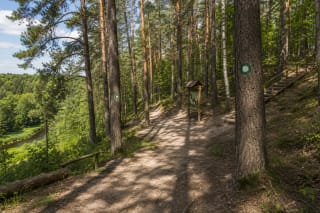
VLE states that Puntukas' Brother has been protected since 1964 and has held geological natural-monument status since 2000. The boulder lies in a small flat clearing, surrounded by pines, spruces, alders, and bird cherry trees, and a footpath passes just to the north of the stone. Saugoma.lt mentions a forest road and steps in the approach.
Other heritage objects cluster around Puntukas' Brother. VLE states that Pašventupys burial mounds lie to the north-east, A. Vienuolis' birthplace and the Karalienės liūnas spring are about 2 km to the south-west, and Šlavė Outcrop lies on the other bank of the Šventoji. This lets the boulder be planned as one stop on a larger Anykščių šilelis route.
How to visit
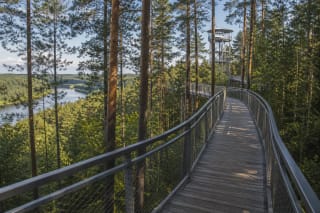
Puntukas' Brother is best visited as a short stop in Anykščių šilelis. If you are already going to Puntukas Stone or the Tree Canopy Walk, allow extra time for this quieter place by the Šventoji. Remember that the stone is on the other side of the river from Puntukas, so check the route on a map.
The stone is an outdoor object, and no ticket is needed for a normal self-guided visit, but path conditions depend on the season. After rain, pine-forest paths may be wet, and in winter they can be slippery. Because it is a protected natural and cultural heritage object, do not climb on the boulder; view the mossy surface from the path.