- Place
- Anykščiai District Municipality
- Region
- Aukštaitija
- Type
- municipal art museum combining a growing collection on the angel motif with Western European and Lithuanian sacred art
- Address
- 11 Vilniaus Street, Anykščiai
- Coordinates
- 55.52417, 25.10191
Angelų muziejus Anykščiuose, Anykščių sakralinio meno centras, Angel Museum - Sacred Art Centre
The name contains two museums, not one collection of decorative angel souvenirs
This branch of Anykščiai Arts Centre at 11 Vilniaus Street combines the Angel Museum and Sacred Art Centre. They share an entrance, ticket desk, and visitor route, but their origins differ: one grows around the angel motif in contemporary and folk art, while the other preserves Monsignor Albertas Talačka's specific legacy of seventeenth- to twentieth-century art, books, and manuscripts.
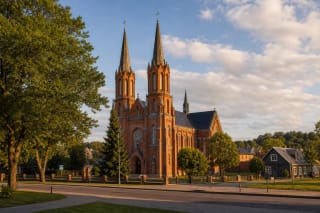
The building stands beside the Church of St Matthew at coordinates 55.5241741, 25.1019121. It is only a few minutes on foot from Bishop's Square and the monument to Antanas Baranauskas. Do not confuse it with Anykščiai Chapel - the World Anykštėnai Arts Centre at a separate address, 36 Vilniaus Street.
Allow 60-90 minutes for a first visit. A shorter stop may cover the angel display but leaves too little time to study paintings in the Sacred Art Centre, their attributions, and the scale of the library. Temporary exhibitions, education, and events require additional time.
Albertas Talačka collected art for the continuity of culture in Anykščiai
Monsignor Albertas Talačka was born in 1921, ordained in 1947, and served as parish priest and dean at St Matthew's from 1969 until his death in 1999. During the Soviet period he supported young artists and religious woodcarvers and promoted the church's stained glass, Rimantas Idzelis's carved Stations of the Cross, a new organ, and the project for the Antanas Baranauskas monument.
Talačka left his art collection, library, and archive to the parish and town. The Sacred Art Centre has publicly displayed the legacy since 23 July 2009. It holds more than fifty works of painting, sculpture, and graphic art from the seventeenth to twentieth centuries, while his personal library contains over 4,000 books and approximately 400 manuscripts, letters, and notes.
This section matters even to visitors who are not drawn to religious iconography. It demonstrates how one regional priest sustained professional art under occupation, preserved Western European works, and built relationships with living Lithuanian artists. The museum explains not only pictured subjects but a mechanism of cultural patronage.
Francken, de Marlier, Lampi, Czechowicz, and Rustem are five names not to miss
The collection's masterpiece is considered to be the seventeenth-century Flemish Presentation of the Virgin at the Temple, attributed to Frans Francken II and Philips de Marlier. Francken specialised in figural biblical scenes and de Marlier in still life; their shared composition brings figures and architecture together with meticulously painted objects and flowers.
Another work of international stature is Austrian portraitist Johann Baptist Lampi's image of Prince Franciszek Sapieha, general of the Lithuanian army and elder of Užpaliai. Also seek a small panel depicting the Virgin and Child enthroned. Its format is easy to overlook among larger canvases, although it is one of the collection's distinctive objects.
Polish-Lithuanian artistic connections continue through a self-portrait by Szymon Czechowicz and Vilnius University professor Jan Rustem's portrait of Antoni Henryk Radziwiłł. The twentieth-century section includes works by Antanas Žmuidzinavičius, Kazys Šimonis, Jonas Janulis, and Česlovas Kontrimas. Displays can change for loans or conservation, so ask the museum about a specific work before travelling.
A gift of 109 angels by Beatričė Kleizaitė-Vasaris founded Lithuania's first Angel Museum in 2010
Cultural figure, art historian, and patron Beatričė Kleizaitė-Vasaris gave Anykščiai a collection of 109 angel-themed works in 2010. They founded the first Angel Museum in Lithuania and, according to the municipality, Eastern Europe, in the same building. The donor symbolically declared Anykščiai a City of Angels.
Kleizaitė-Vasaris was born in Kaunas in 1925, left Lithuania during the Second World War, studied in Italy, and lived in Argentina, Canada, and the United States. After independence was restored, she returned to Lithuania with collections by émigré artists including Vytautas Kašuba, Adomas Galdikas, and Vytautas Ignas. Her angels formed one part of a wider return of culture.
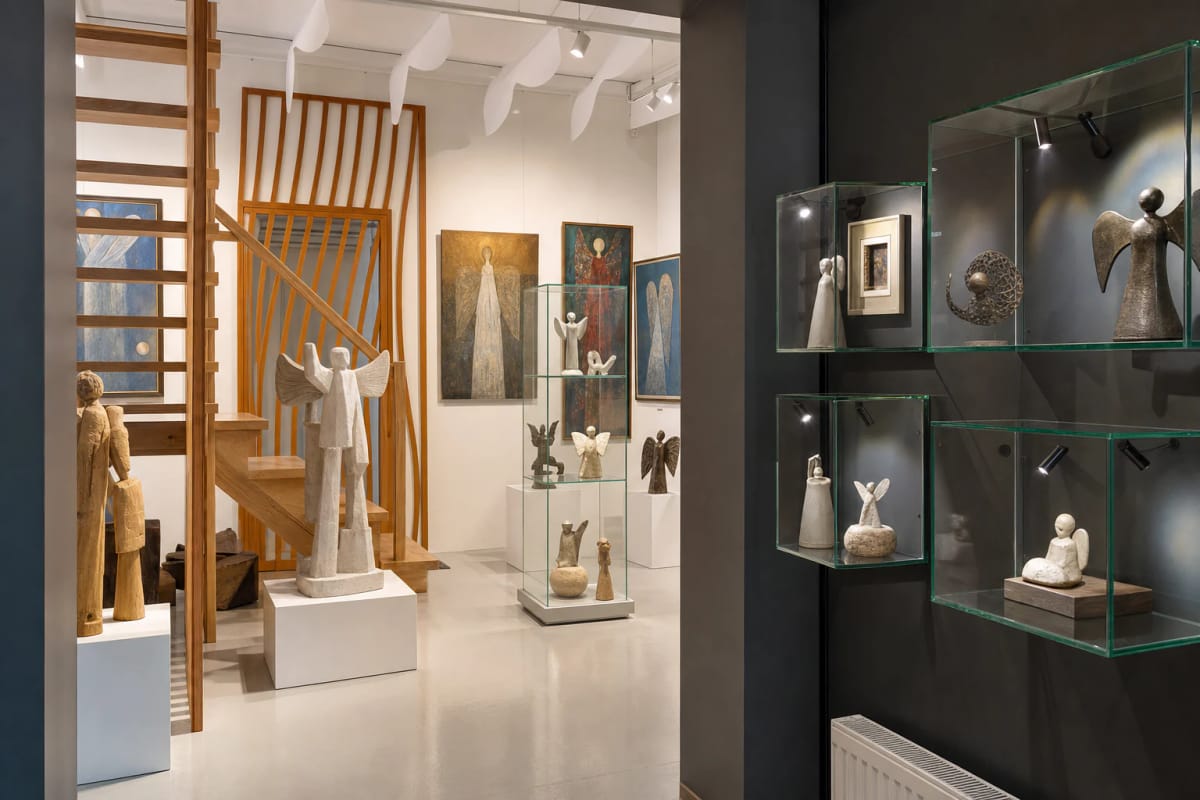
The founding gift was not a row of identical figurines. In it and later acquisitions, angels appear in painting, graphic art, wood, metal, ceramics, glass, and textiles. The most useful comparison is therefore not a count of angels but how one symbol changes across professional art, folk art, the diaspora, and contemporary creators.
Artist residencies have made the collection a living Anykščiai art process since 2011
Professional Angel Creators residencies have taken place in Anykščiai since 2011, with works made there entering the collection. The exhibition is therefore not a capsule sealed around the gift of 2010. Art by Leonas Strioga, Vladas Vildžiūnas, Leonardas Gutauskas, Aloyzas Stasiulevičius, Jurga Ivanauskaitė, Filomena Linčiūtė-Vaitiekūnienė, and others brings wide variation in artistic language and material.
Individual artists, organisations, embassies, and international creators also add to the holdings. Some works travel in temporary exhibitions, while not every new gift fits immediately into the permanent galleries. An angel seen online may therefore be in storage, another room, or on loan on the day of a visit.
The museum hosts concerts, meetings, exhibition openings, and practical education. Some programmes turn museum exploration into a game; others cover cyanotype, linocut, icons, or making a personal dream angel. Education requires booking, and its price includes or supplements admission according to the particular programme.
The museum opens daily in summer 2026, and the combined ticket costs EUR 3
The official 2026 schedule changes by season. The museum opens daily from 10:00 to 17:00 in April-May and September-October, daily from 10:00 to 18:00 in June-August, and Monday-Saturday from 10:00 to 17:00 in November-March. Last admission is fifteen minutes before closing, hours shorten by one hour on the eve of a public holiday, and the museum closes on specified holidays.
In July 2026, a combined Angel Museum and Sacred Art Centre ticket cost EUR 3 for adults, EUR 2 for school pupils, students, and pensioners, EUR 1 for a visitor with a disability, and EUR 7 for a family. A temporary exhibition could cost an additional EUR 1. Prices and exceptions age, so consult the official page or call +370 630 08100 before visiting.
On 13 July 2026, Google Maps rated the museum 4.7 out of 5 from 376 reviews and showed summer hours of 10:00-18:00 daily. The score exceeds the catalogue's 4.5 threshold but changes over time. The official site does not detail step-free access to every room, so ask staff about lifts, stairs, wheelchairs, or sensory needs before travelling.