- Place
- Braziūkai, Kaunas District Municipality
- Region
- Suvalkija
- Type
- a state-protected small-leaved lime and botanical natural heritage object
- Address
- Braziūkų Street, Braziūkai village, Zapyškis Eldership, Kaunas District Municipality
- Coordinates
- 54.89227, 23.48611
- Visit duration
- 15-30 minutes to view the trunk, cavities, crown, and information board from permitted access
- Best time
- late June to July for a green or flowering crown, or early spring when the hollow trunk and old branch structure are clearest
Liepa Motinėlė, Braziūkų liepa, Braziūkai Lime Tree, Mother Lime Tree
An eight-metre trunk makes Mother Lime exceptional even among veteran limes
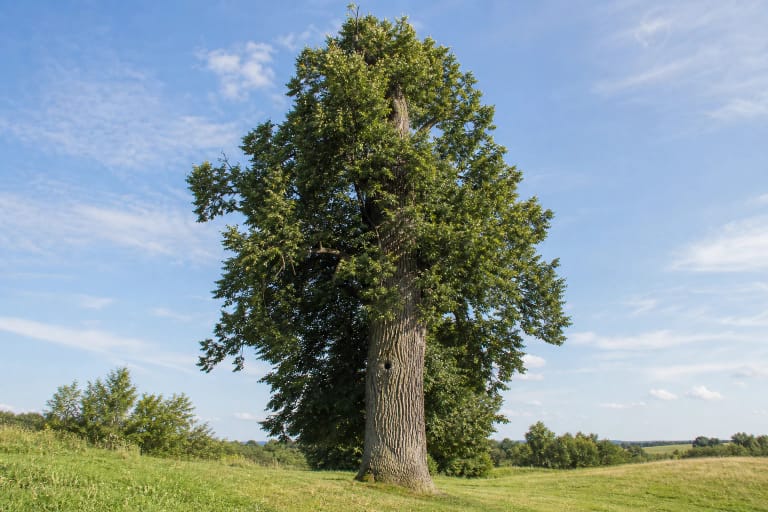
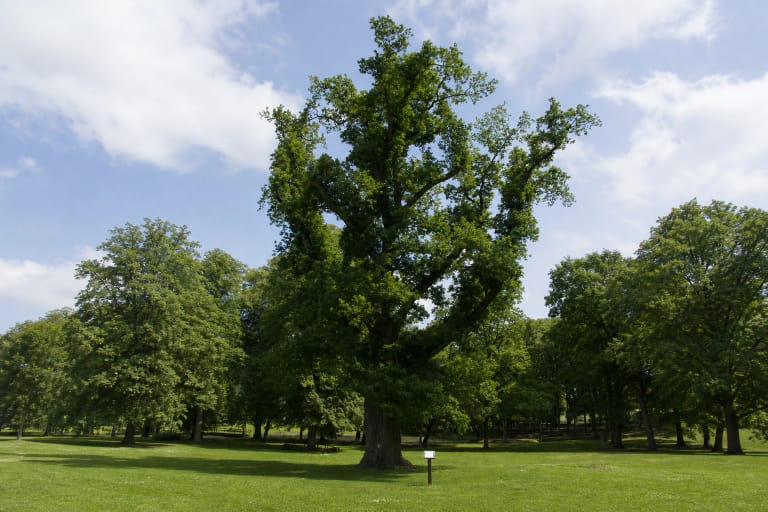
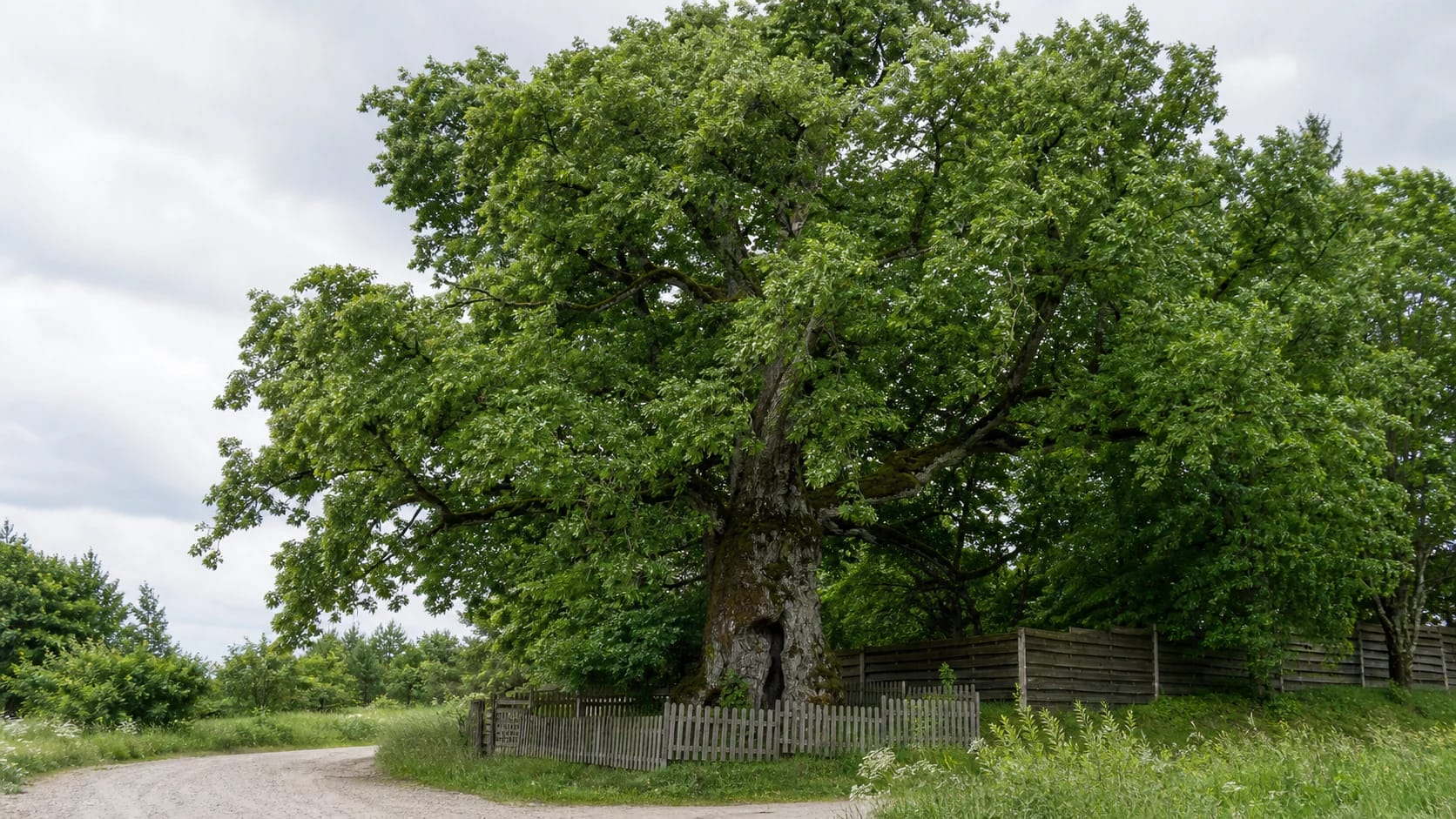
Liepa Motinėlė is a small-leaved lime, Tilia cordata, growing beside the main street through Braziūkai. The State Forest Service describes it as probably Lithuania's oldest and thickest lime. This is not a tree hidden deep in a forest: its enormous low-branching crown rises behind a modest wooden fence at the village roadside, and the trunk's scale is best understood from the public-road side.
The State Forest Service inspected the tree for its veteran-lime inventory on 10 July 2018. At 1.3 m above ground, the trunk measured 8.1 m in circumference; the tree stood 19 m high and its crown spanned 22 m. The first major limbs began at roughly 1.5 m. These are dated measurements, not immutable present-day dimensions.
A later 2025 description by the Lithuanian Arboricultural Centre gives an approximate circumference of 8.6 m and height of 18 m. Those figures should not be read as a simple half-metre of growth followed by a one-metre loss in height. Results for an irregular, heavily burred trunk can vary with date and measuring method. The honest approach is to retain each date rather than manufacture one supposedly exact current figure.
Its exact age is unknown, with published estimates ranging from 300 to 500 years
No planting year is recorded for Liepa Motinėlė, and no published tree-ring study was found in the sources checked for this guide. In 2025 the Lithuanian Arboricultural Centre listed its age as unknown and estimated 300-350 years. A 2023 State Forest Service article uses an estimate of about 500 years, while a 2025 government article gives the broader range of 300-500 years.
The variation is not a reason to select the largest number. A very old hollow tree often lacks the central wood needed for conventional ring counting, while circumference reflects the growing site, trunk form, and past damage as well as age. It is most accurate to describe Mother Lime as a veteran several centuries old whose precise age has not been established.
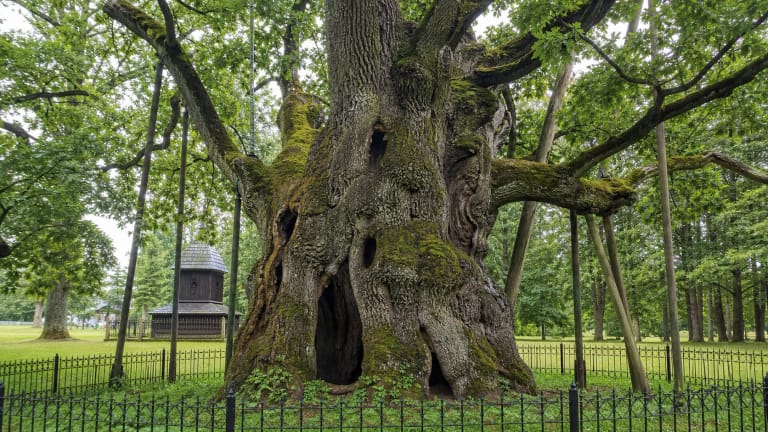
The official 2018 inventory described the trunk as hollow, strongly burred, and open in several places at different heights. At that time the crown was low, broad, fully leafed, and carried only a few small dead branches. Cavities do not mean that the tree is dead because its living tissues lie beneath the bark, but extensive hollows do make its structure more vulnerable.
State protection and the 2010 work show how veteran-tree care has changed
VSTT's current Kaunas District list includes Liepa Motinėlė among the state-protected botanical natural heritage objects, while the protected-areas cadastre marks the same tree in Braziūkai. The Lithuanian Arboricultural Centre says protected status has applied since 1960. This guide uses the precise current designation rather than relying only on the general phrase natural monument.
In the past, cavities were cleaned, walled up, and even covered with sheet metal in the belief that this would arrest decay. A VSTT methodology publication uses Liepa Motinėlė itself as an example, showing the tree before treatment with a cavity blocked by masonry. The publication states that modern arboriculture no longer uses this method. A sealed hollow traps moisture and does not restore the structural wood already lost.
The Lithuanian Arboricultural Centre records that silicate bricks and concrete were removed from the cavity in 2010 and that the outer crown was reduced. The purpose of such work is to reduce load on old limbs rather than shape an ornamental crown. Its 2025 condition note mentions cavities at and above the trunk base, fungal traces near ground level, and cracks higher in the crown, so visitors should not attempt their own safety assessment or touch any visible support equipment.
The hiding place for 1863 insurgents is living oral history, not a verified episode
Local accounts connect Liepa Motinėlė with insurgents during the 1863 Uprising. They are said to have gathered beside the tree and, when danger approached, squeezed into a cavity broad enough to hold as many as seven people. Another part of the story says a person could climb inside the trunk and watch the surroundings through an opening higher up.
The wider historical setting is real: the Universal Lithuanian Encyclopedia records fighting between insurgents and Russian troops near Zapyškis in 1863. However, no named unit, memoir, or archival document was found that confirms hiding inside this particular tree. The story of seven insurgents therefore belongs to local memory, not to a documented tree biography.
Arboricultural descriptions also preserve accounts of Braziūkai residents placing crosses in the tree and attaching plaques bearing meaningful dates. Religious objects can be seen near the trunk in older and newer photographs, but their makers and dates have not been established. This devotional layer is an important part of local cultural memory, yet it should not be turned into a precise origin story for the tree's name.
The real setting is a broad village lime, not a solitary tree deep in woodland
In 2018 photographs, Mother Lime appears as a remarkably broad green crown reaching almost to the ground and concealing much of the trunk. Close views published by arborists in 2025 reveal its other character: a deeply furrowed and greatly expanded trunk, large open cavities, old branch scars, and living limbs curving in every direction.
A low wooden fence surrounds the tree, with a village homestead and timber structures behind it. The route beside it is a local road rather than a purpose-built visitor trail. These details matter for photography: a full-crown view requires stepping back only where the roadside is safe and permitted, while close trunk photographs should be taken without crossing the fence.
The official 2018 inventory described the surroundings as maintained, the tree as fenced, and an information board as present. That is evidence from a specific inspection, not a promise that every element looks identical today. Storms, tree care, and road work can change the setting, so follow current signs when you arrive.
The roadside tree is easy to locate, but parking is not designated
The exact Google Maps listing Liepa Motinėlė, place ID ChIJd1RLaobb5kYRaZJVL170CkA, marks 54.892265, 23.4861075. That point agrees within a few metres with the protected-areas cadastre and the forestry coordinates published in 2018. On 15 July 2026, the listing showed an average rating of 4.9 out of 5 from 82 reviews.
The State Forest Service's 2018 directions use road 1912 between Šakiai Highway and Griškabūdis, turning north towards Braziūkai at approximately the ninth kilometre. The lime stands beside the village's main road, beyond the small shop mentioned at the time; directional signs were then limited. Navigating to the tree listing itself is safer than relying on a shop or sign that may have changed.
Google marked the place open 24 hours on the verification date, while VSTT and State Forest Service pages publish neither a ticket price nor formal visiting hours. This is not a staffed attraction, so recheck the latest listing and observe local signs before travelling. No dedicated visitor car park was identified in the official sources; leave a vehicle only where it is legal and does not block the road or a homestead entrance.
Allow 15-30 minutes for one stop. The fence protects the trunk and root zone, so do not climb over it, enter the cavities, attach new objects, or break shoots. In strong wind, view the tree from farther away because a visitor cannot reliably judge the stability of a hollow trunk and old limbs from the ground.