- Place
- Vilnius District Municipality
- Region
- Vilnius
- Type
- active wooden Lithuanian Tatar Sunni mosque and part of a historic Muslim cemetery complex
- Address
- 4 Totorių Street, Nemėžis, Vilnius District
- Coordinates
- 54.63555, 25.35721
- Visit duration
- 20-30 minutes for the exterior and mizar setting; 45-60 minutes if an interior visit has been arranged with the community
- Best time
- in daylight and after arranging interior access; avoid prayer, funeral, and religious-festival times
Nemėžis Mosque, Nemėžis Muslim Mosque, Nemėžis Tatar Mosque
A living sanctuary of the Nemėžis Tatar community
The mosque stands at 4 Totorių Street in Nemėžis, only a few kilometres southeast of the Vilnius city boundary. Lithuania's Department of National Minorities lists Nemėžis among the places where both a Tatar community and an active mosque remain. This is not merely a protected old building: prayers, religious rites, funerals, and community gatherings take place here.
The Lithuanian Tatar presence in this part of the Vilnius region reaches back to the Grand Duchy of Lithuania. Community memory links settlement with the reign of Vytautas the Great and Tatars who came to Lithuania in 1397. It is more accurate to treat that date as a landmark in the wider migration and historical memory of Lithuanian Tatars, not as the beginning of today's Nemėžis building. The first mosque here is recorded much later.
From the mosque of 1684 to the fire of 1909
Vilnius District Municipality's heritage account dates the first Nemėžis mosque to 1684. Far less is known about its appearance and construction than about the present building, so 1684 marks the beginning of the documented local mosque tradition rather than the age of the walls visitors see today.
The earlier mosque burned down in 1909. A new wooden sanctuary was built on its site that same year to a design by A. Sonin. The Lithuanian Tatar History Museum identifies Aleksandras Iliasevičius, the first member of the Nemėžis community to complete the pilgrimage to Mecca, as its funder; Macejus Konarskis as its builder; and Zofija Kričinska among its patrons. These names show that the rebuilding was not only an architect's project but a community undertaking.
The broad roof and minaret turret
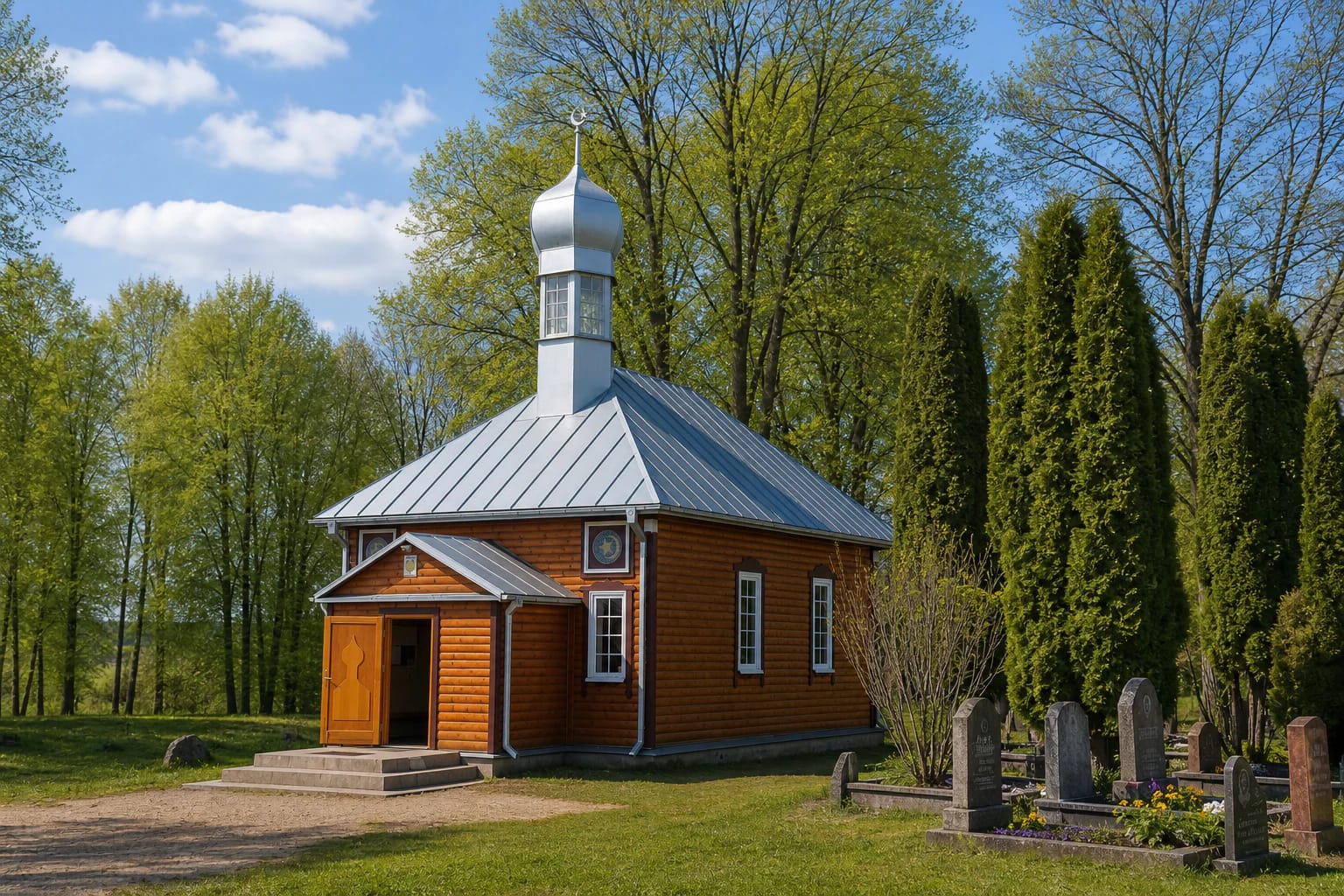
The mosque is a compact rectangular timber building. Orange-brown horizontal boards are covered by an exceptionally broad hipped metal roof, above whose centre rises a slender hexagonal turret. Its glazed section is crowned by a bulbous metal cap and a finial carrying Islamic symbols - a crescent and star.
The turret is the local wooden mosque's architectural sign, not a tall freestanding minaret of the kind associated with large Muslim cities. A small entrance porch, narrow windows with white surrounds, and the intimate scale of the timber walls tie the building to rural architecture in the Vilnius region, while its plan answers the needs of Muslim worship.
Prayer spaces and religious furnishings
The men's and women's prayer spaces are separated inside, as is characteristic of Lithuania's historic Tatar mosques. Worshippers face the mihrab, a niche indicating the direction of Mecca, while the minbar is the raised place from which the imam delivers a sermon. These are not decorative exhibits: they belong to a functioning religious interior.
Access to the interior is possible only with the community's agreement. Shoes are removed before entering the prayer hall, clothing should cover shoulders and knees, and visitors should follow the host's guidance on head coverings, the men's and women's spaces, and photography. Tourist visits must never interrupt prayer or another rite.
Soviet interruption and return to the faithful
After the Second World War, the building's religious use was interrupted and a local-history museum was installed in the mosque. This adaptation preserved the physical volume but removed its central purpose. Vilnius District Municipality states that the sanctuary was returned to believers in 1978.
Once religious life resumed, the building underwent repair and restoration; official accounts record work in 1993 and 2009. In the Register of Cultural Property, the mosque forms part of the Nemėžis old Tatar cemetery and mosque complex and carries unique code 1765. Protection therefore extends beyond picturesque timber architecture to its relationship with the community and sacred setting.
The mizar, advance arrangements, and respectful conduct
The old Tatar cemetery beside the mosque is known within the community as a mizar. Mosque and cemetery form one complex: the mizar speaks of continuing families and is not an ornamental add-on. Keep to obvious paths, do not step on graves, move stones, make rubbings of inscriptions, or photograph mourners.
On 25 July 2026, the official community directory listed telephone +370 655 59 780 and email nemeziototoriubendruomene@gmail.com for the Nemėžis Tatar Community. No reliable daily tourist hours or standard admission tariff were published, so arrange interior access, a possible guided visit, price, and accessibility before travelling. View the exterior from publicly accessible ground, but do not treat an unlocked door as an invitation to enter.