- Place
- Trakai District Municipality
- Region
- Trakai
- Type
- Karaim prayer house and living community heritage site
- Address
- Karaimų g. 30, Trakai
- Coordinates
- 54.64770, 24.93260
Trakai Kenesa, Trakų kenesa
The sacral centre of Karaimų Street in Trakai
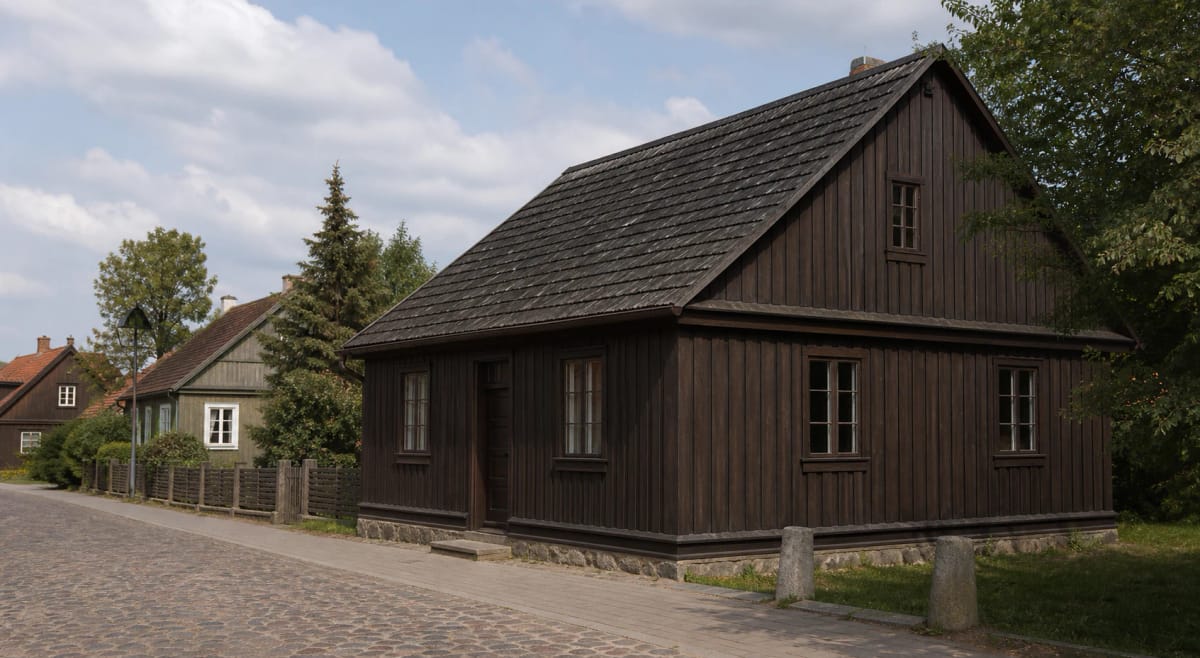
The Trakai Karaim Kenesa stands at Karaimų g. 30 in the historic part of Trakai, where wooden houses facing the street, the human scale of the street, and community memory form one landscape. The Kenesa is not a decorative object; it is a Karaim prayer house and a sign of a living community on the street leading from the town centre toward Island Castle.
Use the precise name when visiting. A kenesa, from Hebrew, is a Karaim prayer house, not a rabbinic synagogue. Karaism, the Karaim language, and the community's history have their own identity, so the place calls for respectful and accurate vocabulary.
The first Lithuanian kenesa and the only one functioning in Europe
According to VLE, the first kenesa in Lithuania was built in Trakai in the fifteenth century, rebuilt around 1825, and renewed in 1997. This makes the Trakai Kenesa the oldest Karaim temple tradition site in Lithuania and a direct descendant of the community that Karaim history says Vytautas the Great brought to Trakai.
It is especially important that during the Soviet occupation, Trakai Kenesa was the only functioning Karaim kenesa in all of Europe. Others in Vilnius, Panevėžys, Biržai, and Naujamiestis were closed or even demolished. That makes Trakai a symbol of continuity not only for Lithuanian but also for international Karaim religious tradition.
Wooden Kenesa architecture and interior order
Trakai Kenesa is a wooden building whose proportions, forms, and details, according to encyclopedic material, draw from traditional Lithuanian folk architecture. This differs from the masonry Vilnius Kenesa, which has Moorish-style features. Its value is not monumentality but its relationship with Karaimų Street, courtyards, window rhythm, and the space of a small religious community.
The interior order reflects Karaim ritual practice: men and women pray separately, everyone must cover their head, and in the main men's hall, on the southern side, stands the ornate altar, or echal. Above it is a choir with a closed women's gallery. Walls and ceilings are decorated with geometric and plant ornaments because human and animal images are prohibited.
Community house and living Karaim heritage
Beside the Kenesa are Karaim community buildings. Historically they housed religious and language schools and hosted meetings and evenings. Sources say the community house in Trakai functions again, so the Kenesa is not an isolated monument but the sacral core of a living community.
Karaim heritage in Trakai is not only the past. It includes religion, the Trakai dialect of the Karaim language, used only in Lithuania, family histories, houses facing the street with three windows, cemeteries, and culinary tradition: crescent-shaped pastries with mutton filling called kibinai, meat noodle soup called tutmač, and curd cake called katlama.
Interior visits and respect for a sacral place
During research, no stable public opening hours or ticket system for the Kenesa as a museum were found. Therefore an interior visit should be understood as possible only according to the order set by the community or local caretakers, often by prior arrangement.
Even if you only see the exterior, the place is worth a stop. It shows that Trakai is not only castle and lakes, but a multiethnic town where the Karaim community left a clear urban, religious, and cultural layer.
How to include the Kenesa in a Trakai route
The Kenesa is easiest to visit while walking Karaimų Street between Trakai centre and Island Castle. For an exterior stop, 15-30 minutes is enough, but the route is stronger if you connect Karaim houses, the castle, lakes, town history, and a kibinai lunch in local Karaim restaurants.
When photographing and walking nearby, remember that this is an active sacral place. Respect the quiet of the surroundings, do not try to enter without clear permission, and do not treat the building only as a tourist object.