- Place
- Molėtai, Molėtai District Municipality
- Region
- Aukštaitija
- Type
- open urban sculpture park on Lake Pastovis, shaped by the 1998 international artists' camp and later additions
- Address
- Lake Pastovis shore off Vasario 16-osios Street, Molėtai
- Coordinates
- 55.23189, 25.42623
- Visit duration
- 30-60 minutes for the park; about 1.5-2 hours with an unhurried continuation along the Lake Pastovis shore
- Best time
- daylight from spring to autumn, with morning or late-afternoon light revealing sculpture textures and reflections on the lake
Molėtai City Sculpture Park, Skulptūrų parkas Molėtuose
The sculpture park occupies one part of the shore, not the entire lake circuit
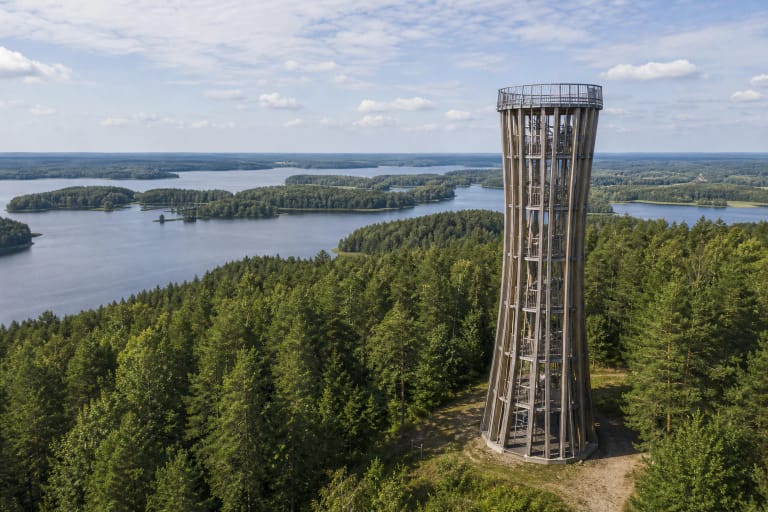
Molėtai Sculpture Park is a compact green space between the Vasario 16-osios Street side of town and Lake Pastovis. Mature deciduous trees, lawns, paths, places to sit, a raised viewing structure, and art placed at the water's edge or in the lake share the site. This is an urban park, not a remote sculpture trail in woodland.
Coordinates 55.231892, 25.426229 were checked against Geoportal orthophotography as a representative point in the central park area. They do not identify a gate, car park, confirmed step-free entrance, or one particular artwork. Several paths reach the space, so use current signs to choose the approach that suits your visit.
Shore paths continue beyond the sculpture park and connect with Molėtai's wider lakeside public realm. A map route around Pastovis or neighbouring Pastovėlis is therefore not a measure of the park's size. This page covers the concentration of sculpture beside Pastovis rather than every path around both lakes.
The official 1998 opening began with Pintas žmogus
The Molėtai Regional Museum calendar gives a precise opening date: 22 April 1998. It credits Dalia Cibauskaitė and Vygintas Čeikauskas-Mačius with conceiving the park and identifies its first sculpture as Arvydas Ališanka's wooden Pintas žmogus, or Woven Man.
The Lithuanian National Culture Centre's chronicle connects the project with the Akcija M art club. Stone works made at an international artists' camp in Antalakaja from 5 July to 15 August 1998 were then installed in Molėtai. The origin story is consequently more than a single unveiling: a first work in wood was followed within months by an international layer of stone sculpture.
VLE likewise describes the park as the outcome of an international sculpture symposium organised by Molėtai Art Gallery. That context still matters. These are not unrelated objects scattered around town but the surviving and evolving record of a deliberate local art initiative.
The works recorded in 1998 are the collection's documented core, not a current inventory
The 1998 chronicle names P. Gellis's Mėnulio šviesa, or Moonlight; T. Gilhespy's Tiltas į Molėtus, or Bridge to Molėtai; Z. R. Maciejievskis's untitled sculpture; Kęstutis Musteikis's Akmuo Sizifui, or Stone for Sisyphus; Arvydas Ališanka's Valtis, or Boat; and Aloyzas Smilingis's Žydėjimas, or Blossoming. Together with Pintas žmogus, these titles provide a sound way to read the early park without inventing identities for every abstract form.
Later accounts associate a 2001 outdoor sculpture camp with Mindaugas Navakas's Grindinys and Svajonė and Paulius Stanikas's Observatorija. The 2014 European Heritage Days programme described the park as newly reconstructed and scheduled the presentation of Donatas Dovidavičius's Purslas and Vidas Steponavičius's Lašas. These records reveal stages of growth, but they are not an audited 2026 object list.
No authoritative, fully numbered inventory of every work still present was found, so this guide does not offer a deceptively exact total. Wood, stone, metal, waterfront structures, and works in the lake age differently, while maintenance changes what can be seen on a given day. VLE confirms works by Ališanka, Navakas, Paulius Stanikas, Svajonė Stanikienė, and other artists.
The first sculpture was renewed in 2024, while the lake remains part of the display
Molėtai Regional Museum's 2024 annual report records the renewal of Arvydas Ališanka's Pintas žmogus and dates the work to 1998. This is clear evidence of care for one sculpture, not evidence that the entire collection underwent restoration that year.
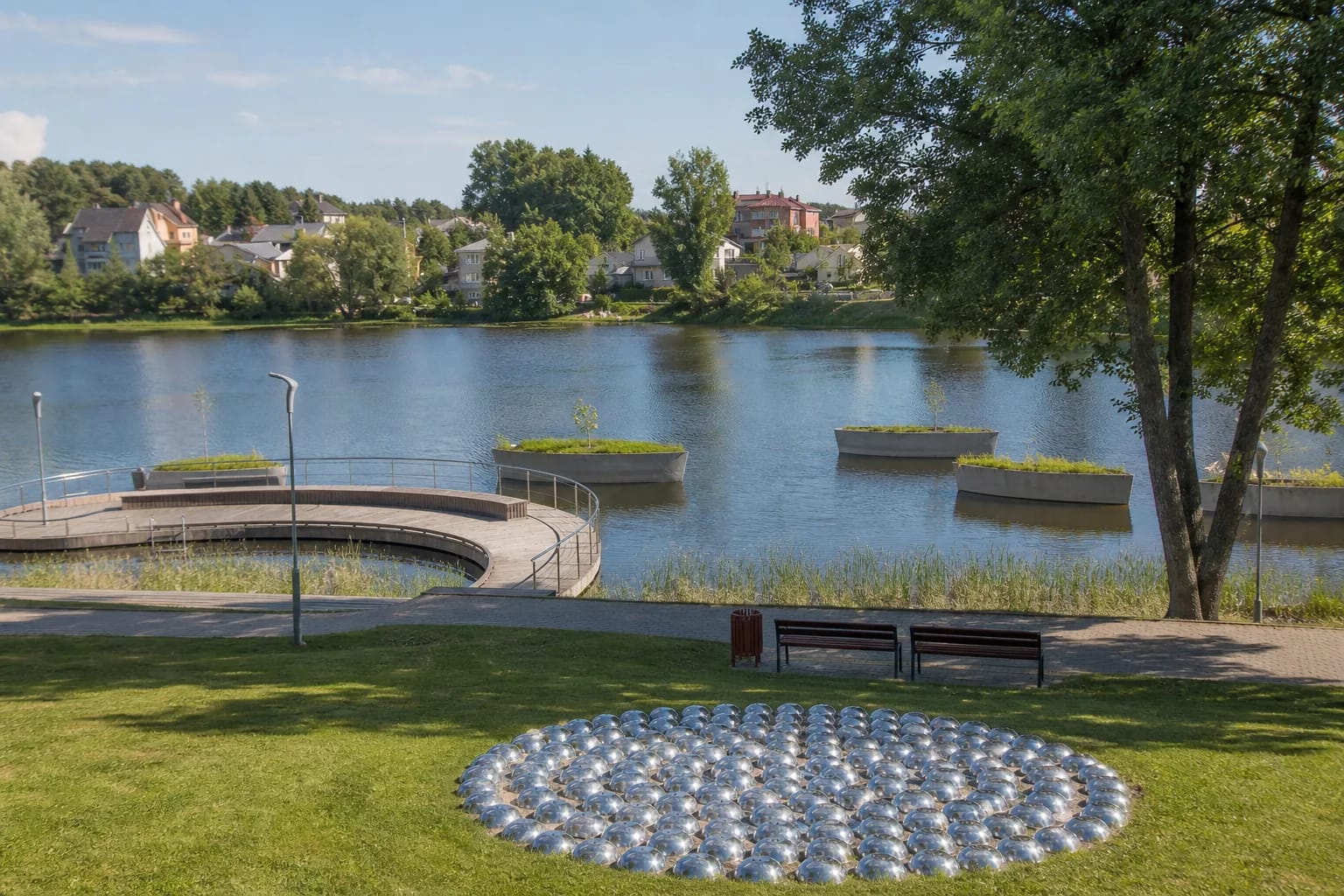
The park's distinctiveness comes from the relationship between art and landscape. Early artists chose slopes, sightlines, and the lake backdrop as parts of their works. Present-day views include objects on lawn and paths as well as low, boat- or island-like forms standing in the water. View the latter from the path or platform rather than climbing onto the art or entering the lake.
Walk the site slowly and change viewing height. The raised structure reveals the arrangement across the lawn, while the shore brings reflections, surface textures, and reeds into the composition. The field of polished metal hemispheres is particularly effective in low light, but the title Grindinys, meaning paving, should not be read as an invitation to walk across the artwork.
The 2026-2027 project is not a completed renewal of the whole park
On 1 June 2026, Molėtai District Municipality announced a new recreation and activity space beside Lake Pastovis. Work began in May 2026 and is scheduled to end in December 2027. Plans include renewing an existing path, adding a new path and paved resting area, and installing benches, an accessible picnic table, outdoor grills, and a bin.
The project also provides for a water-themed sculpture symposium whose three new works are intended to enrich public spaces around Pastovis. On 19 July 2026, these remained planned works rather than sculptures guaranteed to be installed in the park. The municipal description concerns a new rest area and the wider lakeside public realm, so it should not be recast as a finished reconstruction of the entire Sculpture Park.
The work zone and temporary restrictions can change as the project advances. Check current municipal and museum notices before making a special journey, and obey barriers on site. The promise of infrastructure suitable for disabled visitors applies to the new recreation area, not automatically to every older path, slope, or platform in the park.
Visit at the pace of a lakeside walk, but do not assume every facility
The authoritative sources reviewed publish neither a separate ticket desk and admission price nor gate-controlled opening hours for the park. It functions as an open urban space, although events and works can temporarily alter access. A free event listing is not evidence of a permanent admission policy, so check any tour or organised programme separately.
Official photographs show hard-surfaced and timber path sections, but no independent audit was found for every gradient, edge, transition, or potentially slippery waterfront surface. If you require a tested step-free circuit, a specific drop-off point, or an accessible toilet, contact Molėtai Regional Museum or the municipality before arrival.
Allow 30-60 minutes for the park itself and roughly 1.5-2 hours with a gentle continuation along Pastovis. No dedicated park car park or verified capacity was identified, so use legal town parking and keep vehicles off grass. With children, remain alert beside the open shoreline and treat the sculptures as art rather than climbing equipment.