- Place
- Molėtai District Municipality
- Region
- Aukštaitija
- Type
- astronomical research observatory in the Molėtai region
- Address
- Kulionys village, Molėtai District
- Coordinates
- 55.31600, 25.56000
MAO, Molėtai Observatory
An observatory, not a museum branch
Molėtai Astronomical Observatory is often confused with the Lithuanian Museum of Ethnocosmology because both sites are in the Kulionys area and both relate to space. Their purpose is different.
The observatory is first of all a place for scientific astronomical observations. The Ethnocosmology Museum is a more public educational and cultural space. Travellers should plan them as connected but separate experiences.
Why the observatory came to Molėtai
The Molėtai region was chosen for darker sky, forests, and distance from large city lights. The old Vilnius University Observatory from 1753 and the Vingis Park observatory from 1921 were absorbed into the city, so a new base was selected 70 km north of Vilnius, on Kaldiniai Hill, 200 m above sea level, near Kulionys village.
According to the official observatory history, a 25 cm Cassegrain telescope was installed here in autumn 1969, and photometric studies of stars began with it in spring 1970. A 63 cm telescope began operating in 1974, a 35/51 cm Maksutov photographic telescope was acquired in 1975, and in 1975-1977 an administrative building with laboratories and a library was built.
Telescope domes
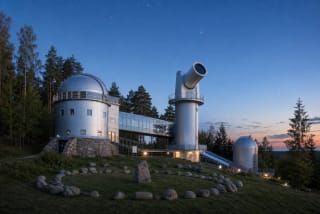
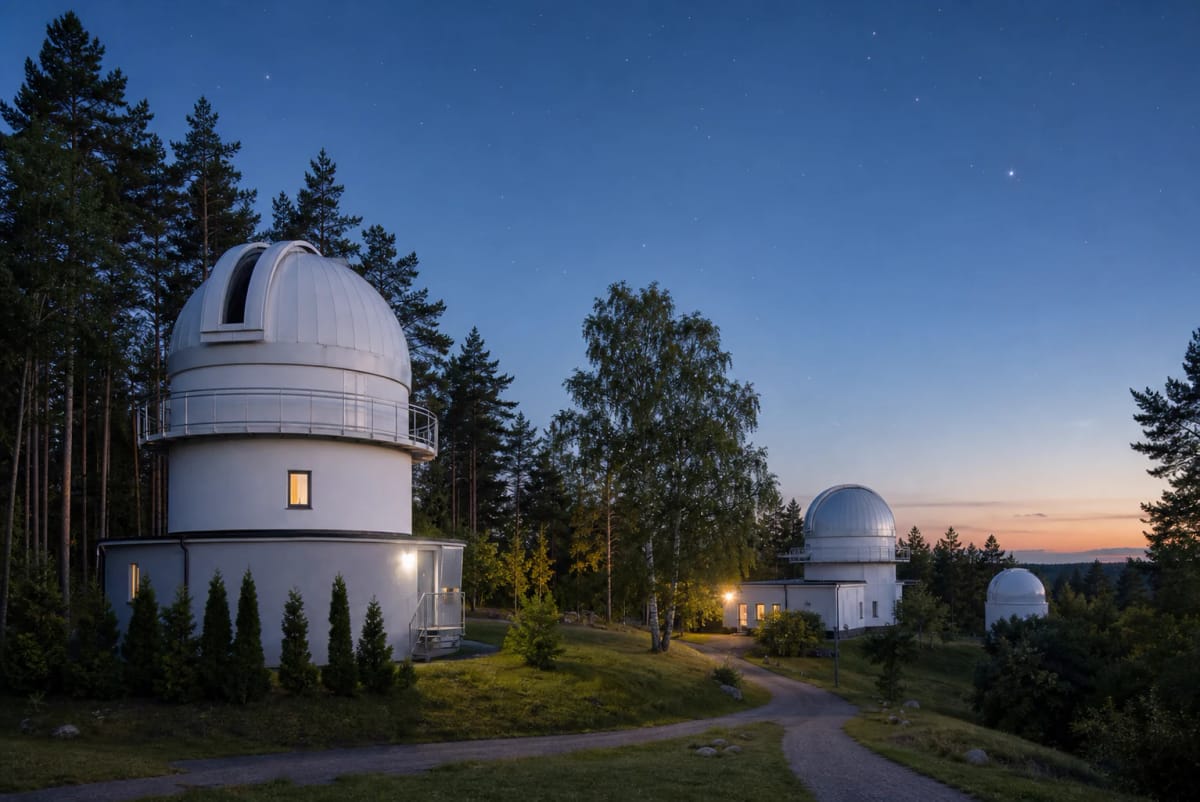
You can recognize the observatory landscape by white domes among the trees. They cover several telescopes, including the 35/51 cm Maksutov, the 63 cm telescope, and the 165 cm reflector put into use in 1991, the largest telescope not only in Lithuania but in all of northern Europe.
The largest telescope is not a tourist attraction merely because of its size. The observatory belongs to Vilnius University's Institute of Theoretical Physics and Astronomy, and Lithuanian and foreign scientists and doctoral students carry out astronomical observations here. It is a site of real photometric, stellar, and galaxy research, not just educational sky viewing.
What visitors can see
Ordinary travellers will best understand the observatory through an organised excursion, public programme, or a combined visit with the Ethnocosmology Museum. Do not arrive expecting to walk freely through scientific observation spaces on your own.
If a night programme is running, the key condition is a clear sky. Even the best telescope will show nothing on a cloudy evening, so astronomical observation always carries weather risk.
Difference from the Ethnocosmology Museum
The Ethnocosmology Museum explains the human relationship with the cosmos through culture, mythology, the calendar, and science. Molėtai Observatory is more specifically astronomical infrastructure.
The best experience comes from combining both: the museum gives the broad story and symbols, while the observatory shows where real sky research takes place.
How to plan
Before travelling, check official contacts, programmes, and access possibilities. The observatory's rhythm depends on scientific work, and public programmes may not run every day.
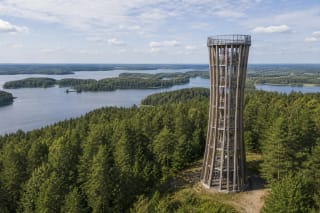
If travelling from Vilnius or Kaunas, set aside a day for the Molėtai region: the Ethnocosmology Museum, observatory surroundings, Mindūnai, and lake panoramas make a strong route.
When it is worth going
By day the observatory domes are interesting as science heritage and landscape: a sundial is installed on the south wall, B. Bružas astronomical stained glass appears in the windows, and near the telescope towers is a collection of sacred cup-marked stones once associated with healing Perkūnas water. Still, the true astronomical impression comes in the evening or at night if observations are taking place.
A clear autumn or winter evening may be better for sky observation than a bright summer night, though comfort, temperature, and programme schedule also matter.