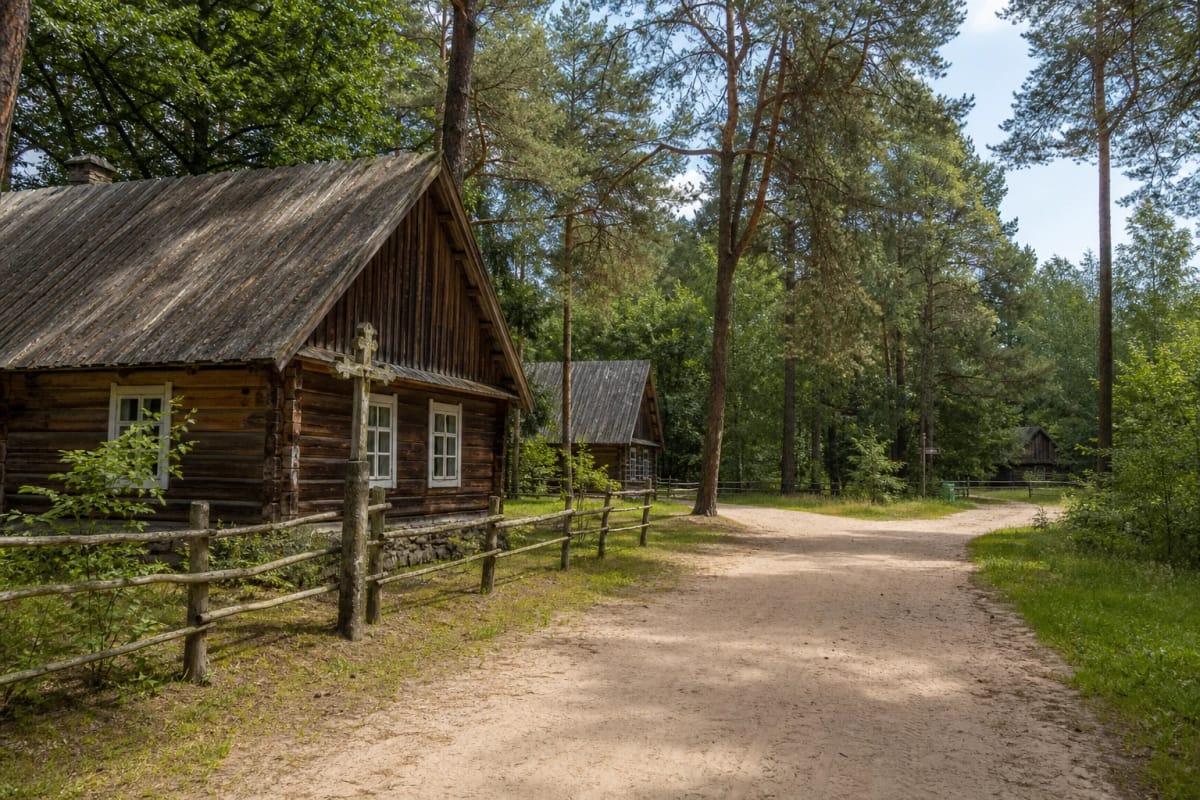
- Place
- Marcinkonys eldership, Varėna District Municipality
- Region
- Dzūkija National Park
- Type
- ethnographic village in Dzūkija National Park
- Coordinates
- 54.11200, 24.49800
Zervynos ethnographic village
Zervynos by the Ūla
Zervynos is in Varėna District, Marcinkonys eldership, in Dzūkija National Park, by the Ūla River. VLE states that the village lies 8 km northeast of Marcinkonys, the Varėna-Marcinkonys railway passes through it, a railway station operates here, and roads connect it with Varėna and Marcinkonys. In 2021 only 36 residents lived here, so the village's vitality is declining and its value increasingly gathers in the heritage layer.
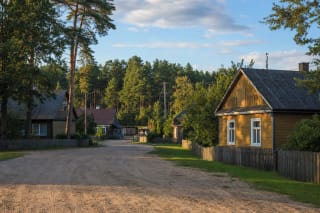
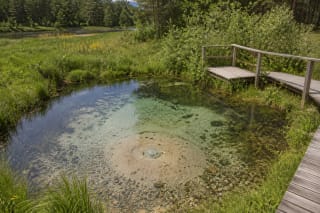
This is a place to visit not as a decorative open-air museum but as a living settlement. Sandy roads, homesteads, the nearby Ūla, pinewoods, and railway show how a Dzūkija village adapted to forest, water, and movement. VLE notes that Zervynos Oak and hollow Zervynos pines have been declared natural monuments, recalling forest beekeeping traditions.
Sparse street-plan village
VLE describes Zervynos as a sparse street-plan village of spontaneous development, with a layout harmonious with nature and formed by the mid-eighteenth century. This is the key value of Zervynos: the homesteads are not only separate attractive houses but a whole village structure recognized in Lithuanian inventories of street villages and traditional settlements.
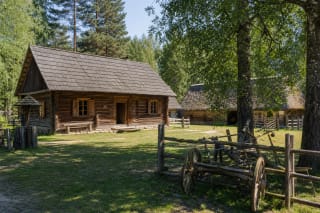
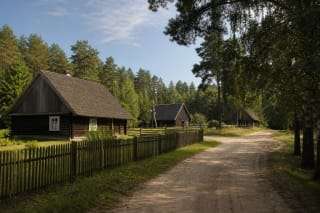
According to VLE, Zervynos has 11 protected homesteads and thirty-five protected buildings from the late eighteenth to early twentieth centuries. The homesteads have irregular plans, adjoin one another or form groups; dwelling houses and farm buildings are arranged across the grouped homestead or placed by function around a shared yard. This harmony with relief and forest makes Zervynos one of the best-preserved Dzūkian village structures.
Wooden homesteads and architectural details
VLE states that Zervynos is dominated by two-ended dwelling houses, one-cell granaries with porches, cell-type cowsheds, and barns with side entrances. This is not stylization but the real building vocabulary of a Dzūkija forest village, worth reading building by building: porch, log joints, and roof proportions.
Wooden architecture works here together with the surroundings. Pine-log walls, low straw or board roofs, sandy roads, and fences create a restrained landscape in which proportion and daily use matter more than decoration. This simplicity and integrity make Zervynos one of Lithuania's benchmark ethnographic villages.
History: from the Swiderian culture to rent-paying forest scouts
Zervynos is mentioned in written sources from 1742, but VLE notes that traces of more than 20 Stone and Bronze Age camps were found in the area, the earliest belonging to the Swiderian culture. This means the Ūla and forest setting attracted people for many millennia before the present village plan.
VLE states that homesteads on the right bank of the Ūla belonged to Varėna manor, while on the left bank a settlement of rent-paying forest scouts formed. In 1869 there were 17 homesteads. In the late nineteenth and early twentieth centuries, a clandestine village school operated here, sustaining Lithuanian identity during the press-ban years.
Twentieth-century memory and a cinema village
VLE states that in 1920-1939 Zervynos was under Polish occupation, and after the Second World War partisans of the Kazimieraitis unit operated in the area, linking the village with Dzūkija's armed resistance history. A primary school operated here in Soviet times, but the population fell quickly: VLE gives 190 residents in 1959 and only 47 in 2011.
Zervynos also has literary and film memory. VLE notes that writer Juozas Aputis lived and worked in the village, and that Lithuanian cinema classics Niekas nenorėjo mirti (1965) and Faktas (1981) were filmed here. Because of its authentic wooden setting, the village still reads as a natural historical stage.
How to visit Zervynos
Zervynos is an outdoor village, so there is no single museum opening time or ticket. Usually visitors may walk public roads and see the village landscape from a respectful distance, but yards, houses, and farm buildings are private or protected spaces governed by heritage requirements.
Do not enter homestead yards without permission, climb fences, photograph people close up, or park so that residents are blocked. The easiest route is to combine Zervynos with Marcinkonys, the Ūla valley, Ūla Eye, and Dzūkija National Park information, so the links between village, river, and forest become clear in one day.